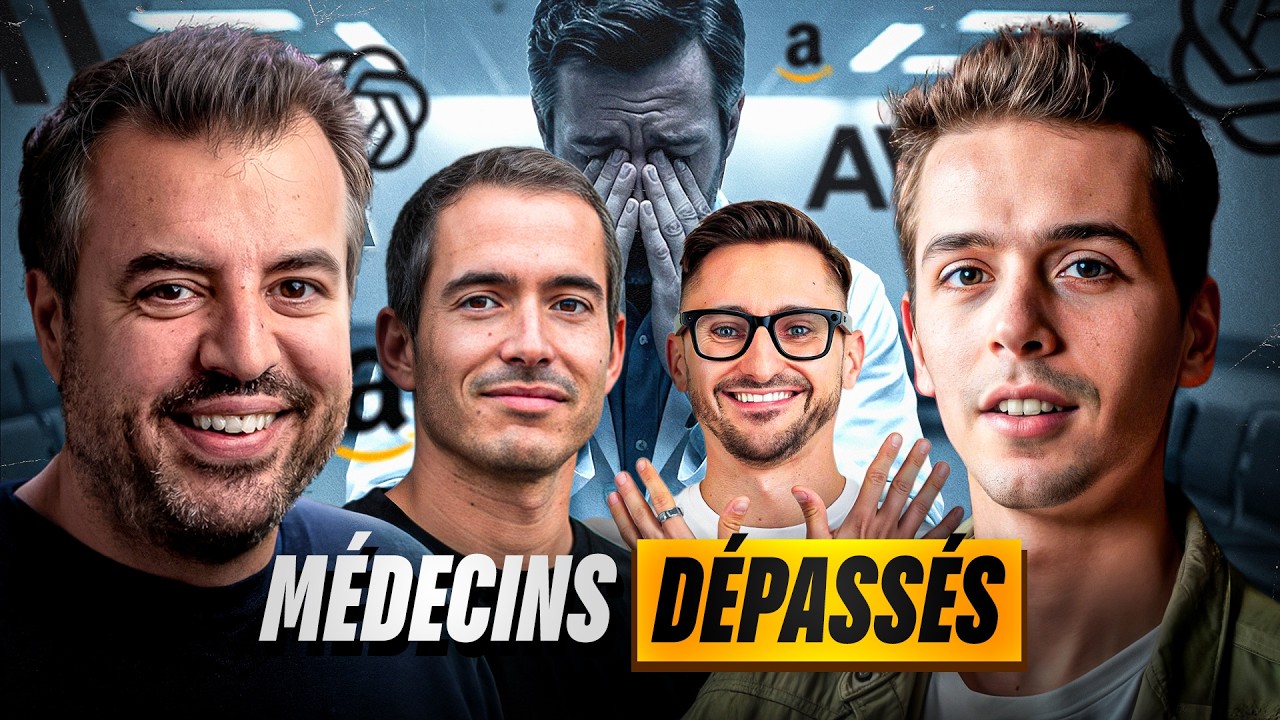
230 millions de personnes utilisent déjà ChatGPT pour leur santé !
230 million people already use ChatGPT for their health!
Keywords
Summary
100 words
Critical Evaluation
Value of the Information & Strength of the Argument
The show provides a rich overview of current AI health trends, with practical anecdotes and insights from people directly involved in startups. However, the argumentation often relies on enthusiasm rather than rigorous evidence, and the lack of a clinician reduces the depth of medical evaluation. The value lies in highlighting immediate changes in consumer behavior and industry movement, but the scientific validity of some claims is not thoroughly scrutinized.
Scientific Rigor, Source Quality, Title Accuracy
The scientific rigor is moderate: while several industry figures and product names are mentioned, concrete studies or verifiable data are rarely provided. Sources mainly consist of the hosts’ professional networks and personal experiences. The title adequately matches the main anecdote, but the episode’s scope is wider than that figure. Overall, the information is presented in a engaging but not deeply evidence-based manner.
146 words
Title / Content Match
The title focuses on a striking statistic that anchors the episode, but the discussion covers a much broader set of topics, making the title somewhat narrow yet still representative of the core theme.
Quality & Reliability
6/10
The conversation is engaging and up-to-date, featuring practitioners and entrepreneurs, but it lacks direct scientific sourcing and medical counterpoints, relying largely on personal anecdotes and industry claims.
Chapters
- L'IA s'impose comme outil de santé
- Présentation des invités
- Offensive santé des géants de l'IA : OpenAI, Amazon et les autres
- GPT Health : connecter son dossier médical à ChatGPT
- Quand ChatGPT évite une erreur médicale aux urgences
- RGPD et IA Act : pourquoi la France sera à la traîne sur les données de santé
- Souveraineté individuelle : les Français n'ont pas accès à leur propre génome
- [SPONSOR] QONTO, partenaire des entrepreneurs
- ChatGPT est devenu l'application de santé la plus utilisée au monde
- Les médecins face à l'IA : remplacement, augmentation, ou pilotage ?
- Open Evidence : le ChatGPT des médecins, utilisé par 40 % d'entre eux aux États-Unis
- La santé comme terrain de jeu des prochains paradigmes
- Pourquoi les géants de la Tech échouent dans la santé
- Où va l'argent dans la santé mondiale : hôpitaux, pharma, assurance
- Pourquoi les acteurs de l'IA ont besoin de la santé pour leur image
- L'IA pour découvrir de nouveaux médicaments, une IPO biotech record
- Vieillissement des populations et génération Z
- [SPONSOR] CORUM USA, première SCPI aux US
- Arnaud Auger : l'inventaire complet de ses devices de santé
- Pourquoi les jeunes veulent vivre éternellement
- La longévité comme réponse à la pression financière et au syndrome du héros
- ChatGPT ton nouveau psy ?
- Carlos soumet son profil à ChatGPT en direct, avec les angles morts
- "Rent a Human" : quand l'IA loue un humain pour faire des câlins
- Aware : le capteur derrière l'oreille qui mesure vos ondes cérébrales en continu
- Neurostimulation à 40 Hz : combattre Alzheimer avec de la lumière et du son
- Nura : un selfie pour mesurer votre rythme cardiaque, stress et glycémie
- L'enjeu de l'interopérabilité
- Les lunettes Meta Ray-Ban et l'EMG
- Robots et seniors : quand l'IA compense l'abandon des personnes âgées
- Robots dans les hôpitaux pédiatriques et maintien à domicile des seniors
- La France a une carte à jouer
Cited Sources
- Silicon Carne Substack — Official Substack for episode notes and community
- Silicon Carne Podcast on Ausha — Podcast version of the show
- Arnaud Auger LinkedIn — Guest profile
- Carlos Diaz LinkedIn — Host profile
- Clément Pouget Osmont LinkedIn — Guest profile
- Wallerand Moullé-Berteaux LinkedIn — Guest profile
Concurring Sources
- Nabla — Startup assisting physicians with AI scribing, mentioned positively
- Open Evidence — AI tool for doctors to find clinical studies
Dissenting Sources
- No direct contradicting sources were provided in the video — The video did not include opposing views or critical references from medical authorities.
External References
Contribution & Novelties
The episode brings fresh insights into how ChatGPT is reshaping patient behavior and the healthcare market, while also contextualizing the European regulatory gap. It uniquely combines perspectives from startup founders, investors, and a longevity advocate, offering a multifaceted view of AI’s incursion into health.
Pour aller plus loin :
- ChatGPT — Background on the AI assistant’s capabilities and adoption.
- Artificial intelligence in healthcare — Overview of AI applications in medicine.
- Geroscience — Field studying the biology of aging, relevant to longevity discussions.
- Insilico Medicine (no URL certain) — Company mentioned as using AI for drug discovery, notable for its IPO.
100 words
Radar Profile
The radar shows high quantity of information but moderate quality and technical depth. Reliability is lower due to lack of citations. The overall profile suggests an engaging but opinion-driven discussion rather than a rigorous scientific review.
💬 Très positif avec quelques réserves. Sur les 30 commentaires analysés, la majorité félicite l'épisode et demande plus de contenu de ce type, mais plusieurs appellent à inviter un médecin pour un contrepoint, et certains expriment des inquiétudes sur la confidentialité des données.