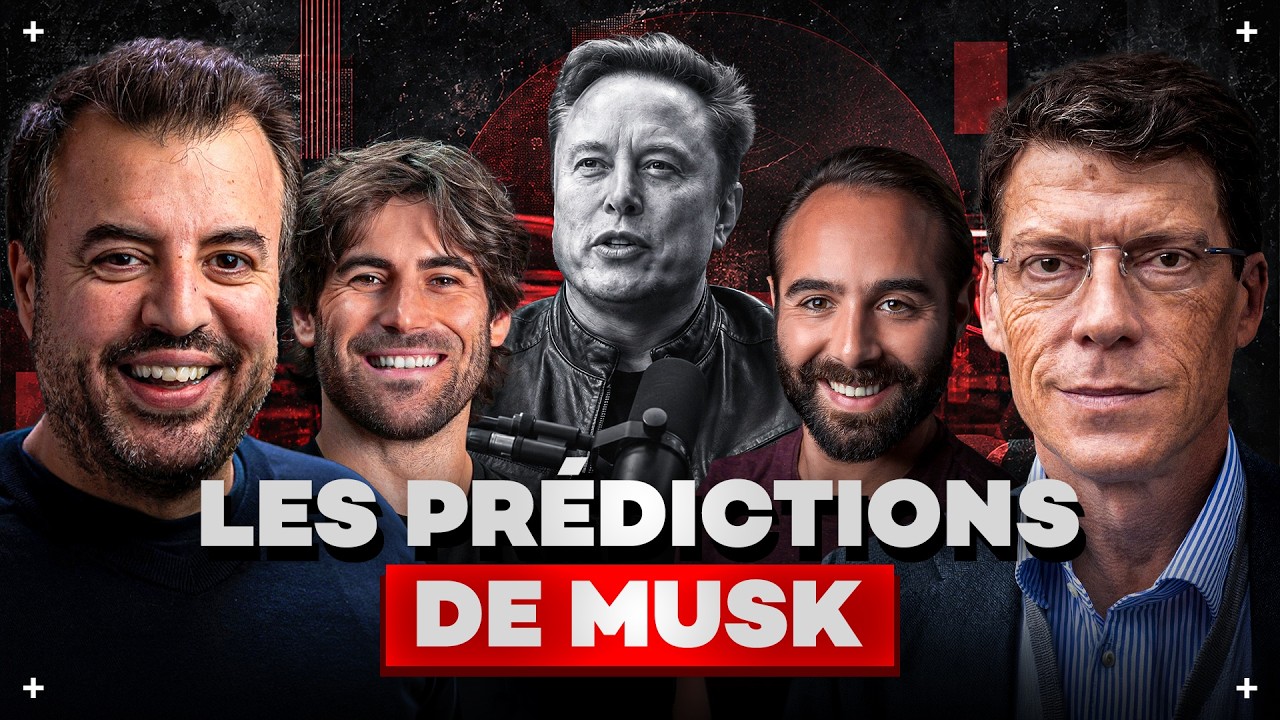
Elon Musk explique sa vision du futur : qu'est-ce qui nous attend dans 10 ans !
Elon Musk explains his vision of the future: what awaits us in 10 years!
Keywords
Summary
158 words
Critical Evaluation
Value of the Information & Strength of the Argument
The video offers a rich and multifaceted exploration of Musk’s economic predictions, balancing supportive and critical viewpoints. Stéphane Mallard provides a solid macroeconomic framework, explaining commoditization and the natural deflationary trend of goods and services. Laurent Alexandre brings a contrarian perspective, emphasizing human resistance and the ‘wall of reality’ that Musk overlooks. Evan Kervella offers a critical take on Musk’s oversimplification. The argumentation is generally coherent, but sometimes relies on rhetorical assertions rather than data, especially when discussing future scenarios. The debate format allows for constructive disagreement, which strengthens the overall analysis by presenting multiple angles.
Scientific Rigor, Source Quality, Title Accuracy
The video does not cite specific scientific studies or peer-reviewed sources, but references The Economist interview and Keynes’ 1930 essay ‘Economic Possibilities for our Grandchildren’ as touchpoints. The panelists draw on their own expertise and publications, such as Laurent Alexandre’s ‘La guerre des intelligences’ and Stéphane Mallard’s ‘Disruption’. The title accurately matches the content, as the entire episode is devoted to Musk’s vision. However, the reliability is limited by the speculative nature of the topic and the lack of empirical evidence. The comments section does not provide additional verifiable sources.
201 words
Title / Content Match
The title accurately reflects the content, which revolves around Musk's predictions and the resulting economic and social debates.
Quality & Reliability
6/10
The video presents a well-structured debate among knowledgeable guests, but relies heavily on speculative predictions and personal opinions rather than empirical evidence, limiting its scientific reliability.
Chapters
- Intro
- [Sponsor] : Qonto, gérez compte pro et facturation sans effort !
- La thèse de Musk : une économie d'abondance infinie
- Evan : Musk est devenu une caricature de lui-même
- Laurent : Musk ne voit pas le mur du réel
- La révolte silencieuse contre l'IA
- Déflation : bonne ou mauvaise nouvelle pour tous ?
- Musk juge l'argent inutile mais accumule des milliards
- Ce qui restera rare dans un monde d'abondance
- Robots, emplois perdus : qui survivra à la transition ?
- Même les plus intelligents bientôt dépassés par l'IA
- La vision de Musk : un simple pitch de Star Trek ?
- L'abondance en dix ans : calendrier réaliste ou pari fou ?
- Keynes avait prédit l'abondance un siècle avant Musk
- Laurent Alexandre, gilet jaune de l'IA
- Qui contrôle l'IA contrôle le monde
- Fausses élites et vraie révolution : la fracture qui vient
Cited Sources
- Silicon Carne Newsletter — Channel's newsletter for additional analyses and community.
- Silicon Carne Podcast — Audio version of the show.
- Evan Kervella LinkedIn — Guest profile.
- Stéphane Mallard LinkedIn — Guest profile.
- Carlos Diaz LinkedIn — Host profile.
- Laurent Alexandre X — Guest profile.
External References
Contribution & Novelties
64 words
Radar Profile
The profile shows high quantity of information and moderate technical level, but lower reliability and quality due to speculative and opinion-based content. This suggests a well-paced discussion that is engaging but not grounded in empirical evidence.
💬 Balanced overall, with a notable trend of criticism towards Laurent Alexandre's stance on COVID and Fauci, while some commenters praise the debate format and the diversity of opinions. Sur les 30 commentaires analysés, les avis sont mitigés, avec une forte proportion de critiques ad hominem envers un invité, mais aussi des éloges pour la qualité des échanges.