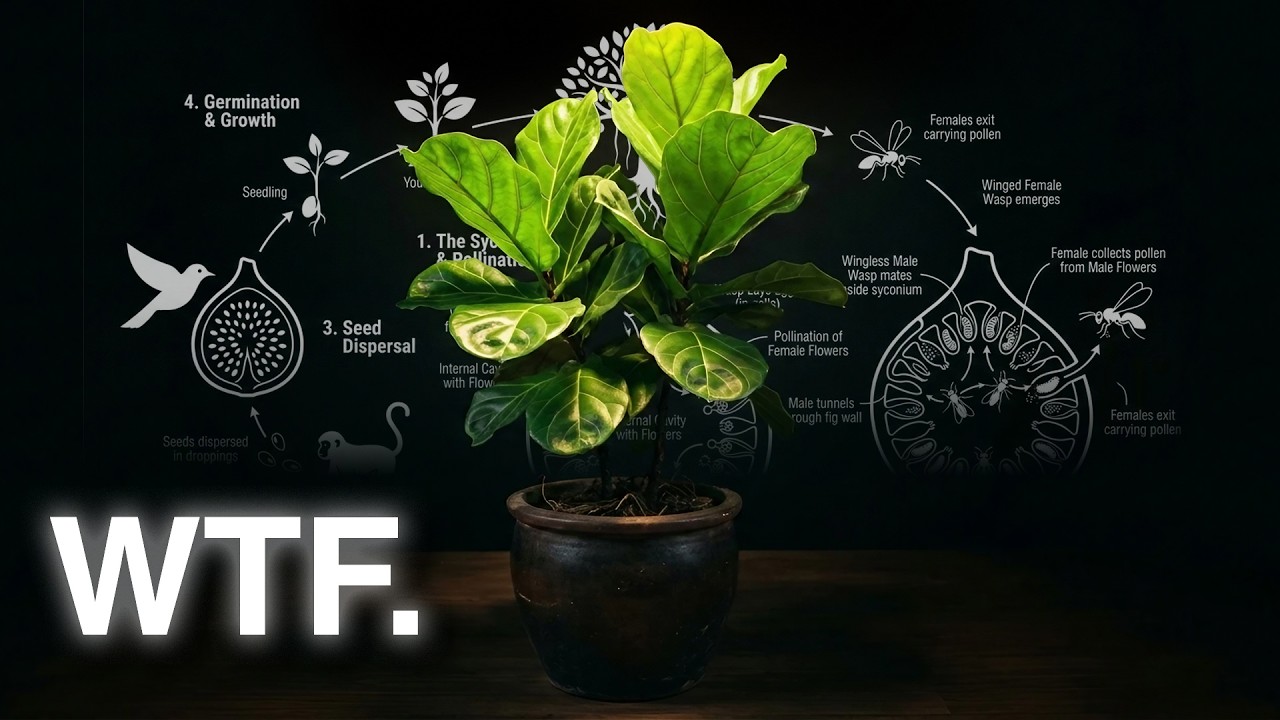
Le cycle de vie "impossible" des plantes d'intérieur
The "impossible" life cycle of houseplants
Title history
- Le cycle de vie "impossible" des plantes d'intérieur — observed on 20261101-0140 UTC (YouTube)
Keywords
Summary
182 words
Critical Evaluation
Value of the Information & Strength of the Argument
The video is exceptionally rich in didactic value. It masterfully converts complex biological concepts into vivid and memorable analogies (such as comparing orchid mycoheterotrophy to a baby being fed by another species, or the fig wasp cycle to a life spent inside a giant fruit). The argumentation is robust: each surprising phenomenon is contextualized within evolutionary logic, explaining why these traits exist. The distinction between symbiosis as a power struggle rather than a benevolent alliance clarifies a common misconception. The demonstration of the diploid advantage using Haig’s hypothesis provides a coherent evolutionary framework for the dominance of diploid plants. The presentation successfully builds a narrative from individual examples toward a unified macro-evolutionary perspective, making the abstract concept of alternation of generations intuitive through comparisons with human life cycles.
Scientific Rigor, Source Quality, Title Accuracy
The scientific rigor is commendable. The video explicitly cites a public Google Docs source sheet containing references, which is a transparent and verifiable practice. The content aligns with established knowledge in plant biology and botany, and the mention of a 2022 paper about parasitic wasps shows currency with recent research. The title is perfectly fitting—it accurately signals the video’s core theme: exploring the seemingly impossible biological quirks of indoor plants. It is a dramatic framing, but the content genuinely delivers on this promise. The presentation is visually enhanced with numerous AI-generated images; while some viewers find them excessive, they do not detract from the factual accuracy and are clearly used to illustrate hypothetical analogies.
257 words
Title / Content Match
The title is a catchy hook that mirrors the content perfectly: the video focuses on reproductive strategies that seem biologically impossible or alien to humans, exactly as promised.
Quality & Reliability
9/10
The video is meticulously argued, relying on widely recognized biological phenomena (Lomatia's clonality, orchid mycoheterotrophy, fig-wasp mutualism, and fern alternation of generations), and explicitly provides a reference document. The presenter's explanations are accurate and up-to-date, even including recent research on parasitic wasps. Minor simplifications for popularization do not compromise scientific rigor.
Key Moments
Markers derived by PSI from the transcript: the creator did not define chapters.
- Introduction with Lomatia tasmanica, a plant cloning itself for up to 130,000 years.
- Explanation of orchid germination and mycoheterotrophy where fungi provide nutrients to the embryo.
- Detailed example of asexual reproduction: stolons, leaf clones, and apomixis in dandelions.
- In-depth segment on fig wasps and the intricate coevolutionary cycle including galls and parasitic wasps.
- Discussion of ferns and alternation of generations, explaining the dominance of diploid sporophytes.
- Final examples: passionflower movement, hermaphroditism, ant-seed dispersal in violets, and yucca mutualism.
Cited Sources
- DirtyBiology — 'Le cycle de vie impossible des plantes d'intérieur' — Sources — The official reference sheet cited in the video description, containing links to the scientific literature and papers used for the episode.
Concurring Sources
- Alternation of generations — Concords with the video's explanation of the sporophyte/gametophyte cycle in ferns and plants.
- Myco-heterotrophy — Concords with the discussion on orchids that obtain carbon from fungi.
- Fig wasp — Concords with the detailed account of the fig–wasp coevolutionary relationship.
- Apomixis — Concords with the mention of asexual seed production (dandelions).
Contribution & Novelties
The video’s originality lies not in new scientific findings but in its remarkable capacity to synthesize and popularize core evolutionary concepts through vivid mental images. It skillfully connects specialized topics (e.g., mycoheterotrophy) with broad evolutionary narratives (e.g., the rise of diploidy), making advanced botany accessible to a general public. By systematically transposing botanical mechanisms into human analogies, it creates memorable cognitive hooks that durably change the viewer’s perception of plants. The significant contribution is pedagogical, breaking the common ‘boring plant’ stereotype and unveiling their complex and alien behaviors.
Pour aller plus loin :
- Alternation of generations — Relevant to the segment on ferns and land plant evolution.
- Mycoheterotrophy — Directly related to the orchid section and their unique interaction with fungi.
- Fig wasp — Deepens the fascinating mutualism and parasitism of fig pollination.
- Apomixis — Clarifies seed production without fertilization, as seen in dandelions.
- Vegetative reproduction — Covers the various clonal propagation strategies mentioned (stolons, leaf clones).
157 words
Radar Profile
The scoring profile shows a well-balanced video: extremely high in information quality and reliability, with very high quantity and a solid technical level. The score dynamics indicate that the video excels in delivering scientifically accurate content presented in a clear and engaging format, with only a slightly lower technical complexity, which matches its popularization-oriented approach.
💬 Sur les 30 commentaires analysés, le climat est très positif : le public salue la clarté, la richesse du contenu et l'approche pédagogique, bien que plusieurs commentaires regrettent une utilisation trop massive de visuels générés par IA.