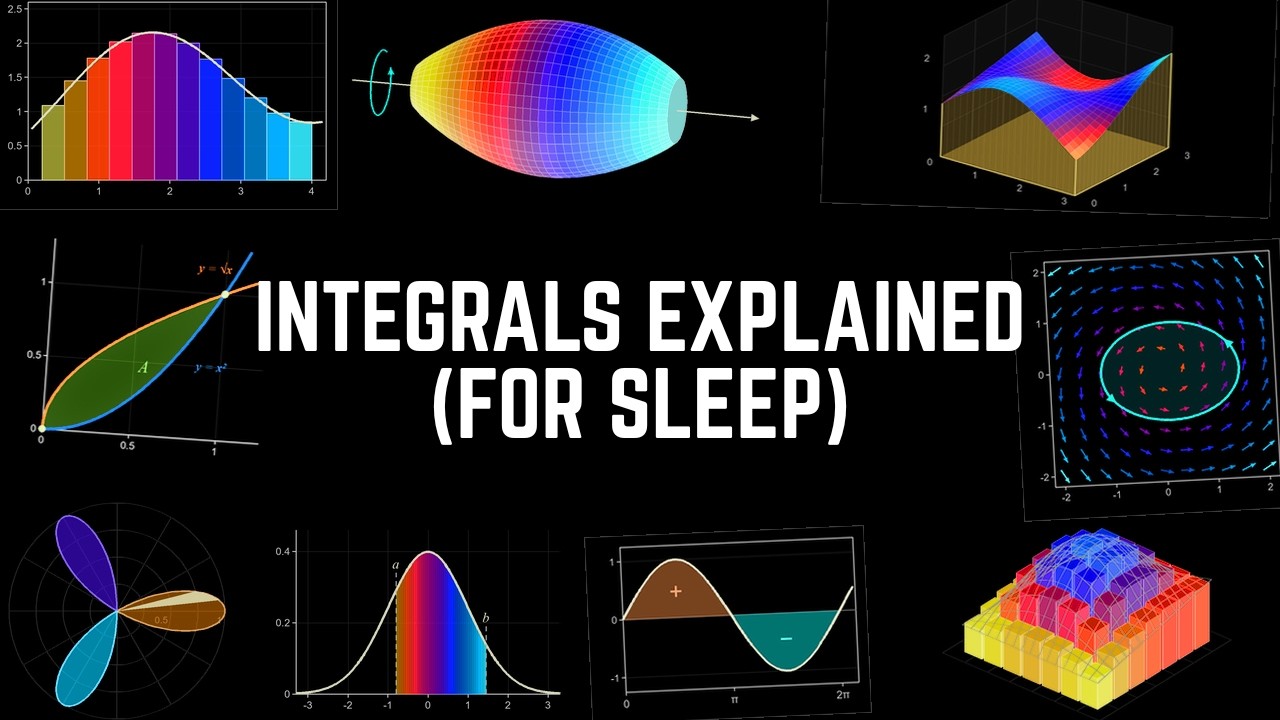
Literally Everything There is To Know About Integrals Explained For Sleep
Keywords
Summary
326 words
Critical Evaluation
Value of the Information & Strength of the Argument
The informational value is high because almost nothing is asserted that is not subsequently derived. The exposition starts from a rate-times-duration case whose correctness is transparent, then perturbs one feature at a time: a linearly increasing rate, then a coarser or finer sampling, then a negative rate, then an unequal partition, then a function whose heights do not settle inside any piece. Each perturbation is accompanied by an explicit numerical check, so the reader can verify the claim with arithmetic rather than trust. The worked computation for the squaring function is complete rather than illustrative: the left and right sums are given as exact fractions, the difference between them is identified as one divided by the number of pieces, the closed-form sum of squares is stated and then justified by induction with a base case and an algebraic step, and the limit is extracted from the resulting expression with the two correction terms shown to vanish. That is a genuine proof, compressed but not truncated. A second strength is the anticipation of specific confusions: the units of a region under a rate graph are shown to come from the axis labels rather than from the word ‘area’; the sum of sampled rates without widths is shown to carry the wrong units and to depend on the number of samples; the number of pieces is explicitly dissociated from the mesh, with a concrete partition at one quarter demonstrating that refining only the small piece leaves the large one unresolved. The step-function argument is likewise a real argument, not a gesture: the uncertainty is localised in the pieces containing the jump, their total width can be made arbitrarily small, and the value assigned at the jump is shown to be irrelevant. The rational indicator function is handled correctly and its failure is traced to the distribution of values rather than to the count of samples. The weaknesses are of the same order as the strengths but smaller. The implication from continuity to integrability is asserted with an intuitive justification about controlled variation rather than proved through uniform continuity, which would require a compactness argument not supplied. The improper integral is named and set aside without development. The fundamental theorem of calculus is announced as the next step and its converse direction, the recovery of a pointwise rate from accumulated information, is flagged as requiring additional conditions but never stated. There are also transcription artefacts in the rendering of technical terms, which do not affect the mathematics but do slow reading. Overall the argumentation is cumulative and internally consistent: each section answers a question raised by the previous one, and the conclusion about what an integral is survives the sequence of counterexamples intact.
Scientific Rigor, Source Quality, Title Accuracy
Scientific rigour is high in substance and low in apparatus. No author, textbook or paper is cited at any point in the narration; the definitions deployed are the standard Riemann and Darboux constructions but are presented as if self-evident, without attribution to a tradition or a source. The one documentary artefact is a linked document described as collecting the visual sources, which serves as a bare trail rather than a bibliography. Within that constraint, the internal consistency is strong: notation is introduced once and used consistently, the distinction between a bounded function on a closed interval and an integrand that grows without bound is maintained rather than blurred, and the failure of Riemann integrability for the rational indicator is not overstated as a failure of integration as such but explicitly framed as an invitation to a later definition that measures the size of sets. The numerical claims check out, which is the main test available for this kind of material. The title and content relation is the weakest element: the claim to cover everything about integrals is contradicted by a scope limited to the one-variable Riemann integral, with no multivariable case, no integration techniques such as substitution or parts, and no treatment of Lebesgue integration beyond a forward reference. The word ‘sleep’ in the title signals a deliberately slow delivery rather than a summary, and on that promise the format is faithful.
697 words
Title / Content Match
The title promises 'literally everything' about integrals but the video delivers a single coherent thread on the one-variable Riemann integral and its integrability conditions, with no multivariable integration, no Lebesgue theory beyond a passing acknowledgement and no integration techniques. The mismatch is in scope rather than in accuracy.
Quality & Reliability
8/10
The mathematical content is standard single-variable real analysis and is delivered without detectable factual error: the worked values for f(x)=x^2 on [0,1] (right sums 15/32, left sums 7/32, gap 1/4, limit 1/3), the closed-form sum of squares and its induction argument, the step-function integrability proof and the rational-indicator counterexample are all correct and coherently sequenced. The deductions are carried by computation rather than assertion, and the distinction between the number of partition pieces and the mesh is handled with unusual care. The limits are the absence of any external citation or bibliography inside the narration, a title whose scope claims far exceed the single-variable Riemann framework actually covered, and several results (continuity implies integrability, the improper-integral case) stated with an intuitive sketch rather than a full proof.
Key Moments
Markers derived by PSI from the transcript: the creator did not define chapters.
- Opening intuition: a rain gauge turned into a rate-versus-total distinction, with units doing the explanation of why millimetres per hour multiplied by hours gives millimetres.
- The pump model: inflow rising linearly from 2 to 6 litres per minute, decomposed graphically into a rectangle and a triangle summing to 16 litres, and the bracketing by initial rate (8 L) and final rate (24 L).
- Refinement in action: four pieces give 14 and 18, eight pieces give 15 and 17, illustrating how lower and upper endpoint sums close in on the true accumulation.
- Signed accumulation: a decelerating object that reverses direction, where signed contributions give zero displacement while magnitudes give four metres of distance.
- Formal construction of the Riemann sum from a partition, its widths and its sample points, with left, right and midpoint variants.
- Complete computation for f(x)=x^2 on [0,1]: right sum 15/32, left sum 7/32, closed-form sum of squares proved by induction, and the limit 1/3 extracted from the resulting expression.
- Unequal partitions and the definition of the mesh, showing why refining only a small piece leaves the total unresolved and why the largest width, not the piece count, controls convergence.
- Upper and lower sums via suprema and infima, and the criterion stating that Riemann integrability is equivalent to making the gap between them arbitrarily small.
- The rational indicator function as a non-integrable bounded counterexample: every upper sum is 1, every lower sum is 0, and the failure is traced to the distribution of values in every interval.
Cited Sources
- Visual Sources (linked document) — The only reference provided in the description: a document listed as collecting the visual sources used in the video. No individual textbook, paper or author is named in the narration itself.
Concurring Sources
- Riemann integral — Wikipedia — Standard exposition confirming the definitions, the upper and lower sum criterion and the integrability of continuous and piecewise-continuous functions described in the video.
- Dirichlet function — Wikipedia — Confirms that the rational indicator function is bounded but not Riemann integrable, with upper sums equal to 1 and lower sums equal to 0 on the unit interval, as stated.
Contribution & Novelties
The distinctive contribution is pedagogical rather than mathematical: the video reconstructs the definite integral in a single unbroken thread that begins with a rain gauge and ends with the distinction between a definite integral and an antiderivative, never changing registers without warning. What is genuinely well chosen is the ordering of the obstacles. The number of partition pieces is attacked before the definition of the mesh, so the reader meets the trap of a permanently coarse interval hidden among many tiny ones only after having been trained to trust refinement. The rational indicator function arrives after the step function, so the contrast between localised and pervasive discontinuity can be read directly off the two arguments rather than abstracted in advance. The treatment of the sum of squares by induction, and the explicit identification of the two vanishing correction terms after the division by the number of pieces cubed, is more than most treatments at this level supply. The deliberate separation of signed displacement from total distance, and of the accumulated change from the amount already present, are small decisions with large consequences for how the later definition is read.
Pour aller plus loin :
- Riemann integral — The formal definition the whole narration reconstructs, including the Darboux upper and lower sum criterion used in the second half.
- Riemann sum — Covers the partition, tag and width vocabulary, plus the left, right, midpoint and trapezoidal variants discussed in the middle section.
- Dirichlet function — The rational-versus-irrational indicator used as the non-integrable counterexample, with its exact upper and lower sum values.
- Partition of an interval — Defines the mesh, the refinement order and the convergence of tagged sums, which the video treats as its central technical device.
- Fundamental theorem of calculus — The link between the accumulated total and the antiderivative, announced at the very end but not developed.
- Improper integral — The separate limiting procedure the video explicitly sets aside for unbounded integrands.
- Lebesgue integration, cited by name only — The later definition the video points toward when it says the rational indicator function will eventually be assigned a meaningful integral.
350 words
Radar Profile
The profile is dominated by information quantity and reliability, both carried by a dense but orderly derivation in which almost every claim is checked numerically. Technical level sits in the middle range: the content is genuine real analysis, but it is unfolded slowly and verbally, with no symbolic notation and no proof of the compactness step behind the continuity result. The weakest axis is not accuracy but the citation apparatus, which is close to absent.