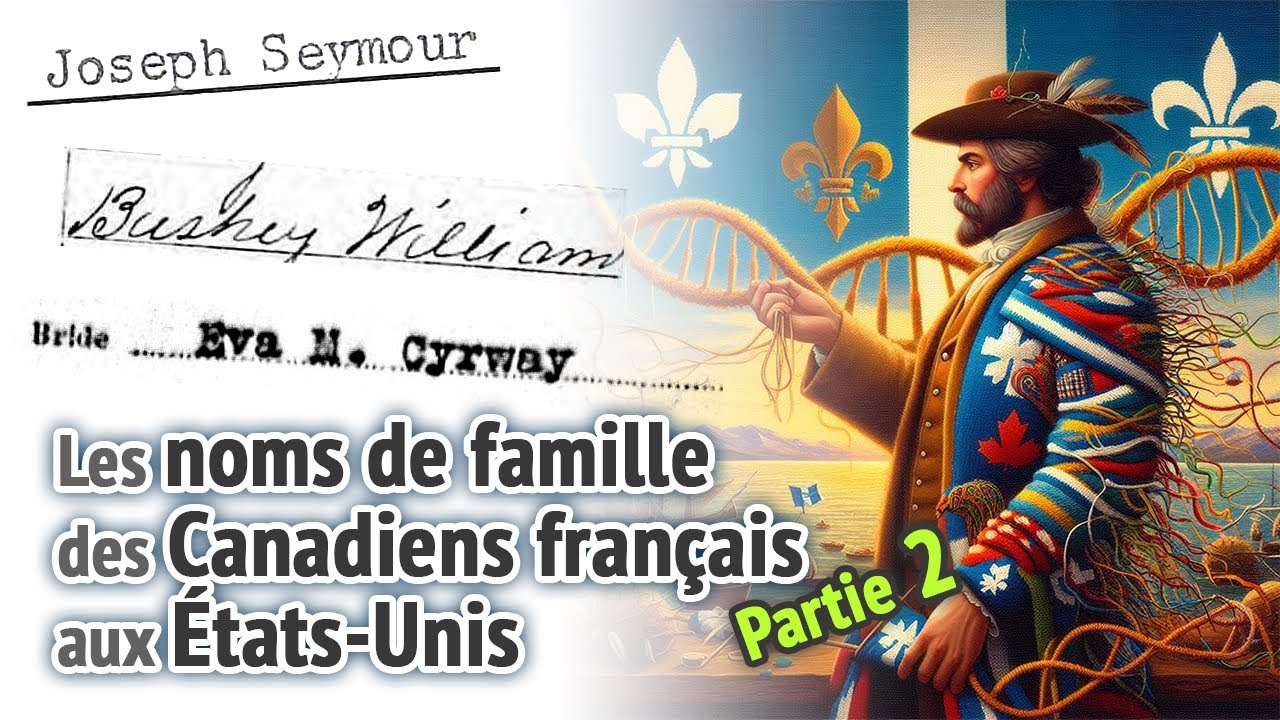
Noms de famille canadiens-français aux États-Unis - Partie 2
French-Canadian surnames in the United States - Part 2
Keywords
Summary
194 words
Critical Evaluation
Value of the Information & Strength of the Argument
The informational value lies in the concrete, document-anchored case studies. Rather than asserting that French-Canadian names were anglicized, the host shows paired documents where the same household appears under two spellings a decade apart, which is a genuinely persuasive form of evidence. The argument for phonetic adaptation is plausible: the OI-to-WAY shift (Sirois to Cyrway, Benoit to Benway) is presented as a recurring pattern across independent cases, which strengthens it beyond anecdote. The Daoust-to-Dough case is explained by the historical pronunciation of the final consonant, and the Boisvert-to-Greenwood case is a clean example of translation rather than phonetic drift, correctly distinguished from the others. The reasoning is careful about what the documents do and do not prove: the host flags that the Victor Barney connection is unverified, that the pronunciation website rests on only three contributors, and that the death certificate’s birth date was supplied from memory by the deceased’s brother. The main weakness is that the phonetic explanations remain intuitive rather than grounded in linguistic scholarship on French-Canadian dialect pronunciation or on the sociology of name change. The argument would be stronger with explicit criteria for when a transformation is phonetic versus translational versus orthographic, and with acknowledgment of alternative explanations such as clerical error or deliberate Americanization by the individuals themselves.
Scientific Rigor, Source Quality, Title Accuracy
The source quality is the video’s strongest dimension. The host works from primary records: US federal censuses, Quebec censuses, parish baptism and marriage registers, civil death certificates, and tombstones. She explicitly ranks their reliability, noting that death dates on tombstones are usually accurate while birth dates may be estimated by survivors, and that death certificate information depends on the informant’s memory. The Saint-Pierre-et-Miquelon marriage acts are cited as exceptionally detailed, sometimes running to three pages. The methodology section is sound: the BMS framework is standard genealogical practice, and the insistence on corroborating multiple independent records is exactly the right standard. The title-content fit is good, with the second half delivering on the promised methodological explanation. The main limitation is the absence of any cited scholarly literature on French-Canadian emigration, onomastics, or historical phonetics, which would let viewers situate these cases within a broader documented pattern. The video also relies on the host’s own prior research without linking to a public database or archive reference numbers, which limits independent verification.
397 words
Title / Content Match
The title accurately reflects the content: a second installment on anglicized French-Canadian surnames in the US, with a methodological section on genealogical proof. The scope matches the promise without overreach.
Quality & Reliability
7/10
The video is built on verifiable genealogical records (census returns, baptism/marriage/burial acts, death certificates, tombstones) and the author explicitly explains her methodology for corroborating sources. She is transparent about uncertainty (e.g., the pronunciation website with only three contributors, the unverified Victor Barney link, the estimated birth date on the death certificate). No external academic literature is cited, and the linguistic explanations remain plausible hypotheses rather than demonstrated phonetic laws.
Chapters
Contribution & Novelties
The video’s original contribution is the pairing of specific anglicization cases with the documentary chain that proves them, rather than presenting the transformations as a list of curiosities. The two extended demonstrations, Louis Bernier to Louis Barney across the 1870 and 1880 censuses, and Émilie Simard to Émilie Seymour across tombstone, death certificate and 1901 census, model a replicable verification procedure. The distinction between phonetic adaptation, orthographic drift and literal translation (Boisvert to Greenwood) is a useful analytical grid for anyone working on immigrant surname change.
Pour aller plus loin :
- French Canadians in New England, Wikipedia — Overview of the migration movement and its cultural consequences.
- Quebec genealogy and parish registers (BMS), Wikipedia — Background on the baptism, marriage and burial records central to the methodology.
- Anglicisation of names, Wikipedia — General framework for the linguistic and social processes discussed.
- Onomastics, Wikipedia — Discipline studying proper names, useful for situating surname change analysis.
154 words
Radar Profile
The profile is balanced toward information quality and reliability, reflecting a documentary built on primary archival records with a transparent method. Technical level is moderate, since the content is accessible but requires familiarity with genealogical record types. Quantity of information is solid given the number of cases covered in under twenty minutes.