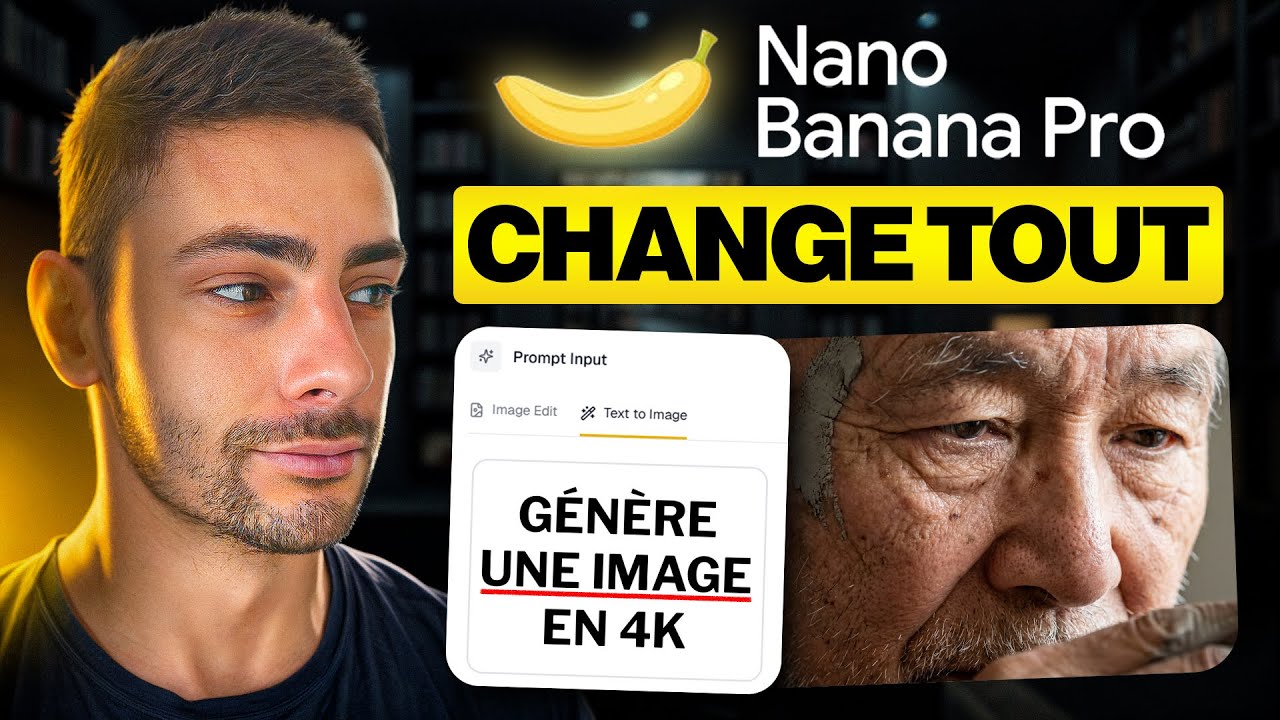
Nano Banana 2 : 8 prompts qui changent tout (testé & validé)
Nano Banana 2: 8 prompts that change everything (tested & validated)
Title history
- Nano Banana 2 : 8 prompts qui changent tout (testé & validé) — observed on 20261112-0057 UTC (YouTube)
Keywords
Summary
157 words
Critical Evaluation
Value of the Information & Strength of the Argument
The video provides high practical value by translating official technical documentation into accessible, tested workflows. The argumentation is built on concrete demonstrations: each technique is explained, applied to a real prompt, and the output is critically examined. The presenter justifies his claims with visual evidence and occasional honest caveats, such as pointing out minor artifacts in complex generations. However, the evaluation is purely subjective, lacking systematic comparisons or blind tests, and the presenter’s heavy promotion of his own services (agency, community) slightly colors the objectivity. Nonetheless, the step-by-step methodology and clear explanation of prompt structure are solid, making it a useful resource for practitioners.
Scientific Rigor, Source Quality, Title Accuracy
The video relies primarily on the official Google documentation for Nano Banana Pro, a primary source, and the presenter cites it explicitly. He also references his own community for prompt downloads, which is a secondary resource not independently verified. The title is accurate and not clickbait; it promises tested prompts and delivers on that promise. The presenter’s interpretation of the documentation is faithful, though he adds personal tips not found in the docs (e.g., writing prompts in English). The methodological rigor is moderate: while the source is credible, the testing is informal and lacks reproducibility details. No contradictions with external sources are noted, but the video is essentially a promotional tutorial.
230 words
Title / Content Match
The title accurately reflects the content: the video systematically presents and tests 8 prompting techniques from the official documentation, all directly related to Nano Banana 2.
Quality & Reliability
7/10
The video is based on the official Google documentation for Nano Banana Pro, and the presenter tests each technique with real examples. However, the evaluation is subjective and lacks systematic comparison or quantitative metrics, relying solely on visual inspection.
Key Moments
Markers derived by PSI from the transcript: the creator did not define chapters.
- Introduction to the official documentation and the 8 techniques to be tested.
- Technique 1: Photorealistic scenes - prompt structure and test with a detailed photorealistic image.
- Technique 2: Perfect text in images - generating an image with complex text in an auditorium.
- Technique 3: E-commerce product photography - testing with a microphone image and image-to-image.
- Technique 4: Minimalist design with negative space - generating a clean design.
- Technique 5: Adding/removing elements - adding rocket boosters to a microphone.
- Technique 6: Merging multiple images - combining a product with a model for a commercial shot.
- Technique 7: Style transfer - applying an artistic style to a photo.
- Technique 8: Sequential art - creating a comic book style panel.
Cited Sources
- Official Google documentation for image generation (Nano Banana Pro) — Referenced as the source of the 8 prompting techniques and the update for Nano Banana Pro.
- Thomas Berton's AI community (Skool) — Mentioned as where full prompts are available and for community resources.
- AIOS - custom AI solutions — Mentioned as a service for custom AI projects.
Concurring Sources
- Official Google documentation for image generation — The techniques and prompt structures are directly taken from this source, which serves as the primary reference.
External References
Contribution & Novelties
The video’s original contribution lies in operationalizing the official documentation, which typically only skilled developers read. It tests each technique with current Nano Banana Pro, offering concrete examples and practical tips (e.g., writing prompts in English, using reference images). This bridges the gap between technical docs and everyday users, potentially benefiting e-commerce, design, and marketing professionals. The demonstration of image-to-image workflows and the critical analysis of strengths/limitations adds value over simply reading the docs.
Pour aller plus loin :
- Prompt engineering — Relevant to understanding how to design effective prompts for AI models.
- Generative adversarial network — Underlying technology for image generation, though current models use diffusion.
- Diffusion model — The actual architecture behind modern image generators like Nano Banana.
120 words
Radar Profile
The radar profile shows balanced scores across quantity and quality of information, with slightly lower technical depth and reliability. This reflects a tutorial that is broad and practical but not deeply technical or rigorously scientific.