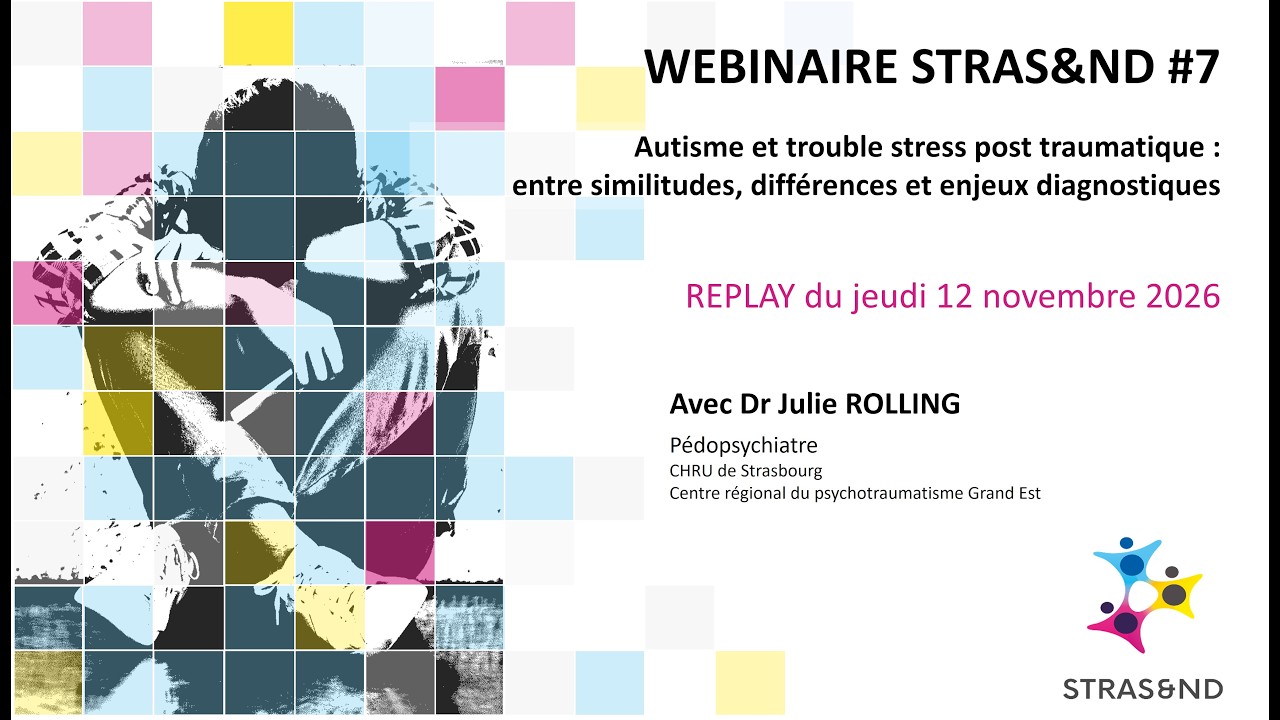
WEBINAIRE #7: TSA et TSPT : similitudes, différences et enjeux diagnostiques
WEBINAR #7: ASD and PTSD: similarities, differences and diagnostic challenges
Title history
- WEBINAIRE #7: TSA et TSPT : similitudes, différences et enjeux diagnostiques — observed on 20261119-1035 UTC (YouTube)
Keywords
Summary
194 words
Critical Evaluation
Value of the Information & Strength of the Argument
The webinar offers substantial value by providing a clear clinical framework for distinguishing and co-managing ASD and PTSD. The argumentation is solid, based on the presenter’s extensive clinical experience and reference to established diagnostic criteria such as ICD-11. The speaker effectively explains the concept of complex PTSD, its underlying mechanisms, and its phenotypic overlap with autism, using accessible clinical examples. She argues that a trauma-informed approach is crucial in evaluating children and adolescents with autism, as symptoms of PTSD may be masked by autistic features. The discussion is clinically oriented, with practical implications for diagnosis and future therapeutic directions. The argumentation is persuasive and well-structured, though it relies more on expert opinion than on cited empirical studies, which is appropriate for a clinical webinar.
Scientific Rigor, Source Quality, Title Accuracy
The scientific rigor is high: the presenter is a recognized specialist, and the content aligns with current nosographic standards, specifically ICD-11. She cites relevant epidemiological figures, such as the 45% prevalence of PTSD in autistic adults, and compares prevalence rates between complex PTSD and classic PTSD. The sources mentioned are limited but credible, including the ICD-11 classification. The title accurately reflects the content, as the webinar thoroughly examines similarities, differences, and diagnostic challenges. The presentation is well-organized, with clear definitions and clinical vignettes, enhancing its educational value. The only minor limitation is the absence of explicit references to specific studies, but the overall rigor is commendable.
245 words
Title / Content Match
The title accurately reflects the webinar's focus on the similarities, differences, and diagnostic challenges between autism spectrum disorder (ASD) and post-traumatic stress disorder (PTSD), with emphasis on complex PTSD.
Quality & Reliability
8/10
The content is presented by a specialist in child psychiatry and psychotrauma, with clear clinical experience and references to recognized diagnostic frameworks (ICD-11). The webinar is structured, evidence-informed, and addresses complex diagnostic nuances. Slight limitations due to lack of cited empirical studies, but the expert perspective is valuable.
Key Moments
Markers derived by PSI from the transcript: the creator did not define chapters.
- Introduction to the webinar and the presenter's background in psychotrauma and autism.
- Definition of PTSD: symptoms of intrusion, hyperarousal, and avoidance following a traumatic event.
- Explanation of complex PTSD: repeated, prolonged trauma with disruption of self-organization, emotional dysregulation, and interpersonal difficulties.
- Discussion on the overlap between complex PTSD and autism: shared features like social withdrawal and emotional numbing, leading to diagnostic challenges.
- Epidemiological data: high comorbidity of trauma in autistic individuals, with 45% of autistic adults meeting PTSD criteria.
- Comorbidities with borderline personality disorder and ADHD, and the importance of a dimensional approach to functioning.
- Implications for therapy: current lack of specific treatments for ASD with trauma, but need for adapted trauma-focused interventions.
- Q&A session: addressing psychological violence, diagnostic difficulties, and practical clinical advice.
Cited Sources
- ICD-11 (International Classification of Diseases, 11th Revision) — The presenter references the ICD-11 recognition of complex PTSD as a distinct diagnostic category since 2018-2019.
Contribution & Novelties
The webinar provides a clinically rich overview of the intersection between autism spectrum disorder and post-traumatic stress disorder, particularly complex PTSD. It emphasizes the high prevalence of trauma in autistic individuals and the diagnostic pitfalls arising from overlapping symptomatology. The presentation highlights the need for a trauma-informed approach in autism care and the importance of recognizing PTSD symptoms that may be obscured by autistic traits. This contributes to the growing body of knowledge on dual diagnosis and advocates for adapted therapeutic strategies.
Pour aller plus loin :
- ICD-11 for Mortality and Morbidity Statistics — Official classification including criteria for PTSD and complex PTSD.
- Autism and Trauma: A Systematic Review — Review of the comorbidity and mechanisms.
- Complex PTSD in Children and Adolescents — Clinical review of complex PTSD in youth, relevant to the webinar’s discussion.
135 words
Radar Profile
The radar profile shows high scores in information quantity and technical level, reflecting the dense, expert-level content. The quality and reliability scores are slightly lower, indicating a reliance on clinical experience rather than systematic citations. Overall, the webinar is a valuable resource for clinicians, with strong practical utility.