Master Deep Learning in 6 Days: Day 3 - Activation Function, Regression & Classification MLPNN,Keras
Keywords
Summary
172 words
Critical Evaluation
Value of the Information & Strength of the Argument
The primary value of this lecture lies in its exceptionally clear, step-by-step mathematical reasoning. It explains not just the ‘how’ but the ‘why’ behind crucial design choices. For instance, the proof that stacking linear layers creates a network mathematically equivalent to a single linear model is pedagogically powerful and justifies the necessity of non-linear activation functions. The explanation of the gradient vanishing problem with the Step function and the network symmetry issue are argued solidly from first principles. The argumentation is logically coherent and does not rely on dogmatic statements; instead, each claim is derived from prior explanations, making the tutorial highly robust for building foundational understanding.
Scientific Rigor, Source Quality, Title Accuracy
Scientifically, the content is accurate and rigorous, adhering to standard deep learning theory. All mathematical formulations (e.g., sigmoid equation, derivative properties, backpropagation update rule) are presented correctly. However, the quality of sources is weak; the video mentions no specific papers, books, or external links, and the description is empty, meaning the content relies entirely on the instructor’s own knowledge. The title accurately reflects the main subjects discussed, despite the promise of ‘Keras’ being unfulfilled, as the lecture is purely theoretical. No comment analysis is possible as none were provided, so no assumptions about public reception are made.
219 words
Title / Content Match
The content accurately covers activation functions, regression, and classification for MLP. However, the word 'Keras' appears only in the title; the spoken content focuses purely on theory and mathematical derivations without any practical Keras implementation.
Quality & Reliability
7/10
The lecture demonstrates high didactic rigor, deriving concepts from first principles and mathematically proving why non-linear activation is necessary. However, it contains no formal citations or external references, relying entirely on standard textbook knowledge, which limits its score despite the correctness of the content.
Key Moments
Markers derived by PSI from the transcript: the creator did not define chapters.
- Introduces Multi-Layer Perceptron (MLP) as a solution to non-linear separability, explaining layer composition (input, hidden, output).
- Explains the network symmetry problem arising from zero initialization and how random initialization with small numbers breaks this symmetry.
- Introduces the Sigmoid activation function, presents its equation, and explains its non-zero derivative which enables backpropagation.
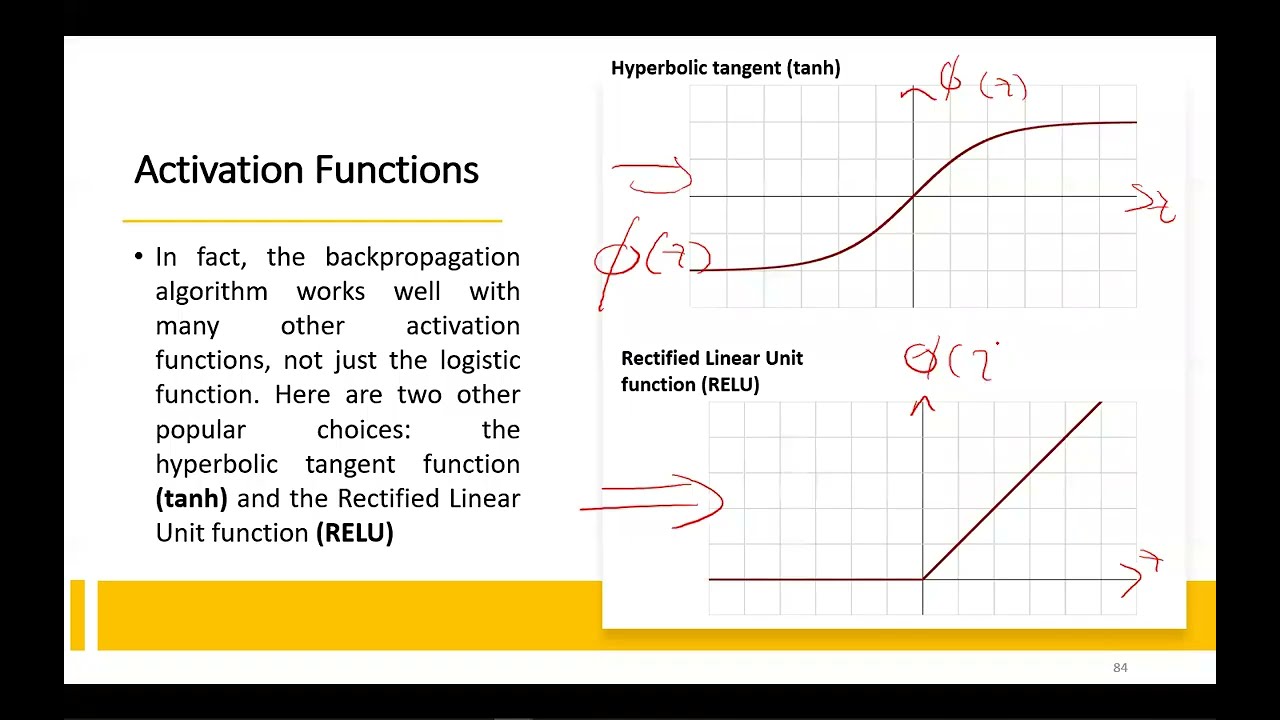
- Presents Tanh and ReLU activation functions, comparing their derivatives and discussing why ReLU is the current default for hidden layers.
- Provides a mathematical proof that linear activation functions across layers collapse the network into a single linear regression function.
- Compares Step, Sigmoid, Tanh, and ReLU graphically with their derivatives to illustrate their impact on gradient magnitude and training speed.
- Discusses multi-output regression using a single MLP where each output neuron predicts a distinct variable.
- Explains output layer choices for regression: identity for unbounded outputs, ReLU/Softplus for non-negative outputs, and scaled sigmoid/tanh for bounded ranges.
- Compares Mean Squared Error (MSE) and Mean Absolute Error (MAE) cost functions, detailing MSE's shrinking gradient near the minimum and MAE's robustness to outliers.
Concurring Sources
- Deep Learning (Goodfellow, Bengio, Courville) — Standard academic reference that formalizes all the concepts taught in the video, including MLP architecture, backpropagation, and activation function choices.
Contribution & Novelties
This lecture offers a particularly effective pedagogical contribution by bridging the gap between high-level deep learning frameworks and the underlying mathematical machinery, all delivered in Arabic for a non-English speaking academic audience. Its original strength lies in the step-by-step derivation of why specific components (like non-linear activation functions) are indispensable, rather than accepting them as heuristics.
Pour aller plus loin :
- Universal approximation theorem — Core mathematical foundation explaining why an MLP with a single hidden layer can approximate any continuous function, directly tied to the lecture’s discussion of network power.
- Activation function — A comprehensive overview of all discussed activation functions and their historical evolution, including variants like Leaky ReLU and Parametric ReLU.
- Backpropagation — Detailed explanation of the algorithm central to training MLPs, complementing the instructor’s high-level description of gradient propagation.
133 words
Radar Profile
The radar profile is strongly oriented towards high 'quantity' and 'quality' of information with a robust 'technical level', but shows a notably lower 'global reliability' score. This indicates an excellent educational content built on solid mathematical principles, yet one that is weakened by the absence of formal citations or external verifiable sources.