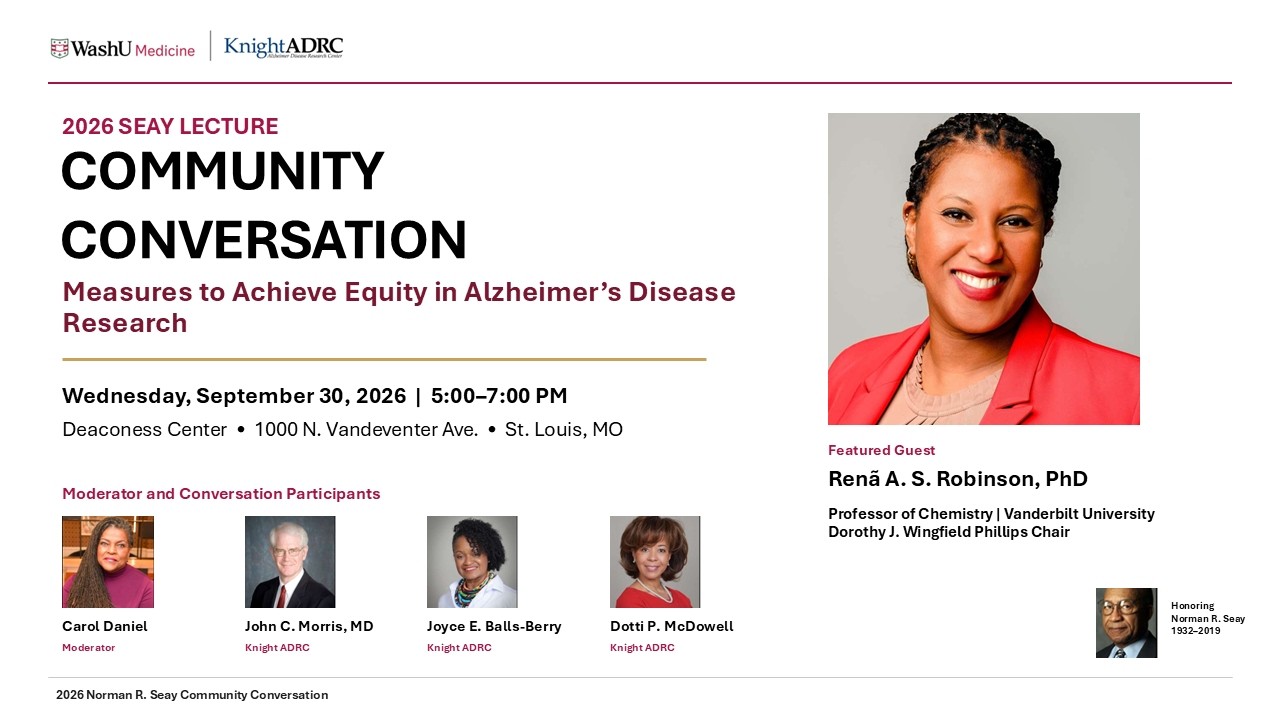
The 2026 Norman R. Seay Community Conversation with Lecturer Renã A. S. Robinson, PhD
Keywords
Summary
197 words
Critical Evaluation
Value of the Information & Strength of the Argument
The information value is strong for a community-oriented discussion: it provides a clear, accessible overview of current Alzheimer’s research (blood biomarkers, anti-amyloid drugs), while critically addressing the lack of diversity in clinical studies. The argumentation is largely evidence-based and relies on the experts’ extensive clinical and research experience. The panel effectively justifies the need for equity by citing statistics on disease prevalence and the historical underrepresentation of minorities. They argue that community engagement and trust-building are essential for improving research participation and ensuring that new treatments work for all populations. The reasoning is coherent and persuasive, though it lacks quantitative details on the effectiveness of the described interventions.
Scientific Rigor, Source Quality, Title Accuracy
The scientific rigor is adequate for a panel discussion: the experts reference FDA approvals and established findings (e.g., amyloid plaques, two new drugs), and explicitly recognize knowledge gaps. The primary source cited is the Knight ADRC event page (from the description), which provides context but no direct scientific references. The title exactly matches the content, as it is a recorded community conversation. No comments were provided, so public reception is not analyzed.
195 words
Title / Content Match
The title accurately describes the event: a community conversation honoring Norman R. Seay, featuring a named lecturer addressing equity in Alzheimer's research.
Quality & Reliability
8/10
The discussion features leading researchers from WashU and Vanderbilt, including a professor of neurology and a chemistry professor specializing in Alzheimer's proteomics. The content aligns with published scientific consensus on biomarkers and treatments, but as a community conversation it relies on expert testimony rather than detailed data. The organizers transparently acknowledge the underrepresentation of minorities in research, which is a well-documented issue. Overall, the information is reliable and credible, though not a formal scientific review.
Key Moments
Markers derived by PSI from the transcript: the creator did not define chapters.
- Carol Daniel introduces the event and provides statistics on Alzheimer's prevalence among African Americans.
- Dr. Morris recounts Norman Seay's legacy and the founding of the African-American Advisory Board.
- Dr. Robinson explains blood-based biomarkers and recent FDA-approved treatments.
- Discussion on the 97% white research population and the need for diversification.
- Dy McDow and Dr. Balls-Berry describe equity in practice: community-based studies, Saturday visits, and the CO-EQUAL registry.
- Panel addresses mistrust, caregiver experiences, and the importance of community partnership.
Cited Sources
- Center Events: Seay Lecture — Official event page for the Norman R. Seay Lecture, providing background and related resources.
Concurring Sources
- Center Events: Seay Lecture — The event page aligns with the video's aim to foster community dialogue on Alzheimer's research equity.
Contribution & Novelties
The video contributes to public understanding of Alzheimer’s research equity by connecting scientific advancements with community perspectives. It highlights specific initiatives, such as the CO-EQUAL registry and decentralized study designs, that demonstrate practical steps to increase diversity in clinical research. The panel’s emphasis on historical mistrust and its tangible efforts to build partnerships with Black communities adds original value for a lay audience.
Pour aller plus loin :
- Alzheimer’s disease - Wikipedia — Overview of disease mechanisms, biomarkers, and treatments.
- Biomarker - Wikipedia — Explanation of blood-based biomarkers and their diagnostic potential.
- Lecanemab - Wikipedia — One of the two recently FDA-approved anti-amyloid antibodies discussed.
- Health Disparities - Wikipedia — Context for racial and ethnic differences in disease prevalence and access to care.
123 words
Radar Profile
The radar profile shows high scores in quantity and quality of information, reflecting the panel's comprehensive coverage of research and equity issues. The technical level is moderate, appropriate for a community audience, while reliability is high due to expert speakers. The profile indicates a balanced, informative session with a strong community engagement focus.