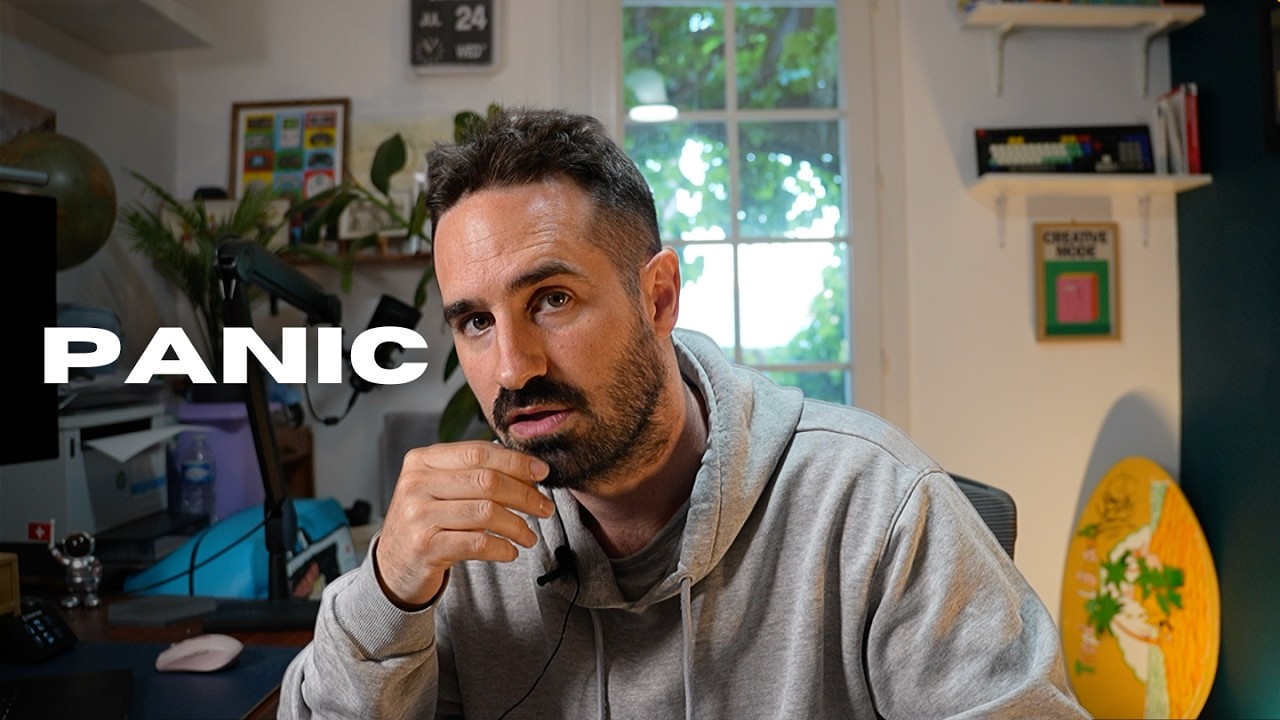
La productivité avec l’IA est devenue une arnaque sociale
Productivity with AI has become a social scam
Title history
- La productivité avec l’IA est devenue une arnaque sociale — observed on 20261101-0126 UTC (YouTube)
Keywords
Summary
152 words
Critical Evaluation
Value of the Information & Strength of the Argument
The video provides a valuable counterpoint to mainstream AI boosterism, articulating a reasoned critique of the emotional manipulation behind AI marketing. The argumentation is built on personal anecdotes and direct observations from the creator’s role as a developer advocate, which gives it authenticity. He effectively deconstructs the myth of ‘100% AI workflows’ and highlights the cognitive costs of relying on AI for note-taking and summarization, drawing parallels with research on learning and memory. However, the reasoning is largely anecdotal and lacks empirical evidence or references to studies, which diminishes its analytical rigor. The argument about ‘ghost meetings’ is compelling but remains speculative without data. Overall, the value lies in raising awareness about the social dynamics and psychological pressure surrounding AI adoption, but the argumentation would benefit from more systematic evidence.
Scientific Rigor, Source Quality, Title Accuracy
The video does not cite any external studies, articles, or official sources. The only references are links to other videos on the same channel in the description, which are promotional rather than authoritative. The creator relies on his own professional experience, which is valid but not sufficient for a rigorous scientific analysis. The title accurately captures the video’s thesis, and despite being a bit dramatic, it matches the content. The adéquation between title and content is strong: the video indeed argues that AI productivity has become a socially constructed scam. The lack of citations is a significant weakness, as it limits the ability to verify claims or place them in a broader research context.
259 words
Title / Content Match
The title accurately reflects the video's core argument that AI productivity is marketed as a social obligation and a source of anxiety, though it's somewhat sensational.
Quality & Reliability
6/10
The video offers a coherent, experience-based critique of AI productivity hype. However, it relies on anecdotes and personal observations without citing external studies or data, limiting its scientific reliability.
Key Moments
Markers derived by PSI from the transcript: the creator did not define chapters.
- Introduction to the social pressure and the 'AI shaming' by colleagues.
- Criticism of AI companies like Anthropic and OpenAI using fear to promote their services.
- Discussion of Claude Opus 4.7 and Claude Design hype as marketing noise.
- Argument that a 100% AI workflow does not exist and the myth of fully automated work.
- Example of AI meeting summaries leading to disengagement and 'ghost meetings'.
- The productivity facade and the importance of human thinking and creativity.
Cited Sources
- Entretien de dev 2025 : 3 questions d’IA à connaître absolument ! — Related video on AI interview questions, not directly referenced in the content.
- Test complet de Mistral Ai — Related video testing Mistral AI, listed in the description.
- Qwen plus fort que DeepSeek et ChatGPT ? LE TEST (étonnant) — Related video comparing AI models, listed in the description.
- Utiliser DeepSeek R1 avec Cursor Ai - Facile et SURPUISSANT — Tutorial video on DeepSeek R1 with Cursor, listed in the description.
- DeepSeek VS ChatGPT vs Claude ? — Comparison video of AI models, listed in the description.
External References
Contribution & Novelties
The video contributes a sobering perspective on the social and psychological mechanisms behind AI productivity narratives, emphasizing the importance of human agency and cognitive engagement. It challenges the prevailing ‘productivity theater’ and encourages a balanced approach to AI adoption.
Pour aller plus loin :
- Productivity paradox — The observation that increased investment in IT doesn’t always lead to higher productivity, relevant to AI’s actual impact.
- Hype cycle — Gartner’s framework explaining how technologies overinflate expectations before reaching maturity, applicable to AI hype.
- Fear of missing out (FOMO) — A psychological factor exploited by AI marketing, as discussed in the video.
- Vibe coding — A term for AI-assisted coding with minimal supervision, related to the creator’s critique of over-reliance on AI.
120 words
Radar Profile
The radar profile shows moderate scores across all dimensions, with information quality and reliability slightly above quantity and technical depth. This reflects a conversational, opinion-driven video that prioritizes insight over density.
💬 Très positif. Sur les 30 commentaires analysés, la quasi-totalité exprime un soutien enthousiaste et une gratitude, partageant des anecdotes personnelles validant les propos du créateur.