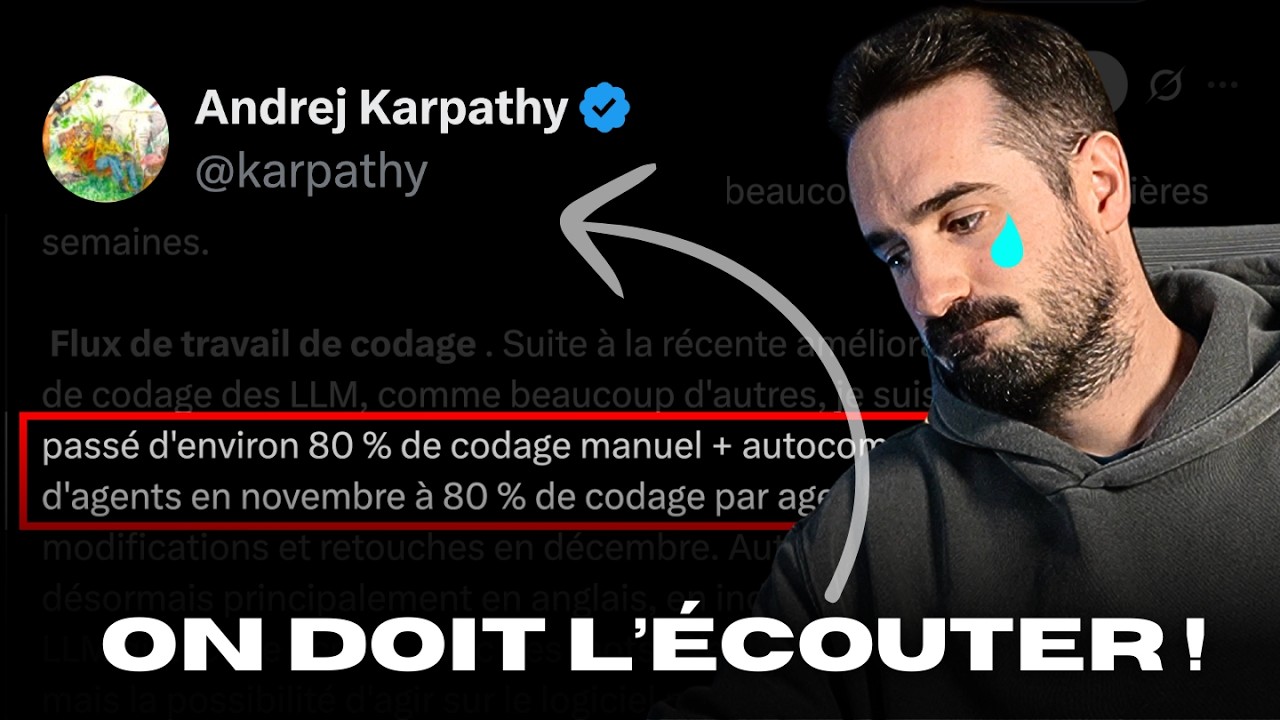
Karpathy dit tout haut ce que beaucoup pensent sur l’IA
Karpathy says out loud what many people think about AI
Title history
- Karpathy dit tout haut ce que beaucoup pensent sur l’IA — observed on 20261101-0145 UTC (YouTube)
Keywords
Summary
164 words
Critical Evaluation
Value of the Information & Strength of the Argument
The video provides a clear, well-structured summary of Karpathy’s tweet and adds the host’s own professional reflections, which strengthens the argument through relatable personal anecdotes. The value lies in making a widely discussed industry shift accessible to a broad developer audience. However, the argumentation is purely subjective and lacks supporting evidence or data. The host does not challenge Karpathy’s claims but endorses them, and his enthusiasm sometimes overshadows a critical analysis. The discussion of specific practices like TDD and MCP is useful, but it is presented without depth or verification.
Scientific Rigor, Source Quality, Title Accuracy
The video relies almost exclusively on a single primary source: Andrej Karpathy’s tweet, which is perfectly adequate for a reaction video. However, the host does not seek additional credible sources or scientific references to corroborate the points made. The title is accurate and appropriately attention-grabbing, as it reflects the core content. The lack of citations and the subjective tone reduce the scientific rigor, but as an opinion piece, it fulfills its purpose. The presenter’s experience is relevant, but no attempt is made to ground the discussion in empirical evidence, apart from the tweet.
198 words
Title / Content Match
The title accurately reflects the content: the host discusses Karpathy's tweet and verbalizes the implicit concerns many developers have about AI's impact on coding.
Quality & Reliability
4/10
The video is a personal commentary on a tweet by Andrej Karpathy, offering subjective perspectives and anecdotal experiences. It lacks rigorous sources, peer-reviewed references, or factual backing beyond the tweet itself. The host's interpretation is reasonable but not scientifically grounded.
Key Moments
Markers derived by PSI from the transcript: the creator did not define chapters.
- Introduction of Andrej Karpathy and his credibility, and the context of the tweet.
- Reading the key part of Karpathy's tweet: the shift from 80% manual editing to 80% AI-generated code.
- Discussion of the over-enthusiasm for AI agents and the persistence of conceptual errors in generated code.
- Highlighting the tenacity of AI agents compared to human programmers and the impact on problem-solving.
- The host's personal anecdotes about how AI expands the scope of attainable projects, but can lead to overreach.
- Discussion of the gradual loss of manual coding skills and the difficulty of reverting to traditional methods.
- Advice on using TDD and MCP browser to improve the reliability of AI-generated code.
- Reflections on 2026 as a pivotal year for the industry and the need for adaptation.
Cited Sources
- Andrej Karpathy's tweet on AI coding workflows — The original tweet that the video analyzes in detail, containing Karpathy's personal observations about AI-assisted coding.
External References
Contribution & Novelties
This video offers a French-speaking audience a commentary on a key industry figure’s candid assessment of AI coding tools. It adds personal reflections from a practicing developer, which can resonate with viewers facing similar uncertainties. However, it brings no new research or data. For deeper exploration:
- Test-driven development — A practice recommended in the video to ensure AI-generated code meets requirements.
- Large language model — Background on the technology underlying AI coding assistants.
- Andrej Karpathy’s tweet — The original source with further discussion and replies.
85 words
Radar Profile
The radar scores indicate a moderate balance: information quantity and technical level are above average, but quality and reliability scores lag. This suggests the video is informative for a technical audience but lacks depth and authoritative backing, reflecting its nature as a personal commentary rather than a rigorous analysis.
💬 Negative – Sur les 30 commentaires analysés, une majorité exprime une anxiété face à la perte de compétences de codage manuel et à l'impact sur la carrière, bien que certains voient des opportunités et adoptent une approche pragmatique.