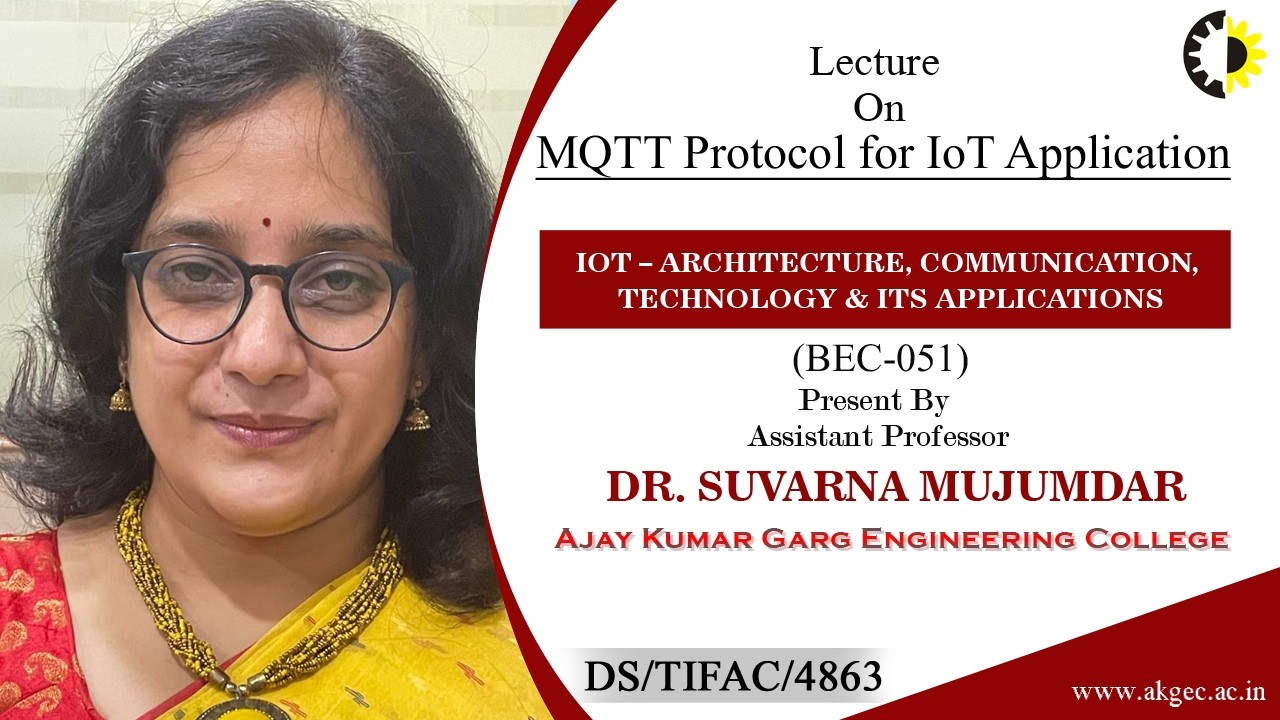
MQTT PROTOCOL FOR IOT APP | IOT–ARC, COMM, TECH & ITS APP | LECTURE 03 BY MS. SUVARNA MUJUMDAR | AKG
Keywords
Summary
191 words
Critical Evaluation
Value of the Information & Strength of the Argument
The video offers a solid foundational explanation of MQTT, structured logically from definition to practical application. The argumentation is coherent: it justifies MQTT’s suitability for IoT through specific characteristics, explains the protocol working with clear analogies (e.g., temperature sensors as publishers), and substantiates claims with real-world use cases. The coverage of QoS levels is particularly valuable as it clarifies reliability trade-offs. However, the content remains introductory and lacks critical depth, such as comparisons to alternative protocols or security implementation details. No experimental or research data is provided; it is purely educational exposition.
Scientific Rigor, Source Quality, Title Accuracy
The lecture is scientifically rigorous in an educational sense: the information aligns with widely accepted MQTT specifications and IoT literature, and the presentation is error-free. However, no external sources are cited within the video; it relies on established knowledge typical of a university course. The description provides a link to the college website and a playlist, which are not direct references but institutional resources. The title accurately reflects the content, and the lecture fulfills its stated purpose as an introductory session. The lack of citations is acceptable for an academic lecture but limits its use as a standalone research source.
207 words
Title / Content Match
The title accurately describes the lecture: it covers MQTT protocol for IoT applications, including architecture, communication, and its applications, as part of a larger course.
Quality & Reliability
7/10
The lecture provides a clear, accurate introduction to MQTT for IoT, based on established knowledge. The presenter is a faculty member at an engineering college, lending credibility. However, no external sources are cited, and the content remains at an introductory level without deep technical or critical analysis.
Key Moments
Markers derived by PSI from the transcript: the creator did not define chapters.
- Introduction: lecture overview and acknowledgment of course context.
- Definition of MQTT and its role in IoT communication.
- Explaining the publisher/subscriber model and the broker.
- Data flow steps: connection, subscription, publishing, and message distribution.
- Detailed explanation of QoS levels (0, 1, 2) with reliability trade-offs.
- Listing advantages and limitations of MQTT in IoT systems.
- Real-world smart home temperature monitoring scenario illustrating practical use.
- Conclusion summarizing MQTT's importance and future in IoT.
Cited Sources
- AKGEC Official Website — Institutional website of the college providing lecture context and faculty information.
- IOT – ARCHITECTURE, COMMUNICATION, TECHNOLOGY & ITS APPLICATIONS Playlist — Playlist containing this lecture as part of a five-unit series.
Concurring Sources
- MQTT Official Website — Confirms the protocol's key features and common usage.
- Wikipedia: MQTT — Provides general information consistent with the lecture's explanations.
Contribution & Novelties
This lecture offers a concise, well-structured introduction to MQTT for IoT, making it accessible to students and newcomers. It does not present original research but serves as a valuable educational resource that consolidates core concepts (publish-subscribe, broker, topics, QoS) and grounds them in practical scenarios. The contribution is pedagogical rather than novel, suitable for academic settings.
Pour aller plus loin :
- MQTT Official Website — The authoritative source for MQTT specifications and resources.
- Wikipedia: MQTT — Comprehensive overview of the protocol, history, and use cases.
- OASIS MQTT Technical Committee — The standards body overseeing MQTT evolution; provides official specifications.
- Publish–subscribe pattern (general design) — Concept widely used in IoT and distributed systems; see Wikipedia for background without an exact guaranteed URL.
121 words
Radar Profile
The radar profile shows moderate scores across all dimensions, with quality_of_information and global_reliability being the highest, reflecting accurate and trustworthy content. Quantity and technical depth are average, typical of an introductory lecture. The low quantity score indicates the lecture covers many topics but at a surface level.