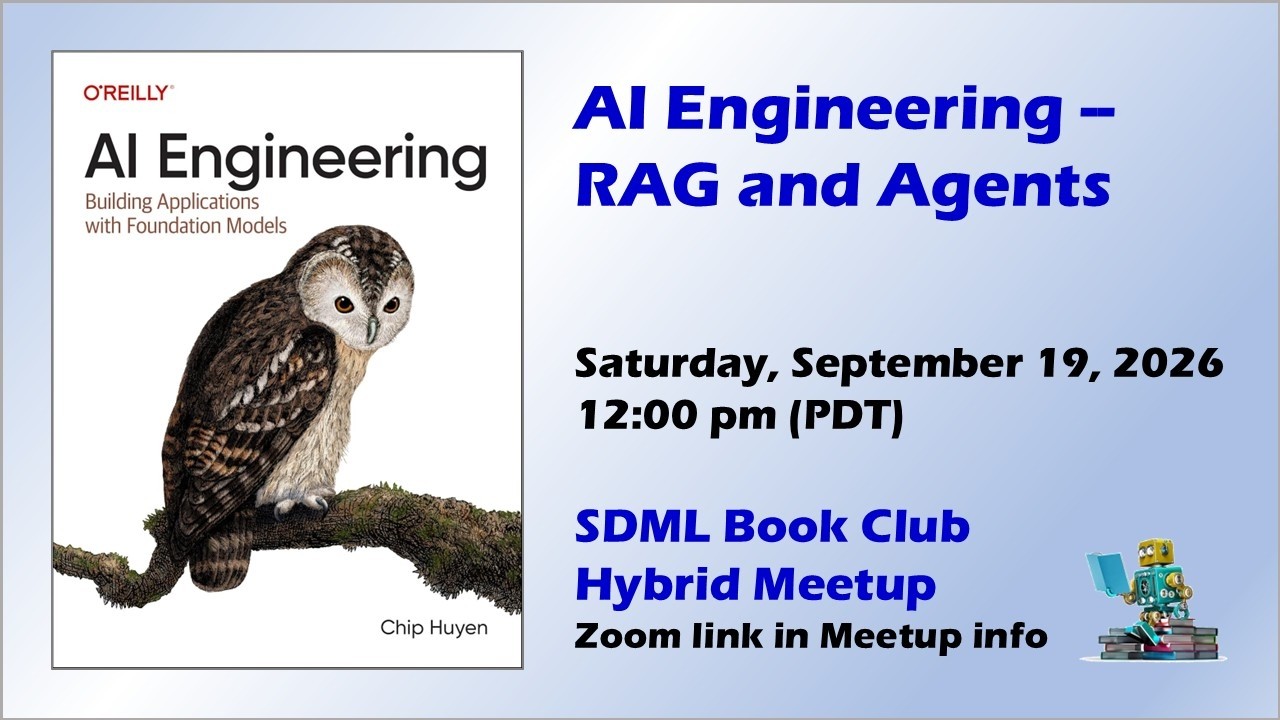
RAG and Agents - AI Engineering
Keywords
Summary
165 words
Critical Evaluation
Value of the Information & Strength of the Argument
The value lies in a clear, structured explanation of RAG’s components and the practical trade-offs when building such systems. The argumentation is coherent: it moves from the high-level idea to specific implementation details, supported by examples (e.g., World Cup query) and analogies (TensorFlow projector for embeddings). The discussion of late interaction models is well-motivated, and the speaker provides a balanced view of pros and cons. Q&A segments add practical insights, such as the impact of training on false positives and latency considerations. The speaker demonstrates deep understanding and provides useful context for engineers.
Scientific Rigor, Source Quality, Title Accuracy
The talk is based on the book ‘AI Engineering’ by Chip Huyen, which is a reputable source. The speaker references the book and mentions relevant papers and techniques (e.g., late interaction, HNSW) without formal citations but with sufficient accuracy. The title precisely matches the content, which is a chapter discussion. The presentation is informal but rigorous enough for a meetup audience. No comments were provided, so public reception cannot be assessed.
179 words
Title / Content Match
The title accurately reflects the content, which focuses on retrieval-augmented generation and agent building within the context of AI engineering.
Quality & Reliability
7/10
The talk provides a solid overview of RAG, retrieval methods, and trade-offs, grounded in well-known techniques and recent developments. It is informal but technically accurate, with appropriate citations to the book and general knowledge.
Key Moments
Markers derived by PSI from the transcript: the creator did not define chapters.
- Introduction to RAG: definition and motivation.
- RAG architecture: indexing and querying phases explained.
- Term-based retrieval: TF-IDF and BM25.
- Embedding-based retrieval and vector search algorithms.
- HNSW and trade-offs between speed, accuracy, and storage.
- Late interaction models: per-token embeddings and ColBERT.
- Q&A: latency and storage concerns for late interaction.
- Evaluation metrics: recall, precision, NDCG.
- Benchmarks like MIRACL/MTEB and labeling challenges.
Cited Sources
- AI Engineering: Building Applications with Foundation Models (O'Reilly) — The book being discussed; referenced throughout the presentation.
- SDML Book Club GitHub Repository — Links to presentation notes and prior sessions.
- SDML Slack Community Invite — Community discussion channel mentioned in the video.
Concurring Sources
- AI Engineering (book) — The chapter content aligns with the book's material on RAG and agents.
Contribution & Novelties
The video offers a practical walkthrough of RAG implementation, emphasizing the critical role of retrieval quality in overall system performance. It highlights less-discussed aspects like the impact of nearest neighbor search algorithms on accuracy and the trade-offs of late interaction models. The speaker’s connection to a team training embedding models adds a practitioner’s perspective.
Pour aller plus loin :
- Retrieval-Augmented Generation (Wikipedia) — Overview and history of RAG.
- Okapi BM25 (Wikipedia) — Classic retrieval algorithm mentioned in the talk.
- HNSW (arXiv) — Paper on Hierarchical Navigable Small World graphs, the standard ANN method.
- ColBERT: Efficient and Effective Passage Search via Contextualized Late Interaction (arXiv) — Original paper on late interaction models.
111 words
Radar Profile
The radar profile shows a balanced skill set with strong technical depth (8) and good content quality (7), but moderate information quantity (6) and reliability (7). The niche focus on RAG and retrieval techniques suggests a specialized audience.