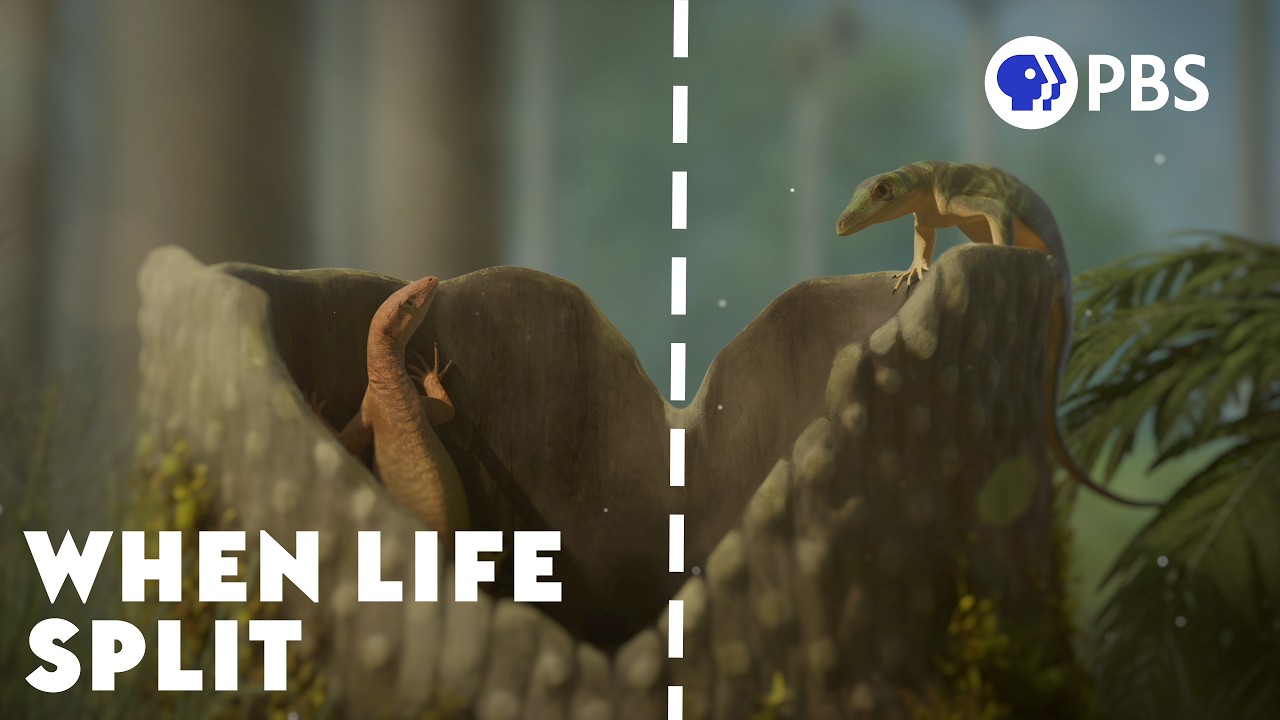
When Mammals and Reptiles Split
Keywords
Summary
182 words
Critical Evaluation
Value of the Information & Strength of the Argument
The video provides valuable scientific context by connecting major evolutionary innovations—seeds and amniotic eggs—to environmental changes, demonstrating convergent solutions. Arguments are supported by direct field observations, fossil evidence, and interviews with experts (e.g., Dr. Jade Atkins on fossils, Benjamin Jones on seed production). The explanation of the amniote split is clear, emphasizing that early differences were subtle but crucial. The narrative is compelling and logically structured, but some causal links, such as the reasons for the evolutionary split, are presented as hypotheses without deep speculation, which maintains scientific rigor.
Scientific Rigor, Source Quality, Title Accuracy
The program adheres to high production standards typical of PBS Eons. It features experts and researchers, and visits reputable locations like the Joggins Fossil Cliffs, a UNESCO World Heritage Site. However, it does not provide direct citations to academic papers, though it indirectly references established paleontological knowledge. The title accurately encapsulates the focus on the mammal-reptile divergence, and the content is well-aligned. Comments analysis: commentators express strong appreciation, though some note audio mixing issues and dramatic music, but these do not detract from scientific content.
189 words
Title / Content Match
The title accurately reflects the core theme: the evolutionary divergence between mammals and reptiles (synapsids and sauropsids), which is thoroughly explained.
Quality & Reliability
8/10
The video features expert commentary, fieldwork at a UNESCO site, and interviews with specialists, but does not provide explicit citations to peer-reviewed papers. The information is consistent with current paleontological understanding.
Chapters
Cited Sources
- PBS Eons App — Where to watch the full series, as mentioned in the intro.
- PBS.org Eons — Alternative viewing platform, recommended for non-US viewers.
- Eons Watch Party RSVP — Sign-up for the live watch party mentioned at the end.
- Eons on Bluesky — Social media profile for the channel.
Contribution & Novelties
The video adds value by presenting a holistic view of the Carboniferous-Permian transition, emphasizing how environmental stress drove convergent evolution across kingdoms. It connects the ‘seed’ and ‘amniotic egg’ as analogous solutions, a perspective rarely highlighted in popular media. The fieldwork at Joggins provides tangible evidence and visual appeal that enriches the narrative.
Pour aller plus loin :
- Amniote — Definitive overview of the amniotic egg and its evolutionary significance.
- Carboniferous rainforest collapse — Details on the ecological event that reshaped terrestrial ecosystems.
- Synapsid — The lineage leading to mammals, as discussed in the video.
- Sauropsid — The lineage leading to reptiles and birds.
- Permian–Triassic extinction event — Background on the Great Dying.
113 words
Radar Profile
The radar profile shows strong scores in quantity and quality of information (9 and 8), indicating a dense, well-structured presentation. Technical depth (7) is adequate for a popular audience, while reliability (8) reflects solid scientific grounding but lacks explicit citations. Overall, the video is both informative and trustworthy within its scope.
💬 Très positif : sur les 30 commentaires analysés, les spectateurs expriment un enthousiasme marqué pour la série, la qualité de production et l'attention portée à une période méconnue, avec quelques remarques sur les niveaux audio et la dramatisation de la musique.