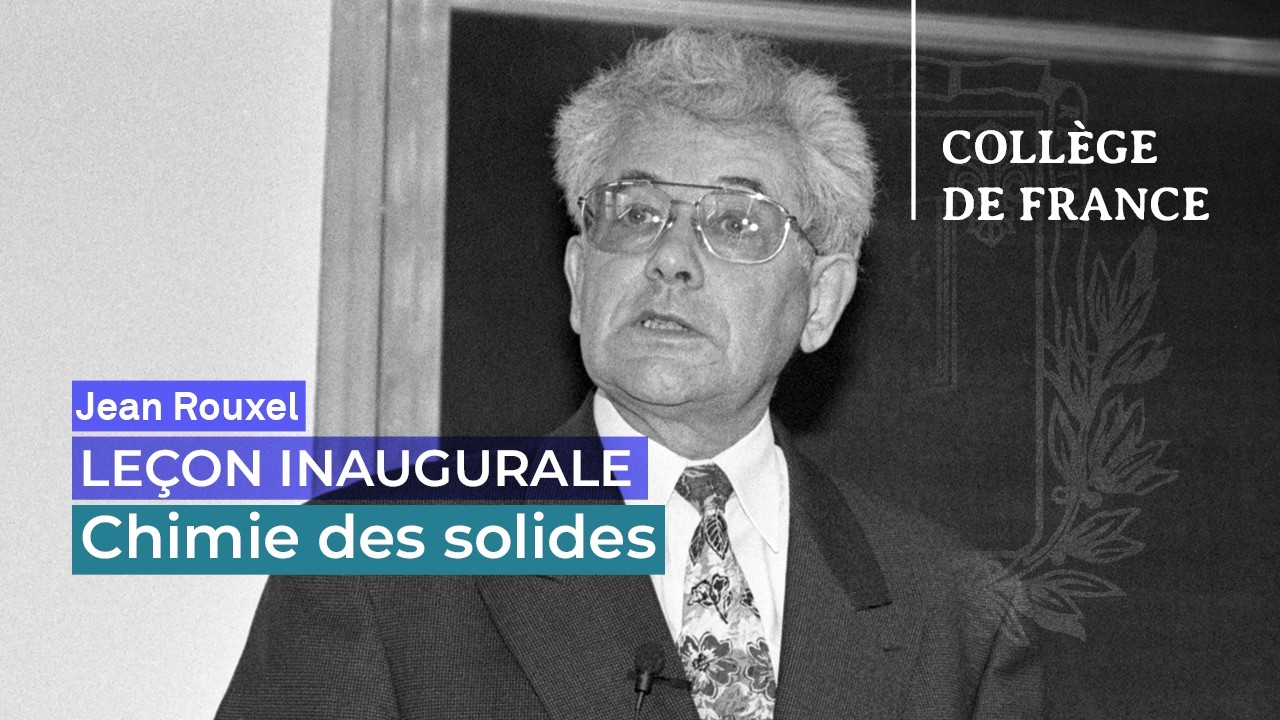
Chimie des solides - Jean Rouxel (1997)
Chemistry of Solids - Jean Rouxel (1997)
Keywords
Summary
144 words
Critical Evaluation
Value of the Information & Strength of the Argument
The lecture provides valuable historical perspective and conceptual clarity on solid state chemistry. Rouxel’s argumentation is rigorous, building from fundamental principles to practical examples. He demonstrates how soft chemistry opens new synthesis routes, and his discussion of competing redox processes in deintercalation is particularly insightful. The use of layered materials as case studies effectively illustrates the principles. However, the presentation is somewhat dated (1997) and lacks modern computational perspectives.
Scientific Rigor, Source Quality, Title Accuracy
The scientific rigor is high, consistent with an academic lecture at a prestigious institution. Rouxel cites examples from his own research and that of colleagues (e.g., Jacques Livage), grounding the talk in published work. The title ‘Solid State Chemistry’ matches the content well, though it is broad. The video description provides links to the Collège de France resources, including the chair page, which serve as reliable sources. No comments were available for analysis.
157 words
Title / Content Match
The title accurately reflects the content: a lecture on solid state chemistry by Jean Rouxel.
Quality & Reliability
8/10
High reliability due to the institutional setting (Collège de France) and the speaker's recognized expertise. The content is somewhat dated but remains historically and scientifically valuable.
Key Moments
Markers derived by PSI from the transcript: the creator did not define chapters.
- Introduction by the administrator of the Collège de France presenting Jean Rouxel.
- Rouxel contrasts solid state chemistry with molecular chemistry, noting the infinite number of atoms in solids.
- Discussion of the historical development from crystallography to structure-property relationships.
- Introduction of 'chimie douce' (soft chemistry), its topotactic character, and the role of precursors.
- Example of potassium titanate and the formation of new TiO2 forms via soft chemistry.
- Explanation of redox soft chemistry with intercalation reactions in layered compounds.
- Discussion of diffusion fronts and percolation in intercalation systems, linking to local chemical constraints.
- Deintercalation as a route to new compounds, exemplified by V S2 and Fe S2.
- Analysis of competing redox reactions during deintercalation using CuCr2S4 and NaCrS2 examples.
- Concluding remarks on the need to go beyond structure-property relationships and understand local electronic structure.
Cited Sources
- Jean Rouxel - Chimie des solides (chaire statutaire) — Official page of the chair held by Jean Rouxel at Collège de France.
- Collège de France — Institutional website hosting the video and other resources.
Concurring Sources
- Chimie douce - Wikipedia — French Wikipedia article on soft chemistry, aligning with Rouxel's presentation.
External References
Contribution & Novelties
The lecture articulates the concept of ‘chimie douce’ (soft chemistry) as a distinct methodology in solid state synthesis, emphasizing topotactic reactions and the memory of structural motifs. Rouxel’s discussion of intercalation/deintercalation as a reversible pathway to novel compounds, combined with electronic band structure arguments, constitutes a valuable conceptual framework. The historical perspective on the field adds depth. To go further:
- Soft chemistry (Wikipedia) — Provides an overview of the concept, its origins, and applications.
- Intercalation (chemistry) (Wikipedia) — Explains the phenomenon of intercalation in layered materials, central to Rouxel’s talk.
- Layered double hydroxides (Wikipedia) — Example of materials prepared via soft chemistry routes.
- Inorganic–organic hybrid materials (Wikipedia) — Relevant to the incorporation of organic molecules in inorganic hosts, as mentioned in the lecture.
123 words
Radar Profile
The radar profile shows strong scores in information quality and quantity, with a slightly lower technical level due to the accessible nature of the lecture. Reliability is high, reflecting the authoritative source.