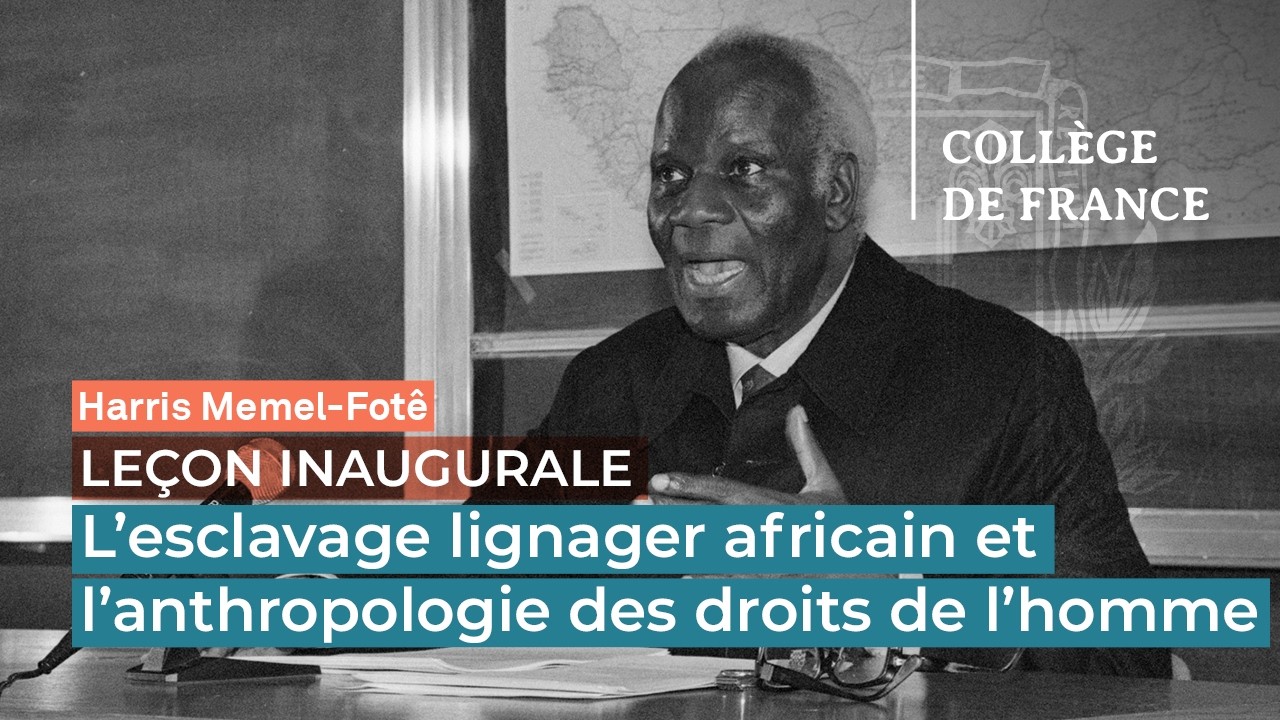
L'esclavage lignager africain et l'anthropologie des droits de l'homme - Harris Memel-Fotê (1995)
African lineage slavery and the anthropology of human rights - Harris Memel-Fotê (1995)
Keywords
Summary
214 words
Critical Evaluation
Value of the Information & Strength of the Argument
The lecture offers high value for researchers and students of anthropology, African history, and human rights. Memel-Fotê provides a rich, nuanced analysis of a neglected topic, combining theoretical sophistication with empirical grounding. His argument is meticulously constructed: he first recounts the methodological journey that led him from studying age classes to uncovering lineage slavery, then presents the main features of this institution across different societies, and finally builds a convincing critique of the epistemological frameworks that had marginalized it. The discussion of Nkrumah’s communalist theory is particularly compelling, as he exposes its ideological roots while acknowledging its political significance. Memel-Fotê’s proposal for an anthropolology of rights—possession, dépossession, repossession—offers a creative and dynamic way to think about human rights beyond Western-centric abstractions. The argument’s strength lies in its careful distinction between categories (e.g., cadets, slaves, free men), its attention to historical change, and its effort to give voice to both the oppressed and the community’s internal debates about historical memory.
Scientific Rigor, Source Quality, Title Accuracy
The lecture demonstrates rigorous scientific standards: Memel-Fotê draws on his own extensive fieldwork, as well as historical documents and the autobiography of Olaudah Equiano (Gustavus Vassa) to illustrate points. He engages critically with theorists like Aristote and Nkrumah, and uses comparative method across multiple ethnic groups. The title ‘L’esclavage lignager africain et l’anthropologie des droits de l’homme’ is precise and faithfully represents the content, which indeed centers on lineage slavery in African societies and its articulation with a rights-based anthropology. The source base is diverse: primary ethnographic data, historical sources, and philosophical arguments. The quality of sources is high, though some claims are based on his own interpretations; he explicitly presents his conclusions as hypotheses for future verification. The institutional context (Collège de France) adds authority. No commercial sponsorships or advertisements are present in the video description; the lecture itself is pure scientific content, with an introduction by the administrator of the Collège de France.
329 words
Title / Content Match
The title accurately reflects the content: the analysis of lineage slavery in West Africa through an anthropological and human rights lens.
Quality & Reliability
10/10
Inaugural lecture at the Collège de France, a top academic institution. The content is dense, rigorously argued, and based on long-term ethnographic fieldwork and deep historical analysis. The format ensures high scholarly reliability.
Key Moments
Markers derived by PSI from the transcript: the creator did not define chapters.
- Introduction by the administrator of the Collège de France, welcoming Harris Memel-Fotê as the first African holder of the International Chair.
- Memel-Fotê begins his lecture, outlining the three main themes: West Africa, lineage societies, and the concept of slavery, contextualizing his research journey.
- Presentation of the ethnological findings on lineage slavery, detailing the internal structure of lineages and the status of slaves (captives, gages, adopted) across different Ivorian societies.
- Critical discussion of the three circumstances that led to the denial of lineage slavery: Atlantic slave trade, economic anthropology, and philosophies of African history.
- In-depth refutation of Nkrumah's concept of communalism, using ethnographic evidence to show the presence of inequality and hierarchy in lineage societies.
- Development of the 'epistemology of plenitude' and the introduction of the anthropology of human rights: possession, dispossession, and repossession.
- Conclusion: summary of hypotheses for future research, emphasizing the need to study slavery as a fundamental dimension of African societies.
Cited Sources
- Page de la chaire de Harris Memel-Fotê au Collège de France — Description de la leçon inaugurale et de la chaire internationale occupée par l'auteur.
- Collège de France - Site officiel — Institution académique qui héberge la publication des cours et leçons.
- Fondation du Collège de France — Soutien à l'institution, mais non source scientifique directe.
Concurring Sources
- Slavery in Africa (Wikipedia) — Confirms the existence and complexity of various forms of slavery in African societies, including lineage societies.
- The African Origin of Civilization (Cheikh Anta Diop) — Provides historical arguments on African social structures that align with Memel-Fotê's emphasis on internal dynamics.
Dissenting Sources
- The Myth of the Negro Past (Melville Herskovits) — This classic work may emphasize cultural continuity and downplay internal African hierarchies, contrasting with Memel-Fotê's focus on slavery.
External References
Contribution & Novelties
This lecture brings a major original contribution by rehabilitating the study of lineage slavery as a central topic in African anthropology. Memel-Fotê introduces the concepts of ’epistemology of the almost nothing’ and ’epistemology of plenitude’ to criticize previous neglect and propose a more accurate approach. His anthropology of human rights, structured around possession, dépossession, and repossession, offers a non-Western and historically grounded framework for understanding rights in African societies. This perspective contests the idea that slavery in Africa was marginal or benign, demonstrating that it was a structural feature with deep historical roots.
Pour aller plus loin :
- Slavery in Africa — Contextualizes the historical and contemporary forms of slavery on the continent.
- Lineage society — Provides background on the social organization based on kinship and lineage.
- Consciencism — Explains Nkrumah’s philosophical concept critiqued in the lecture.
- Olaudah Equiano — The primary source used to illustrate the difference between Atlantic slavery and lineage slavery.
154 words
Radar Profile
The radar profile is nearly uniform with high scores across quantity, quality, technical level, and reliability, reflecting the lecture's dense and authoritative nature. The extremely high scores in technical level and reliability are typical of an academic lecture from a prestigious institution. The feature that distinguishes it is the strong grounding in original fieldwork, which is reflected in the high quality score.