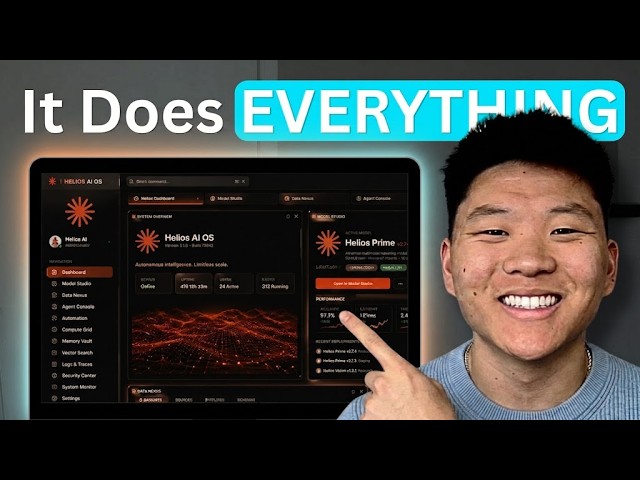
Build & Sell Claude Code Operating Systems (2+ Hour Course)
Keywords
Summary
156 words
Critical Evaluation
Value of the Information & Strength of the Argument
The video offers substantial practical value, providing a step-by-step guide that viewers can follow to build their own AIOS. The frameworks (Three Ms, Four Cs) are well-structured and provide a clear mental model. The argumentation is based on the creator’s personal success and experience, which adds credibility but also introduces potential bias. The emphasis on tool-agnostic design is a strong point, addressing the rapid evolution of AI tools. The tutorial includes real demonstrations and practical tips, such as mapping tools and creating skills, which enhance its value. However, the lack of independent validation and the reliance on anecdotal evidence for productivity gains weaken the overall argumentation.
Scientific Rigor, Source Quality, Title Accuracy
The video is a tutorial based on the creator’s personal experience, not a scientific study. It does not cite external sources or peer-reviewed research. The description provides links to the creator’s community, tools, and social media, but these are not academic references. The title accurately reflects the content, which is a comprehensive course on building AI operating systems. The creator’s approach is practical and transparent, but the lack of formal citations limits the scientific rigor. The content is internally consistent, and the creator acknowledges the evolving nature of the tools, which is a positive aspect.
216 words
Title / Content Match
The title accurately reflects the content: a comprehensive course on building and selling AI operating systems using Claude Code.
Quality & Reliability
7/10
The video is a practical tutorial based on the creator's personal experience. It provides a structured framework (Three Ms, Four Cs) and demonstrates real implementations. However, it lacks formal citations, peer-reviewed sources, and independent verification. The claims about productivity gains are anecdotal.
Chapters
- Intro
- The Three Ms of AI
- The Four Cs of an AIOS
- Mapping Your Tools
- Cloning the Repo & VS Code Setup
- The Onboarding Skill
- Connecting ClickUp
- Audit & Level Up Skills
- Google Workspace CLI
- Capabilities & Building Skills
- Live Skill Build
- Cadence & Cloud Routines
- Loop & Reminders
- Karpathy's LLM Wiki
- Dashboards with Artifacts
- Daily Loop & Success Criteria
- Final Thoughts
Cited Sources
- AI Automation Society (Free Community) — Free community and resources mentioned in the video.
- AI Automation Society Plus (Full Courses) — Paid courses and support mentioned in the video.
- Glaido (Voice to Text) — Tool mentioned in the video for voice-to-text.
- Hostinger VPS — VPS hosting for Claude Code mentioned in the video.
- Nate Herk's LinkedIn — Creator's LinkedIn profile.
- Podcast Application — Application for creator's podcast.
- Uppit AI — Creator's business website.
Concurring Sources
- Claude Code Documentation — Official documentation for Claude Code, the primary tool used in the video.
- Model Context Protocol (MCP) — Official MCP documentation, relevant to the connections aspect of the AIOS.
Contribution & Novelties
The video provides a comprehensive, practical framework for building an AI operating system, which is a relatively new concept. The Three Ms and Four Cs frameworks offer a structured approach that is not commonly found in other tutorials. The emphasis on tool-agnostic design and future-proofing is a valuable contribution. The tutorial includes real-world examples and a free template, making it accessible to beginners.
Pour aller plus loin :
- Model Context Protocol (MCP) — Official documentation for MCP, a key technology for connecting AI to external tools.
- Claude Code Documentation — Official documentation for Claude Code, the primary tool used in the video.
- Agentic AI — Wikipedia article on agentic AI, which relates to the concept of autonomous AI systems.
- Second Brain — Wikipedia article on the second brain concept, which is related to the AIOS idea.
136 words
Radar Profile
The radar profile shows high scores in quantity of information and technical level, indicating a content-rich tutorial. The quality of information and global reliability are slightly lower, reflecting the lack of formal citations and reliance on personal experience.
💬 Très positif. Sur les 30 commentaires analysés, les utilisateurs expriment une gratitude et un enthousiasme marqués, saluant la clarté du contenu et son applicabilité immédiate, avec plusieurs témoignages de mise en œuvre réussie.