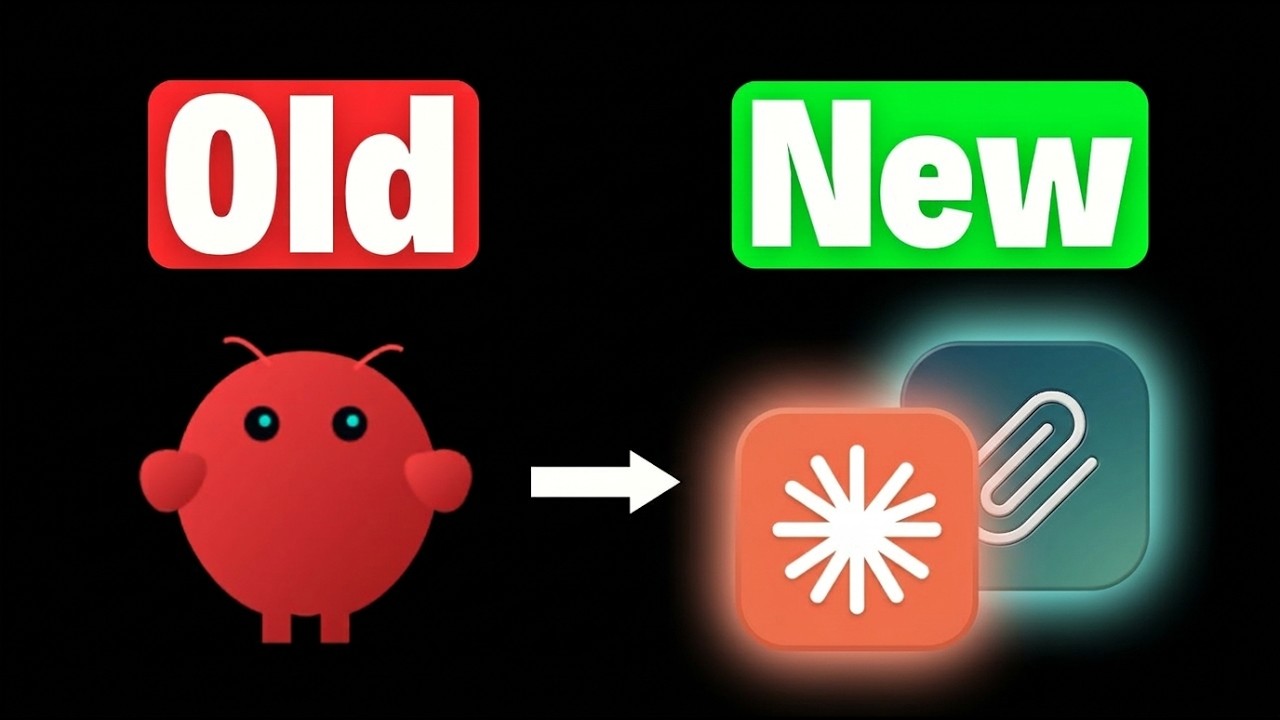
Claude Code + Paperclip Just Destroyed OpenClaw
Keywords
Summary
123 words
Critical Evaluation
Value of the Information & Strength of the Argument
The video provides a clear, step-by-step demonstration of Paperclip’s core functionalities, which is valuable for users interested in AI agent orchestration. The argumentation is based on the creator’s personal experience and the tool’s growing popularity on GitHub, but it lacks objective benchmarks or comparisons with other tools. The value lies in the practical walkthrough, but the argumentation is somewhat promotional and does not address potential drawbacks such as token consumption or reliability issues.
Scientific Rigor, Source Quality, Title Accuracy
The video references the Paperclip GitHub repository and website, and mentions the skills.sh marketplace, but does not provide in-depth source analysis. The title is somewhat clickbait, but the content does align with the topic. The creator’s expertise is evident, but the lack of independent verification and the promotional tone reduce the scientific rigor.
141 words
Title / Content Match
The title is somewhat sensationalist ('Destroyed OpenClaw') but the content does focus on Paperclip as a potential alternative to OpenClaw, so it is broadly aligned.
Quality & Reliability
6/10
The video is a hands-on tutorial demonstrating the setup and use of Paperclip, an open-source AI orchestration tool. It provides practical steps and visual walkthroughs, but lacks in-depth technical detail or independent verification of claims. The creator's expertise is evident in the demo, but the content is promotional in nature and relies on anecdotal evidence.
Chapters
- My AI Company Dashboard
- What Is Paperclip?
- Free Resource Guide
- Why Paperclip Blew Up
- How to Install & Get Started
- Building a Company From Scratch
- Agent Configuration & Heartbeats
- Setting Up Projects & Hiring QA
- Adding Skills
- Routines
- Importing Company Templates
- Secrets & API Keys With Claude Code
- Final Thoughts
Cited Sources
- Paperclip Official Website — The tool being demonstrated, with installation instructions and documentation.
- Glaido (Voice to Text) — A tool recommended by the creator, possibly for transcription or voice commands.
- Hostinger VPS — Mentioned as a hosting option for running Paperclip on a VPS for remote access.
- AI Automation Society (Free Community) — The creator's free community where a resource guide is offered.
- AI Automation Society Plus (Paid Courses) — The creator's paid courses and support community.
Concurring Sources
- Paperclip GitHub Repository — The official repository, which the video claims has over 36,000 stars, indicating community adoption.
Dissenting Sources
- Commentary on token consumption — Several comments point out that Paperclip consumes tokens rapidly, which is a potential drawback not addressed in the video.
External References
Contribution & Novelties
The video contributes a practical, hands-on tutorial for a newly emerging open-source tool (Paperclip) that aims to simplify AI agent orchestration. It highlights the tool’s unique features like heartbeats, skills, and routines, and demonstrates how to set up a company from scratch. This is valuable for early adopters.
Pour aller plus loin :
- AI agent — Provides foundational concepts of AI agents.
- Multi-agent system — Relevant to the orchestration of multiple agents.
- Claude Code — The underlying AI coding tool used in the demo.
- OpenClaw — A competing open-source AI agent framework mentioned in the video.
96 words
Radar Profile
The radar profile shows a balanced but moderate performance across all dimensions. The video excels in practical demonstration (quantité d'information) but is weaker in scientific rigor and source quality, reflecting its tutorial nature and promotional tone.
💬 Positif avec réserves. Sur les 30 commentaires analysés, la majorité exprime un intérêt positif pour la démonstration, mais plusieurs soulignent des préoccupations concernant la consommation de tokens et l'utilité pratique réelle.