Research ANYTHING and Get a PDF Report (free n8n template)
Keywords
Summary
197 words
Critical Evaluation
Value of the Information & Strength of the Argument
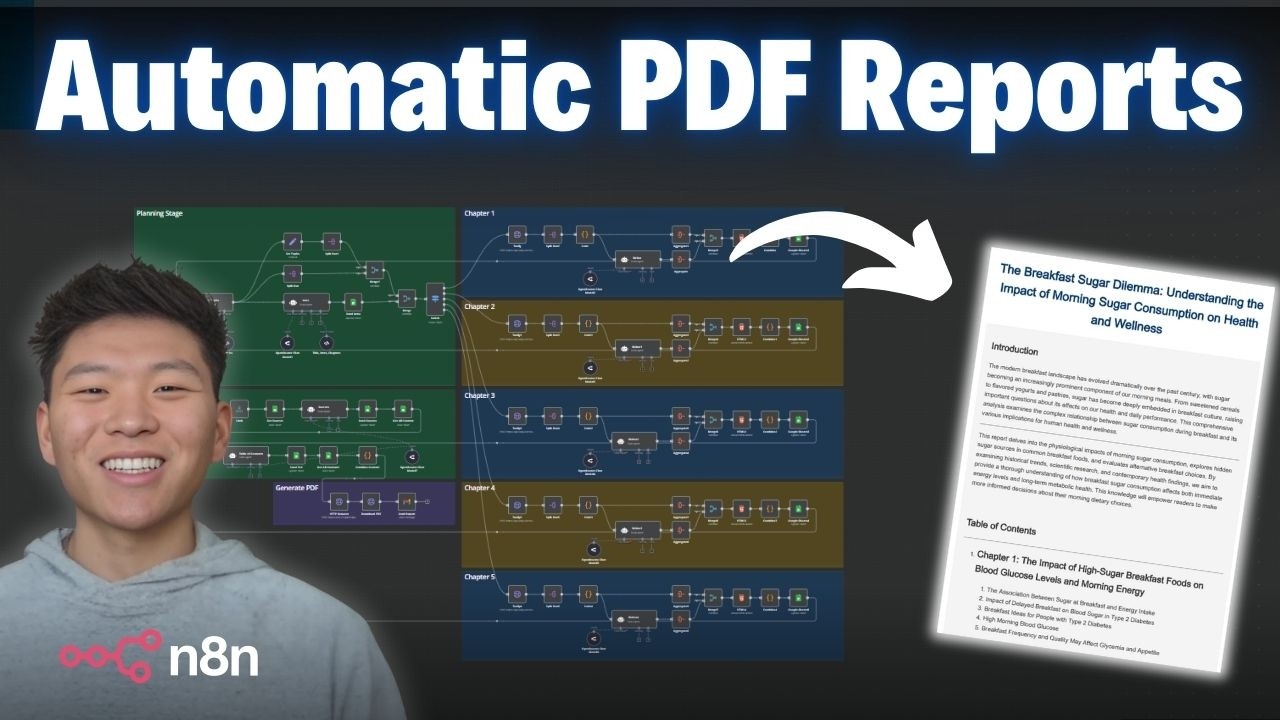
The video provides high practical value by offering a free, reusable n8n template and a detailed breakdown of its architecture. The argumentation is solid, supported by live demonstrations and specific cost calculations. The creator explains design choices and trade-offs, such as using Google Sheets for data persistence and the limitations of sequential processing. The comparison with OpenAI Deep Research is relevant and highlights the workflow’s advantages in cost and speed, though it lacks a rigorous benchmark.
Scientific Rigor, Source Quality, Title Accuracy
The video demonstrates a high level of technical rigor, with clear explanations of each node and API integration. Sources are primarily the creator’s own workflow and the tools used (Tavily, OpenRouter, HTML to PDF API). The title accurately reflects the content. The description includes links to the creator’s community and affiliate links, but no external scientific sources are cited. The video does not claim to be a scientific study, but rather a practical tutorial, so the lack of peer-reviewed sources is acceptable.
173 words
Title / Content Match
The title accurately describes the content: a tutorial on building an n8n workflow that generates PDF research reports.
Quality & Reliability
7/10
The video provides a detailed, transparent walkthrough of an n8n workflow, including system prompts, API usage, and cost breakdowns. Claims are supported by live demonstrations and specific numbers, though some external claims (e.g., cost comparisons) are not independently verified.
Chapters
- Quick Demo
- Deep Research PDF Report
- Limitations of OpenAI Deep Research
- Access Free Template
- High Level Workflow Breakdown
- How Much Does this Cost?
- Workflow Analysis: The Planning Stage
- Workflow Analysis: Research & Writing
- Limitations of This Workflow
- Workflow Analysis: Finalize Content Stage
- Generate and Send PDF Report
- Cost of This Run - 50 cents
Cited Sources
- n8n partner link — Affiliate link to n8n, the automation platform used in the workflow.
- Nate Herk LinkedIn — Creator's professional profile.
- Skool community (paid) — Paid community for deeper AI learning.
- Skool community (free) — Free community where the workflow template is shared.
- Watch next video — Link to a related video by the same creator.
Concurring Sources
- n8n documentation — Official documentation for n8n, the platform used in the workflow.
Contribution & Novelties
The video offers a practical, cost-effective alternative to proprietary deep research tools, with a fully transparent and customizable n8n workflow. It demonstrates how to orchestrate multiple AI agents and APIs to produce structured, source-linked PDF reports. The approach is innovative in its use of Google Sheets as a data store to handle large content volumes and its modular design.
Pour aller plus loin :
- n8n documentation — Official documentation for n8n, the automation platform used.
- Tavily API — The search API used for research; provides AI-optimized search results.
- OpenRouter — The model aggregation service used to access Claude 3.5 Sonnet and other models.
- HTML to PDF API (APITemplate.io) — The service used to generate PDFs from HTML.
- Claude 3.5 Sonnet — The AI model used for writing and planning agents.
130 words
Radar Profile
The radar profile shows high scores in information quantity and technical level, reflecting the detailed tutorial nature. Quality and reliability are slightly lower due to the lack of external verification and the promotional aspects. The overall balance indicates a practical, hands-on resource rather than a rigorous scientific analysis.
💬 Très positif. Sur les 30 commentaires analysés, la grande majorité exprime une admiration et une gratitude pour le partage gratuit du workflow, certains le qualifiant de 'game changer' et de 'meilleur créateur n8n'.