Aaron Mueller: Time- and Context-aware Interpretability (2025-11-05)
Keywords
Summary
195 words
Critical Evaluation
Value of the Information & Strength of the Argument
The talk provides substantial value by addressing a critical gap in interpretability research: the assumption of static mechanisms. The argumentation is solid, grounded in experimental evidence and comparisons against baselines. The speaker clearly explains the motivation, methodology, and results, making a compelling case for time-aware interpretability. The use of faithfulness metrics and validation against human-generated schemas strengthens the claims. However, the talk is a summary of ongoing research, and some details are glossed over, but the overall argument is coherent and well-supported.
Scientific Rigor, Source Quality, Title Accuracy
The talk demonstrates scientific rigor by referencing foundational work (e.g., Elman 1998) and presenting original research with methodological details. The quality of sources is high, as the speaker is a recognized expert and the work has been published in top venues (ACL, TMLR). The title accurately reflects the content, focusing on time- and context-aware interpretability. The talk does not include external sources beyond the speaker’s own work, but the internal consistency and experimental validation are strong. The adéquation titre/contenu is excellent, with no significant discrepancies.
182 words
Title / Content Match
The title accurately reflects the content, focusing on time- and context-aware interpretability methods.
Quality & Reliability
8/10
The talk presents original research by a recognized expert, with methodological details and validation against human baselines. Claims are supported by experiments, but the presentation is a summary without full peer-reviewed context.
Key Moments
Markers derived by PSI from the transcript: the creator did not define chapters.
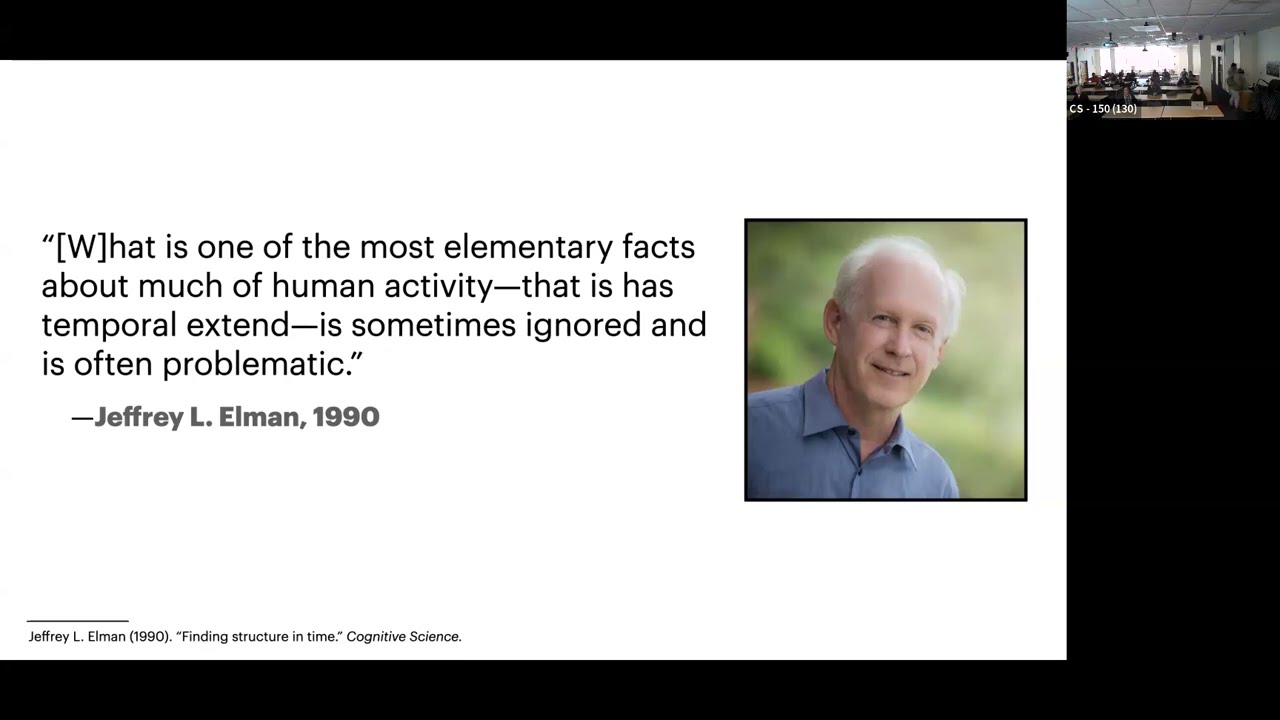
- Introduction to the temporal nature of language and Elman's work.
- Motivation for time-aware interpretability and the main claim.
- Explanation of circuit discovery and causal mediation analysis.
- Challenges of position-aware circuits and the use of semantic spans.
- Method for generating schemas using language models and binary masks.
- Definition of cross-positional edges and experimental setup.
- Results showing improved faithfulness with position-aware circuits.
- Introduction to Temporal Sparse Autoencoders and their motivation.
- Case study on garden-path sentences and incremental processing.
- Conclusion and future directions for time-aware interpretability.
Cited Sources
- Elman (1998) - Finding Structure in Time — Cited as foundational work on temporal structure in language.
- ACL paper on position-aware circuits — Mentioned as presented at ACL, but no specific URL provided.
Concurring Sources
- Elman (1998) - Finding Structure in Time — Supports the temporal nature of language.
Contribution & Novelties
The talk contributes original methods for incorporating temporal and positional dynamics into interpretability, specifically position-aware circuit discovery and Temporal Sparse Autoencoders. These methods address limitations of static interpretability approaches and provide more faithful and concise explanations. The case study on garden-path sentences demonstrates practical applications.
Pour aller plus loin :
- Causal mediation analysis — Relevant to the circuit discovery methodology.
- Sparse autoencoder — Background for Temporal Sparse Autoencoders.
- Garden-path sentence — Context for the case study.
76 words
Radar Profile
The radar profile shows high scores across all dimensions, indicating a well-rounded and technically rigorous presentation. The talk excels in information quantity and quality, with a strong technical level and high reliability, reflecting the speaker's expertise and the experimental validation.