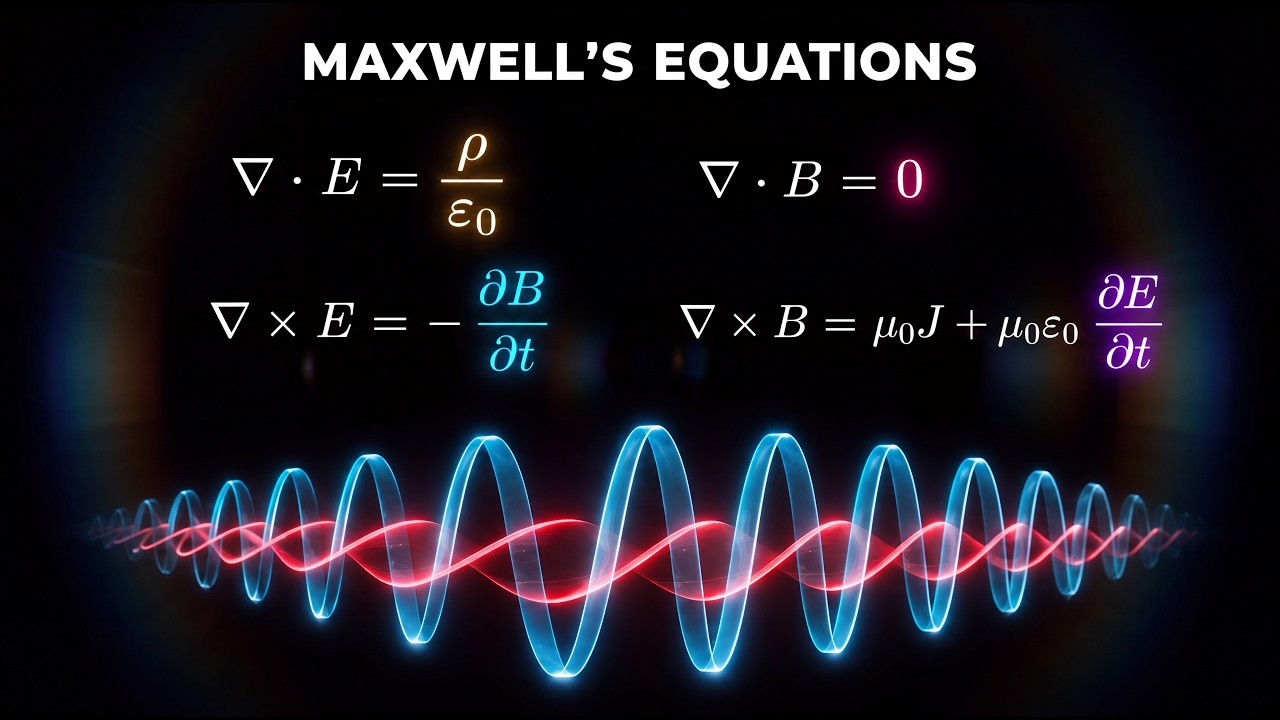
Nobody Explained Maxwell's Equations Like THIS!
Keywords
Summary
180 words
Critical Evaluation
Value of the Information & Strength of the Argument
The video’s primary value lies in its exceptional ability to convey the conceptual depth and historical significance of Maxwell’s equations without relying on heavy mathematics. It successfully argues that these equations are not just abstract symbols but a coherent description of a unified electromagnetic phenomenon. The argumentation is solid, building logically from experimental discoveries to Maxwell’s theoretical insights, and culminating in the profound implication that light is an electromagnetic wave. The narrative is compelling and well-structured, making a strong case for the elegance and power of the theory.
Scientific Rigor, Source Quality, Title Accuracy
The video demonstrates strong scientific rigor by grounding its narrative in well-documented historical events and referencing primary sources such as Maxwell’s 1865 paper and Faraday’s ‘Experimental Researches’. The inclusion of standard textbooks like Griffiths and Feynman Lectures adds credibility. The title is accurate and engaging, promising a unique explanation that the video delivers. The creator also invites corrections, showing a commitment to accuracy. The description includes a list of references, which enhances the video’s reliability.
178 words
Title / Content Match
The title is engaging and accurately reflects the video's unique, narrative-driven approach to explaining Maxwell's equations.
Quality & Reliability
8/10
The video provides a historically accurate and conceptually sound explanation of Maxwell's equations, with references to primary sources and standard textbooks. Minor simplifications are appropriate for the intended audience, and the creator invites corrections.
Chapters
Cited Sources
- Animated Physics E-book — Linked in the video description as a supplementary resource.
- Maxwell, J. C. (1865). A Dynamical Theory of the Electromagnetic Field — Referenced in the description as a primary source for Maxwell's work.
- Faraday, M. (1839-1855). Experimental Researches in Electricity — Referenced in the description as a primary source for Faraday's experiments.
- Ørsted, H. C. (1820). Experiments on the Effect of a Current of Electricity on the Magnetic Needle — Referenced in the description as a primary source for Ørsted's discovery.
- Hertz, H. (1893). Electric Waves — Referenced in the description as a primary source for Hertz's experiments.
- Michelson, A. A., and Morley, E. W. (1887). On the Relative Motion of the Earth and the Luminiferous Ether — Referenced in the description as the source for the Michelson-Morley experiment.
- Feynman, R. P. The Feynman Lectures on Physics, Vol. II, Ch. 1 — Referenced in the description as the source of the 'ten thousand years' remark.
- Forbes, N., and Mahon, B. (2014). Faraday, Maxwell, and the Electromagnetic Field — Referenced in the description as a historical source.
- Griffiths, D. J. Introduction to Electrodynamics — Referenced in the description as a standard textbook.
Concurring Sources
- Maxwell's equations - Wikipedia — Confirms the standard formulation and historical context of Maxwell's equations.
- Displacement current - Wikipedia — Explains the concept of displacement current and its role in Maxwell's equations.
- Electromagnetic radiation - Wikipedia — Supports the claim that light is an electromagnetic wave.
Contribution & Novelties
The video’s original contribution is its narrative-driven, visual approach to explaining Maxwell’s equations, making them accessible to a broad audience. It effectively conveys the historical detective story and the conceptual leap of the displacement current, which is often presented as a mere mathematical fix. The video also clearly connects Maxwell’s work to the development of special relativity, framing it as a direct consequence of the constant speed of light.
Pour aller plus loin :
- Maxwell’s equations - Wikipedia — Provides a comprehensive overview of the equations and their history.
- A Dynamical Theory of the Electromagnetic Field - Wikipedia — Details Maxwell’s original 1865 paper.
- Michelson–Morley experiment - Wikipedia — Explains the famous experiment that failed to detect the ether.
- Special relativity - Wikipedia — Explores the theory that emerged from the constant speed of light.
135 words
Radar Profile
The radar profile shows high scores in information quality and reliability, with a moderate level of technical depth. This indicates a well-researched and accurate video that is accessible to a general audience, balancing scientific rigor with engaging storytelling.
💬 Très positif. Sur les 30 commentaires analysés, les spectateurs expriment une admiration quasi unanime pour la clarté de l'explication, la qualité de l'animation et la narration captivante, certains allant jusqu'à dire que cela a changé leur compréhension de la physique.