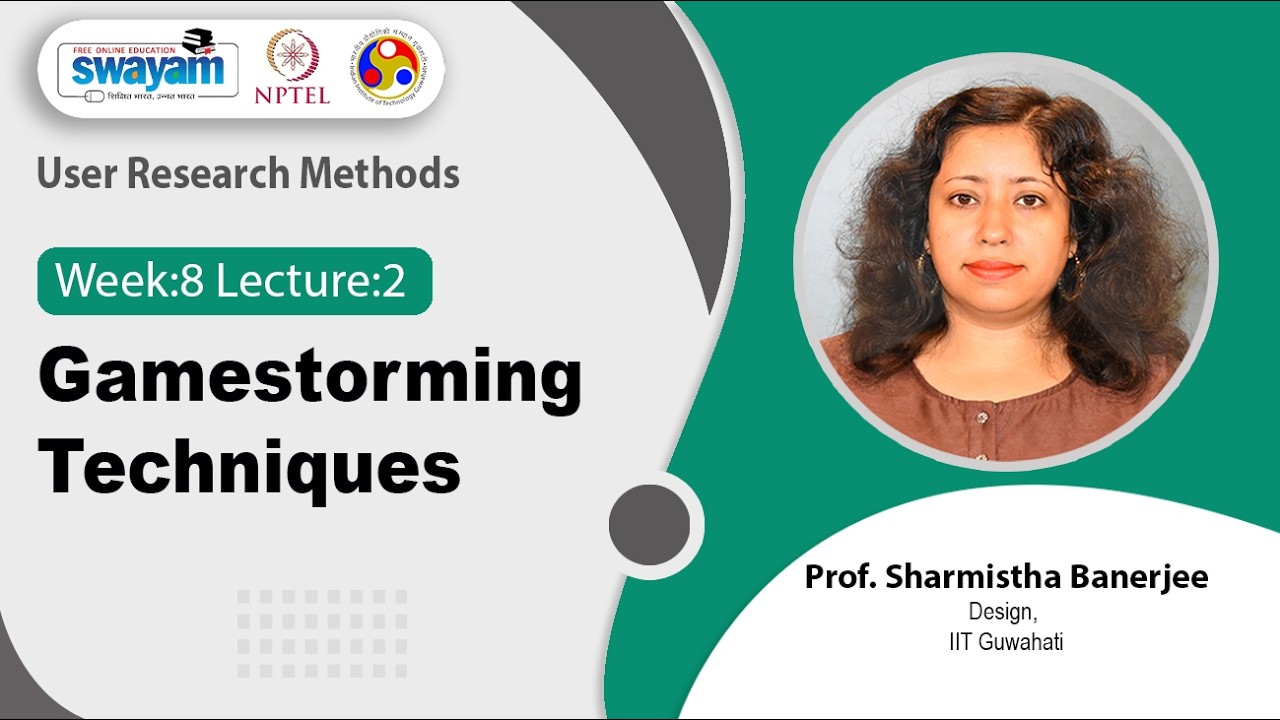
Lec 38: Gamestorming Techniques
Keywords
Summary
144 words
Critical Evaluation
Value of the Information & Strength of the Argument
The lecture provides a clear and structured overview of gamestorming techniques, with practical guidance on how to facilitate them. The value lies in its actionable advice, such as setting high idea quotas, using timers, and creating visual accumulation to maintain momentum. The argumentation is solid, as the instructor explains the psychological mechanisms behind each technique (e.g., time pressure silencing the inner critic, anonymity reducing status anxiety) and supports them with examples. The library case study effectively demonstrates how to combine techniques (e.g., assumption reversal leading to storytelling) to generate and refine ideas. However, the lecture could benefit from more empirical evidence or case studies to strengthen the claims about effectiveness.
Scientific Rigor, Source Quality, Title Accuracy
The lecture is scientifically rigorous in its pedagogical approach, but it lacks explicit citations to external sources during the talk. The instructor mentions ‘The Innovator’s Dilemma’ at the end, but no other references are provided. The course is part of NPTEL, a reputable platform, and the instructor is a professor at IIT Guwahati, which adds credibility. The title accurately reflects the content, which is a focused presentation of gamestorming techniques. The description provides links to the course and playlist, which are useful for context but do not directly support the specific claims made in the lecture.
221 words
Title / Content Match
The title accurately reflects the content, which focuses on presenting and explaining various gamestorming techniques.
Quality & Reliability
7/10
Lecture by an academic from IIT Guwahati, structured and coherent, but lacks explicit citations to external sources during the talk. The methods presented are well-established in design thinking literature, and the examples are illustrative. The video is part of a formal course, which adds credibility, but the absence of in-video references limits the verifiability of specific claims.
Key Moments
Markers derived by PSI from the transcript: the creator did not define chapters.
- Introduction to gamestorming techniques and learning objectives.
- Overview of core techniques: rapid fire, assumption reversal, storytelling, dot voting, ranking.
- Detailed explanation of rapid fire technique: high-volume ideation with time pressure.
- Explanation of assumption reversal with examples (banking app, shopping site, social app).
- Library example: applying assumption reversal to hide books and then storytelling to design the experience.
- Introduction to dot voting and ranking for convergence.
- Playbook games: 685, prune the future, anti-problem, friend or foe.
- Detailed example of prune the future with a product tree for the library.
- Explanation of anti-problem and friend or foe techniques.
- Key takeaways and references for further reading.
Cited Sources
- Course: User Research Methods — Official course page for the lecture series.
- Playlist: User Research Methods — YouTube playlist containing all lectures of the course.
Concurring Sources
- Gamestorming: A Playbook for Innovators, Rulebreakers, and Changemakers — The book that defines gamestorming techniques, consistent with the methods presented in the lecture.
Contribution & Novelties
The lecture provides a structured and practical overview of gamestorming techniques, with a strong emphasis on their application in design thinking. It offers a clear framework for matching techniques to specific design challenges and demonstrates how to combine them (e.g., assumption reversal leading to storytelling) to generate innovative solutions. The library case study is a valuable illustration of the process. The lecture also highlights the psychological principles behind the techniques, such as silencing the inner critic and reducing status anxiety, which adds depth to the practical advice.
Pour aller plus loin :
- Gamestorming: A Playbook for Innovators, Rulebreakers, and Changemakers — The foundational book by Dave Gray, Sunni Brown, and James Macanufo that popularized these techniques.
- Design Thinking — A broader framework that encompasses gamestorming as an ideation method.
- The Innovator’s Dilemma — Referenced in the lecture, this book by Clayton Christensen explains why successful companies fail and is relevant to the ‘friend or foe’ technique.
156 words
Radar Profile
The radar profile shows a balanced performance across all dimensions, with slightly higher scores in information quantity and quality, and slightly lower in technical level. This reflects a lecture that is informative and well-structured but not highly technical, suitable for a general audience interested in design methods.