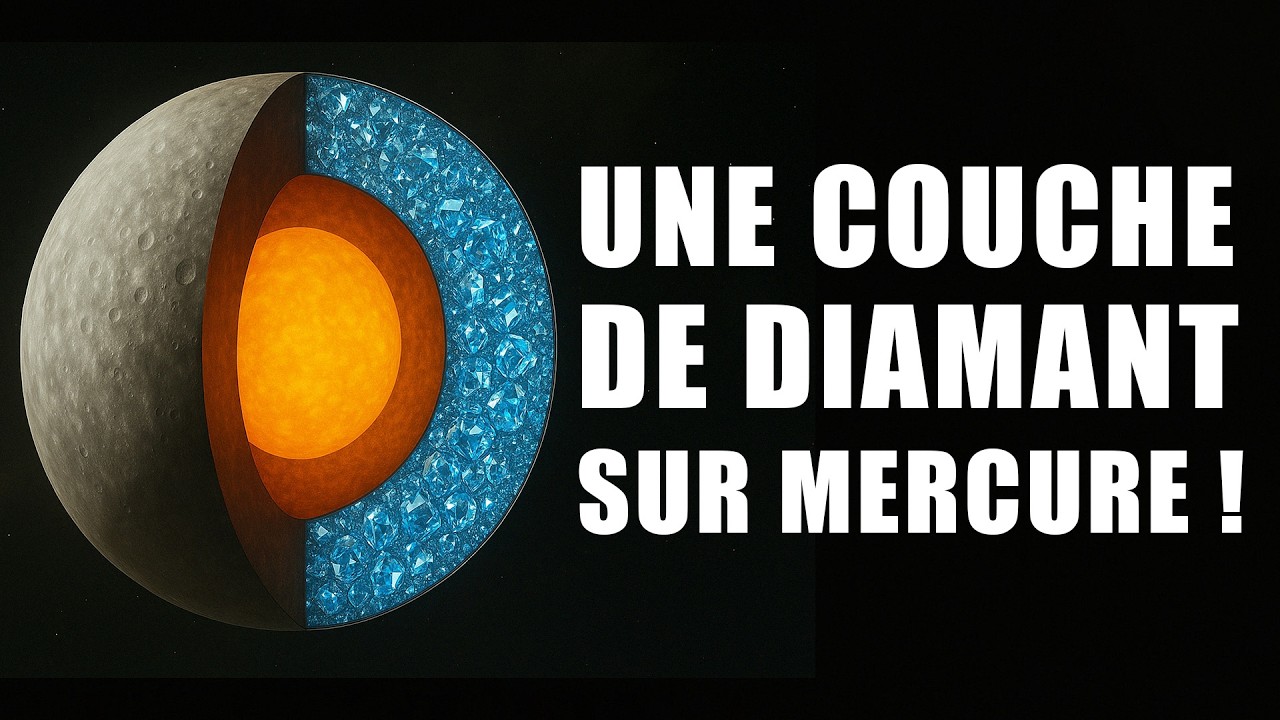
Une couche de 18KM de DIAMANT dans la PLANÈTE MERCURE ? DNDE 392
Keywords
Summary
171 words
Critical Evaluation
Value of the Information & Strength of the Argument
The video provides valuable information by synthesizing recent scientific publications and space industry developments. The argumentation is solid: the host explains the scientific reasoning behind the diamond layer hypothesis, clearly distinguishing between established facts and speculative models. He also presents multiple perspectives on the feasibility of private space stations, acknowledging uncertainties and potential delays. The coverage of the ATMOS mission is balanced, noting both the innovative technology and the risks involved. The discussion on K2-18b is nuanced, highlighting the scientific community’s skepticism and the inherent uncertainties in exoplanet research.
Scientific Rigor, Source Quality, Title Accuracy
The video demonstrates scientific rigor by citing a peer-reviewed paper in Nature for the Mercury diamond study and referencing NASA’s official updates for Orbital Reef. The host also mentions the source for Vast’s progress and ATMOS’s mission. The title accurately reflects the main topic, though the video covers additional news. The content is well-structured and the host clearly distinguishes between confirmed findings and hypotheses. The inclusion of a sponsor segment is clearly marked and does not affect the scientific content.
184 words
Title / Content Match
The title accurately reflects the main topic of the video, which is the possibility of an 18 km diamond layer on Mercury, though the video also covers other space news.
Quality & Reliability
8/10
The video presents a recent scientific model on Mercury's diamond layer, citing a Nature paper, and covers space industry news with references to NASA and company updates. The host clearly distinguishes hypotheses from confirmed facts, and the sources are credible. Minor caveats: some claims about future missions are speculative, and the video includes a sponsor segment.
Chapters
Cited Sources
- A diamond layer in Mercury's deep interior? (Nature paper) — Source for the scientific model on Mercury's diamond layer.
- NASA sees progress on Blue Origin's Orbital Reef design/development — Source for updates on Orbital Reef space station.
- Vast Space update video — Source for Vast's Haven-1 station progress.
- ATMOS Phoenix capsule tweet — Source for the ATMOS Phoenix mission details.
Concurring Sources
- NASA's Commercial Space program — NASA's initiative supporting private space stations, consistent with the video's coverage.
- BepiColombo mission page — ESA's mission to Mercury, which will provide data to test the diamond layer hypothesis.
Dissenting Sources
- Critique of K2-18b DMS detection — Some scientists are skeptical about the detection of dimethyl sulfide in K2-18b's atmosphere, as mentioned in the video.
External References
Contribution & Novelties
The video provides a clear and accessible explanation of a recent scientific model about Mercury’s diamond layer, which is a novel and intriguing hypothesis. It also offers an update on the rapidly evolving private space station landscape, highlighting Vast’s aggressive timeline. The coverage of the ATMOS mission adds value by showcasing an innovative European reentry technology. The discussion on K2-18b provides a balanced perspective on the ongoing scientific debate.
Pour aller plus loin :
- BepiColombo mission — ESA’s mission to Mercury, which will test the diamond layer hypothesis.
- Orbital Reef — Blue Origin’s commercial space station project.
- Vast Space — Company developing Haven-1 and future space stations.
- Atmos Space Cargo — Developer of the Phoenix capsule and inflatable heat shield technology.
- K2-18b — Exoplanet with potential biosignature detection, discussed in the video.
132 words
Radar Profile
The radar profile shows high scores in information quantity, quality, and reliability, with a slightly lower technical level. This indicates that the video is informative and trustworthy, but may not delve deeply into technical details, making it accessible to a broad audience.
💬 Très positif. Sur les 30 commentaires analysés, les spectateurs expriment une grande appréciation pour la qualité du contenu, la vulgarisation et la passion de l'animateur, avec des remerciements et des encouragements.