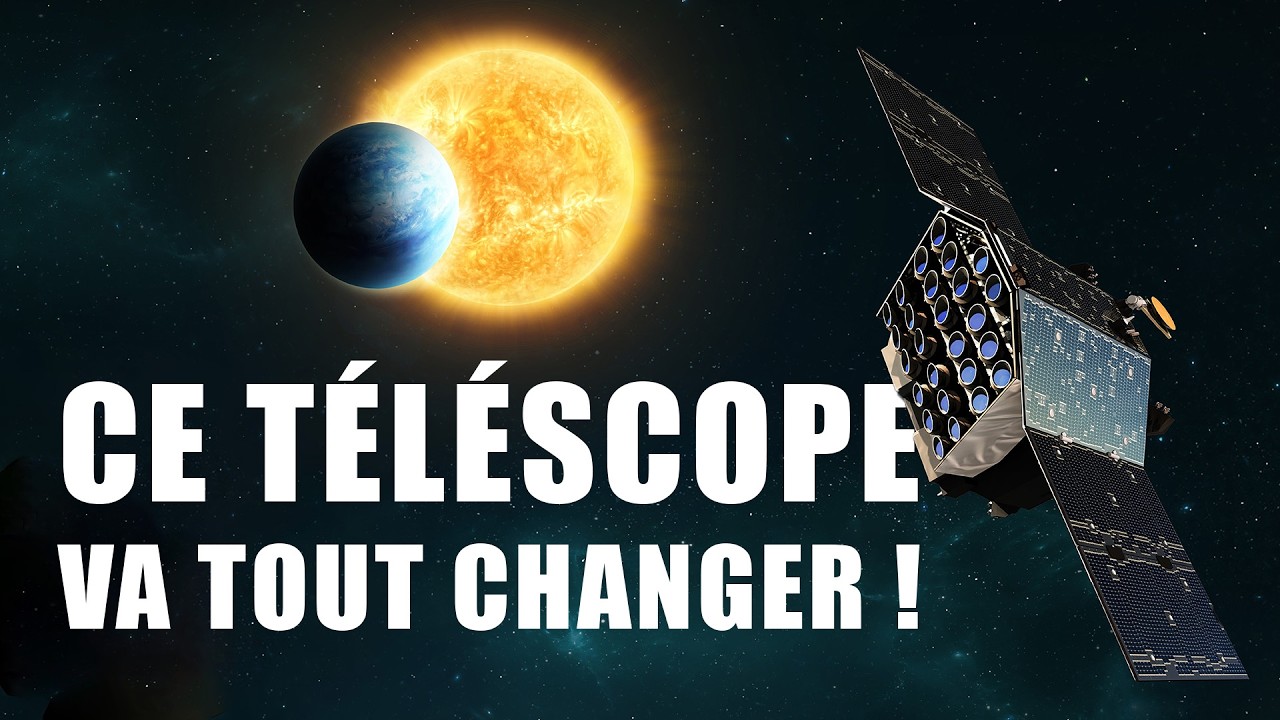
Ce nouveau TÉLÉSCOPE va permettre de découvrir la JUMELLE de la TERRE !
Keywords
Summary
225 words
Critical Evaluation
Value of the Information & Strength of the Argument
The video provides substantial value by explaining the scientific rationale behind the PLATO mission in a clear and engaging manner. It effectively argues that PLATO’s unique design—multiple small telescopes and long-duration observations—will overcome the limitations of previous exoplanet surveys. The emphasis on asteroseismology as a tool for precise stellar characterization is well-justified, as it directly addresses the need for accurate planet parameters. The argumentation is solid, building logically from the challenges of exoplanet detection to the specific solutions PLATO offers, and finally to the broader implications for future research. The video also contextualizes PLATO within the larger landscape of space missions, showing how it complements upcoming observatories.
Scientific Rigor, Source Quality, Title Accuracy
The video demonstrates strong scientific rigor, referencing official ESA sources and scientific publications. The information is accurate and up-to-date, with no obvious errors or misleading claims. The title, while slightly sensational, is not misleading as the video does discuss the potential for discovering Earth-like planets. The content is well-researched, and the creator clearly has a good understanding of the subject. The use of sources from ESA and astrobiology.com adds credibility. The video does not include any advertising segments, and the title-content alignment is good, with only a minor exaggeration in the title’s phrasing.
215 words
Title / Content Match
The title is somewhat sensationalist ('discover the twin of Earth') but accurately reflects the video's focus on PLATO's potential to find Earth-like exoplanets. It is engaging and not misleading.
Quality & Reliability
8/10
The video presents accurate and up-to-date information about the PLATO mission, based on official ESA sources and scientific publications. The content is well-structured and technically sound, with clear explanations of complex concepts like asteroseismology and transit photometry. Minor simplifications are present but do not compromise accuracy.
Key Moments
Markers derived by PSI from the transcript: the creator did not define chapters.
- Introduction to the discovery of exoplanets and the bias of current surveys.
- Explanation of the transit method and its limitations.
- Overview of PLATO's design: 26 small telescopes and wide field of view.
- Discussion on the importance of long observation periods for detecting Earth-like planets.
- Introduction to asteroseismology and its role in characterizing stars.
- Expected precision of PLATO's measurements and comparison with Kepler.
- Future missions and how PLATO will complement them.
Cited Sources
- ESA - PLATO Mission — Official ESA page for the PLATO mission, providing mission overview and objectives.
- Asteroseismology - PLATO Mission — Article explaining the role of asteroseismology in the PLATO mission.
- The PLATO Mission - Astrobiology — Article discussing the scientific goals and potential of the PLATO mission.
Concurring Sources
- ESA - PLATO Mission — Official ESA page confirming the mission's objectives and design.
- Asteroseismology - PLATO Mission — Article supporting the role of asteroseismology in the mission.
External References
Contribution & Novelties
The video provides a comprehensive and accessible overview of the PLATO mission, highlighting its innovative approach to exoplanet discovery. It emphasizes the importance of asteroseismology in reducing uncertainties in planet characterization, which is a key advancement over previous missions. The video also connects PLATO’s findings to future missions, showing a clear roadmap for exoplanet research.
Pour aller plus loin :
- PLATO Mission (ESA) — Official mission page with detailed technical information.
- Asteroseismology — Overview of the technique used to study stellar oscillations.
- Transit method — Explanation of the primary detection method used by PLATO.
- Habitable zone — Concept of the region around a star where conditions might allow liquid water.
110 words
Radar Profile
The radar profile shows high scores across all dimensions, indicating a well-balanced and reliable video. The strongest points are the quantity and quality of information, with slightly lower but still good scores on technical depth and overall reliability, reflecting the accessible yet accurate presentation.
💬 Très positif. Sur les 30 commentaires analysés, les spectateurs expriment une forte appréciation pour la qualité du contenu et la clarté des explications, avec des remerciements et des encouragements à la chaîne. Un commentaire notable d'un ancien technicien du Centre Spatial de Liège ajoute une touche personnelle et émouvante, renforçant l'enthousiasme général.