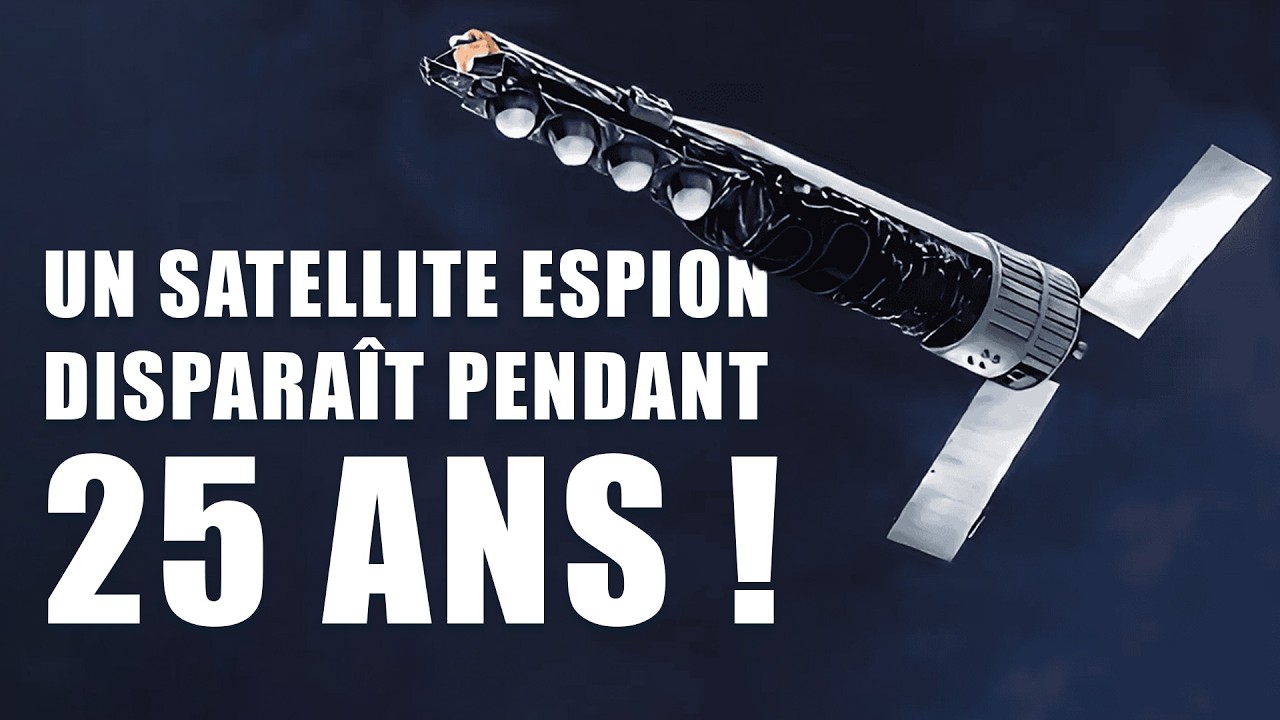
Un SATELLITE ESPION PERDU depuis 25 ans RÉAPPARAÎT ! Documentaire espace 2024
Keywords
Summary
184 words
Critical Evaluation
Value of the Information & Strength of the Argument
The video provides a compelling and informative narrative, combining historical context with recent scientific data. The argumentation is solid, clearly explaining the technical aspects of satellite tracking and the reasons for S73-7’s elusiveness. The presenter effectively uses analogies and visual aids to make complex concepts accessible. The value lies in its ability to connect a specific event to broader issues of space debris and surveillance, offering a balanced perspective that acknowledges uncertainties.
Scientific Rigor, Source Quality, Title Accuracy
The video demonstrates good scientific rigor by citing specific sources in the description, including Space.com, the National Museum of the US Air Force, and a tweet from Jonathan McDowell. These sources are reputable and directly relevant to the topic. The title accurately reflects the content, and the video does not overstate claims, clearly distinguishing between established facts and hypotheses. The presentation is well-researched and avoids sensationalism, maintaining a factual tone throughout.
158 words
Title / Content Match
The title accurately reflects the content: the video tells the story of a lost spy satellite that reappeared after 25 years, with a focus on the KH-9 Hexagon program and the recent detection of S73-7.
Quality & Reliability
8/10
The video provides a well-structured narrative based on declassified information and recent tracking data, with sources cited in the description. The presenter clearly distinguishes facts from hypotheses, and the technical details are accurate. Minor limitations include a lack of peer-reviewed sources and some simplifications for a general audience.
Key Moments
Markers derived by PSI from the transcript: the creator did not define chapters.
- Introduction to the story of S73-7 and the KH-9 Hexagon program.
- Explanation of the KH-9 satellite's size, cameras, and film return capsules.
- Details on the launch of S73-7 and its failed balloon deployment.
- Discussion of how S73-7 was tracked and then lost in the early 1980s.
- Rediscovery of S73-7 in April 2024 and its current orbit.
- Analysis of why S73-7 is hard to track and the dangers of ghost debris.
- Future tracking methods and conclusion.
Cited Sources
- Lost Satellite Found After 25 Years (Space.com) — Article reporting the rediscovery of S73-7 by US Space Force.
- Jonathan McDowell's tweet about S73-7 — Tweet providing orbital data and context for the rediscovery.
- HEXAGON KH-9 Reconnaissance Satellite (National Museum of the US Air Force) — Fact sheet detailing the KH-9 satellite program.
Concurring Sources
- Space.com article on lost satellite — Confirms the rediscovery and provides additional details.
- National Museum of the US Air Force fact sheet — Provides background on the KH-9 program.
External References
Contribution & Novelties
The video provides a fresh perspective on a niche space history event, connecting it to contemporary issues of space debris and tracking. It highlights the challenges of tracking non-metallic objects and the importance of international cooperation in space surveillance. The narrative is engaging and well-researched, offering insights into the KH-9 program that are not widely known.
Pour aller plus loin :
- Space debris — Overview of space debris and its risks.
- KH-9 Hexagon — Detailed article on the KH-9 reconnaissance satellite program.
- US Space Surveillance Network — Information on the network that tracks objects in orbit.
- Jonathan McDowell’s website — Independent space analyst’s data and resources.
106 words
Radar Profile
The radar profile shows high scores in information quantity and quality, indicating a well-researched and informative video. The technical level is moderately high, suitable for an interested general audience. The overall reliability is strong, supported by credible sources and clear presentation.
💬 Très positif. Sur les 30 commentaires analysés, les spectateurs expriment un enthousiasme marqué pour le contenu, saluant la qualité de la narration et l'intérêt du sujet, avec des demandes de vidéos similaires.