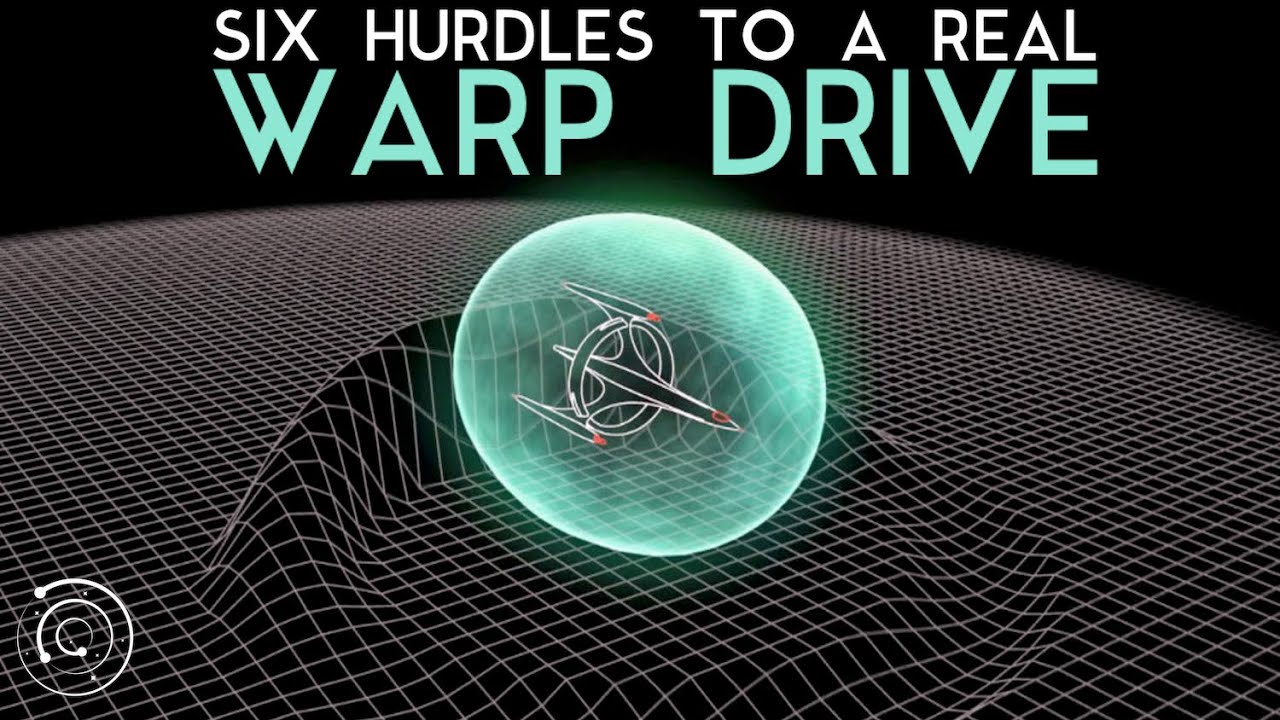
What's Stopping Us From Building a Warp Drive?
Keywords
Summary
122 words
Critical Evaluation
Value of the Information & Strength of the Argument
The video provides substantial value by synthesizing a complex body of theoretical physics literature into an accessible format. It goes beyond superficial explanations, detailing the specific physical mechanisms and mathematical constraints involved. The argumentation is rigorous: each obstacle is presented with its historical context, key papers, and current debates. For instance, the discussion of the weak energy condition includes the 2021 papers by Bobrick & Martire, Fell & Heisenberg, and Lentz, followed by the rebuttal from Santiago et al., demonstrating a balanced and critical approach. The presenter clearly distinguishes between established physics and speculative possibilities, and he avoids overhyping the topic, which is common in popular science media.
Scientific Rigor, Source Quality, Title Accuracy
The video demonstrates high scientific rigor by grounding every claim in specific peer-reviewed publications, which are listed in the description with arXiv links. The presenter, a professional astrophysicist, accurately represents the state of the field, including controversies and unresolved questions. The title accurately reflects the content, which is a critical examination of the feasibility of warp drives. The video does not overstate the possibilities and clearly separates theoretical possibilities from practical engineering challenges. The inclusion of an interview excerpt with Alcubierre adds authenticity. Overall, the sourcing is excellent and the presentation is trustworthy.
216 words
Title / Content Match
The title accurately reflects the content, which systematically examines the main physical and engineering obstacles to building a warp drive.
Quality & Reliability
9/10
The video is presented by a professional astrophysicist (David Kipping) and systematically reviews peer-reviewed literature on warp drives, citing specific papers and authors. The content is technically accurate and balanced, acknowledging controversies and uncertainties. The presentation is clear and well-structured, with appropriate caveats about speculative physics.
Chapters
Cited Sources
- Alcubierre 1994, Class. Quant. Grav. 11, L73 — Original paper introducing the warp drive metric.
- Everett 1996, Phys. Rev. D 53, 7365 — Proves that FTL travel implies closed timelike curves.
- Krasnikov 1998, Phys. Rev. D 57, 4760 — Identifies the horizon problem for warp drives.
- Pfenning & Ford 1998, Phys. Rev. D 57, 3489 — Estimates the enormous energy requirements of the original Alcubierre drive.
- Van Den Broeck 1999, Class. Quant. Grav. 16, 3973 — Shows that modifying the bubble shape can reduce energy requirements to a few solar masses.
- Bobrick & Martire 2021, Class. Quant. Grav. 38, 22 — Argues that warp drives may not require exotic matter and discusses subluminal possibilities.
- Fell & Heisenberg 2021, Class. Quant. Grav. 38, 16 — Proposes a warp drive solution that may avoid the weak energy condition violation.
- Lentz 2021, Class. Quant. Grav. 38, 14 — Presents a warp drive solution with positive energy density, but later disputed.
- Santiago et al. 2022, Phys. Rev. D 105, 064038 — Rebuts the 2021 claims, arguing that all warp drives violate the weak energy condition.
- McMonigal et al. 2012, Phys. Rev. D 85, 064024 — Analyzes the radiation hazard from particles swept up by the warp bubble.
- Finazzi et al. 2009, Phys. Rev. D 79, 124017 — Shows that Hawking radiation from the bubble's horizon leads to instability and Planck-scale temperatures.
- Coule 1998, Class. Quant. Grav. 15, 2523 — Argues that the matter distribution must move superluminally, creating a chicken-and-egg problem.
- Van Den Broeck 1999, arXiv — Further discusses the chicken-and-egg problem and possible workarounds.
- Hawking 1992, Phys. Rev. D 46, 603 — Introduces the chronology protection conjecture.
- Alcubierre & Lobo 2017, Wormholes, Warp Drives and Energy Conditions, Fundam. Theor. Phys. 189, 257 — Follow-up book by Alcubierre and Lobo discussing warp drives and energy conditions.
Concurring Sources
- Alcubierre 1994, Class. Quant. Grav. 11, L73 — Original paper introducing the warp drive metric.
- Pfenning & Ford 1998, Phys. Rev. D 57, 3489 — Confirms the huge energy requirements.
- Van Den Broeck 1999, Class. Quant. Grav. 16, 3973 — Shows energy reduction is possible.
- Krasnikov 1998, Phys. Rev. D 57, 4760 — Identifies the horizon problem.
- McMonigal et al. 2012, Phys. Rev. D 85, 064024 — Analyzes radiation hazards.
- Finazzi et al. 2009, Phys. Rev. D 79, 124017 — Shows instability due to Hawking radiation.
- Coule 1998, Class. Quant. Grav. 15, 2523 — Raises the chicken-and-egg problem.
- Everett 1996, Phys. Rev. D 53, 7365 — Proves causality violations.
- Hawking 1992, Phys. Rev. D 46, 603 — Proposes chronology protection.
Dissenting Sources
External References
Contribution & Novelties
The video provides a comprehensive and up-to-date synthesis of the scientific literature on warp drives, going beyond the original Alcubierre paper to include recent developments and controversies. It clearly distinguishes between fundamental physical obstacles and engineering challenges, offering a balanced perspective often missing in popular media. The presenter’s personal connection to the topic adds a unique perspective, and the video encourages viewers to think critically about the feasibility of FTL travel.
Pour aller plus loin :
- Alcubierre drive - Wikipedia — Provides a general overview and historical context.
- Weak energy condition - Wikipedia — Explains the energy conditions in general relativity.
- Closed timelike curve - Wikipedia — Discusses the concept of closed timelike curves and their implications for time travel.
- Chronology protection conjecture - Wikipedia — Details Hawking’s conjecture against time travel.
- Casimir effect - Wikipedia — Provides background on negative energy density from quantum vacuum effects.
147 words
Radar Profile
The radar profile shows high scores across all dimensions, with particularly strong quality of information and reliability. The video is technically dense but accessible, and the presenter's expertise ensures a high level of trustworthiness. The balance between depth and clarity is excellent.
💬 Très positif. Sur les 30 commentaires analysés, la grande majorité exprime enthousiasme et admiration pour la qualité de l'explication, certains partageant des réflexions personnelles sur les implications du voyage FTL.