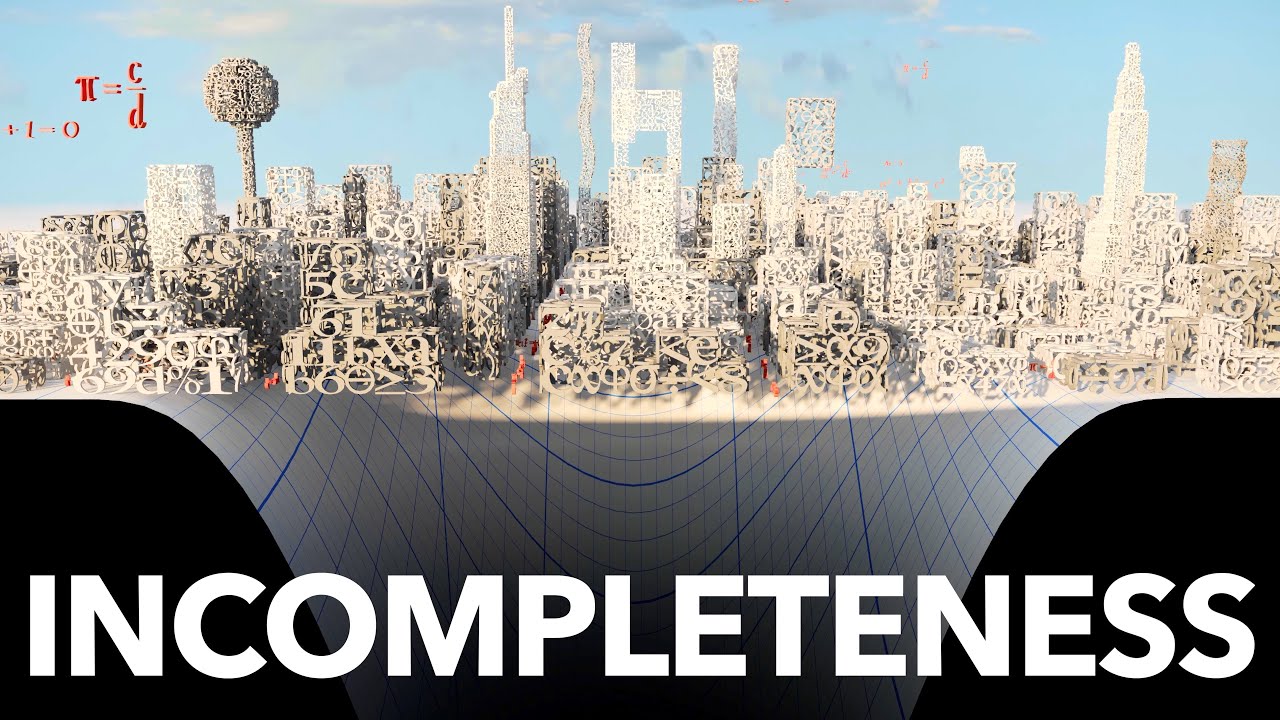
Math's Fundamental Flaw
Keywords
Summary
231 words
Critical Evaluation
Value of the Information & Strength of the Argument
The video provides a high-value explanation of deep mathematical concepts, making them accessible through clear analogies and visualizations. The argumentation is solid, building logically from Cantor’s diagonalization to Gödel’s incompleteness and Turing’s halting problem. The use of the Game of Life as a concrete example of undecidability is particularly effective. The video also highlights the historical context and the human drama behind these mathematical discoveries, which enhances engagement. The reasoning is sound and the connections between different concepts are well-established.
Scientific Rigor, Source Quality, Title Accuracy
The video demonstrates high scientific rigor. It cites primary sources, including Gödel’s original paper, Russell and Whitehead’s Principia Mathematica, and the 2015 paper on the undecidability of the spectral gap. The video also acknowledges consultations with experts in set theory and logic. The title accurately reflects the content, and the video does not overstate its claims. The presentation is balanced, acknowledging both the achievements and the limitations of mathematics.
164 words
Title / Content Match
The title accurately reflects the content: the video explores the fundamental limitation of mathematics—the existence of true but unprovable statements.
Quality & Reliability
9/10
High-quality exposition of deep mathematical results (Gödel's incompleteness theorems, Turing's halting problem) with consultation from experts and references to primary literature. The video is clear, accurate, and well-illustrated, though it simplifies some technical details for a broad audience.
Key Moments
Markers derived by PSI from the transcript: the creator did not define chapters.
- Introduction: The Twin Prime Conjecture and the idea that some true statements may be unprovable.
- Conway's Game of Life and the undecidability of its patterns.
- Cantor's diagonalization proof showing different sizes of infinity.
- The debate between intuitionists and formalists, and Hilbert's program.
- Russell's paradox and the barber analogy.
- Introduction to Gödel numbering and encoding mathematical statements.
- Explanation of Gödel's incompleteness theorem and the self-referential statement.
- Turing's halting problem and the invention of the Turing machine.
- Proof that the halting problem is undecidable.
- Turing completeness and examples of undecidable systems, including the spectral gap in quantum physics.
Cited Sources
- Churchill, A., Biderman, S., Herrick, A. (2019). Magic: The Gathering is Turing Complete. — Cited as an example of a Turing complete system with undecidable properties.
- Conway, J. (1970). The game of life. Scientific American, 223(4), 4. — Original reference for Conway's Game of Life.
- Cubitt, T. S., Perez-Garcia, D., & Wolf, M. M. (2015). Undecidability of the spectral gap. Nature, 528(7581), 207-211. — Reference for the undecidability of the spectral gap in quantum systems.
- Dunham, W. (2013). A Note on the Origin of the Twin Prime Conjecture. — Historical reference for the Twin Prime Conjecture.
- Gaifman, H. (2006). Naming and Diagonalization, from Cantor to Godel to Kleene. — Reference for the history of diagonalization and self-reference.
- Lénárt, I. (2010). Gauss, Bolyai, Lobachevsky–in General Education? — Reference for non-Euclidean geometries.
- Attribution of Poincare's quote, The Mathematical Intelligencer, vol. 13, no. 1, Winter 1991. — Source for Poincaré's quote about set theory.
- Irvine, A. D., & Deutsch, H. (1995). Russell's paradox. — Reference for Russell's paradox.
- Gödel, K. (1992). On formally undecidable propositions of Principia Mathematica and related systems. — Gödel's original paper on incompleteness.
- Russell, B., & Whitehead, A. (1973). Principia Mathematica. — Reference for Principia Mathematica.
- Gödel, K. (1986). Kurt Gödel: Collected Works: Volume I. — Collected works of Gödel.
Concurring Sources
- Gödel's incompleteness theorems — The video's explanation aligns with the standard mathematical understanding of Gödel's theorems.
- Halting problem — The video's description of the halting problem is consistent with the established result.
- Turing machine — The video's explanation of Turing machines matches the standard definition.
Dissenting Sources
- Potential criticism: The video may oversimplify the technical details of Gödel's proof. — Some mathematicians might argue that the video's explanation of Gödel numbering and the construction of the self-referential statement is a simplification that could lead to misunderstandings for a rigorous audience.
External References
Contribution & Novelties
The video provides a clear and engaging synthesis of the history and implications of Gödel’s incompleteness theorems and Turing’s halting problem. It connects these abstract mathematical concepts to concrete examples like the Game of Life and quantum physics, making them accessible to a broad audience. The video also highlights the human stories behind these discoveries, adding a narrative dimension that is often missing from textbooks.
Pour aller plus loin :
- Gödel’s incompleteness theorems — A comprehensive overview of the theorems and their implications.
- Halting problem — Detailed explanation of the halting problem and its significance in computer science.
- Turing machine — The theoretical model of computation introduced by Alan Turing.
- Conway’s Game of Life — The cellular automaton used as an example of undecidability.
- Spectral gap — The concept in quantum physics that is undecidable in general.
137 words
Radar Profile
The radar profile shows high scores across all dimensions, indicating a well-rounded and reliable video. The quantity and quality of information are excellent, the technical level is appropriate for the target audience, and the overall reliability is high.
💬 Très positif. Sur les 30 commentaires analysés, le public exprime une admiration massive pour la clarté de l'explication et l'impact émotionnel de la vidéo, avec de nombreux commentaires soulignant la beauté des concepts et la qualité de la vulgarisation.