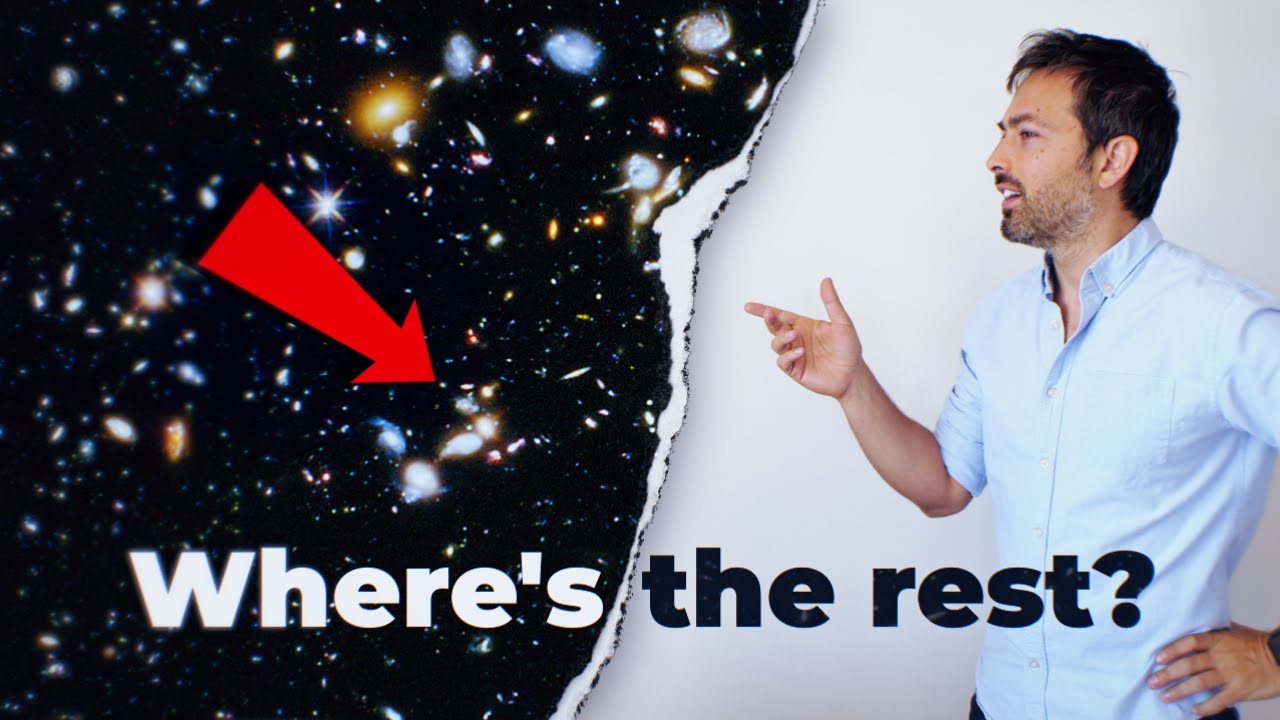
Half the universe was missing... until now
Keywords
Summary
175 words
Critical Evaluation
Value of the Information & Strength of the Argument
The video provides a clear and compelling narrative that builds from fundamental physics (Big Bang nucleosynthesis) to a recent observational result. The argumentation is logically structured: it establishes the prediction, explains the observational challenge, introduces the novel probe (FRBs), and presents the confirming evidence. The use of analogies (lightning whistlers) helps make the dispersion concept accessible. The video also highlights the importance of simulations and the iterative nature of scientific progress.
Scientific Rigor, Source Quality, Title Accuracy
The video is scientifically rigorous, citing a specific Nature paper (Macquart et al. 2020) and featuring expert commentary from Prof. Geraint Lewis. The explanation of the physics is accurate and appropriately nuanced. The title is catchy but accurate, as the video indeed explains how the missing baryons were found. The video does not overstate the findings, acknowledging that the FRB method provides a new measurement that aligns with expectations.
155 words
Title / Content Match
The title accurately reflects the content: the video explains the missing baryon problem and how recent observations of fast radio bursts have accounted for the missing matter.
Quality & Reliability
9/10
The video is based on a peer-reviewed Nature paper and features expert commentary from Prof. Geraint Lewis. The explanation is accurate and well-contextualized within established cosmological models.
Key Moments
Markers derived by PSI from the transcript: the creator did not define chapters.
- Introduction: the missing baryon problem
- Explanation of Big Bang nucleosynthesis and deuterium abundance
- The baryon census: only 20% of baryons found in stars and galaxies
- Introduction of the Lyman-alpha forest and quasars as backlights
- The warm-hot intergalactic medium (WHIM) and simulations
- Fast radio bursts as probes: dispersion measure and the Nature paper
- Results: the missing baryons found in the WHIM, and concluding remarks
Cited Sources
- Nature paper: A census of baryons in the Universe from localized fast radio bursts — The paper that reported the measurement of baryons using FRBs.
- Prof. Geraint Lewis's website — Special thanks to Prof. Geraint Lewis for his expertise.
Concurring Sources
- Macquart et al. (2020) Nature paper — The primary source confirming the baryon census.
External References
Contribution & Novelties
The video explains a recent breakthrough in cosmology: using fast radio bursts to detect the missing baryons in the warm-hot intergalactic medium. It provides a clear and accessible explanation of the dispersion measure technique and its application to a long-standing problem.
Pour aller plus loin :
- Fast radio burst — Overview of FRBs, their properties, and possible origins.
- Warm–hot intergalactic medium — Detailed description of the WHIM and its role in baryon distribution.
- Lyman-alpha forest — Explanation of the absorption features used to map neutral hydrogen.
86 words
Radar Profile
The radar profile shows high scores in information quantity, quality, and reliability, with a slightly lower technical level, indicating that the video is both informative and accessible. The balance between technical depth and clarity is well-suited for a general audience interested in astrophysics.
💬 Très positif. Sur les 30 commentaires analysés, les spectateurs expriment un enthousiasme marqué pour la clarté de l'explication et l'humour, avec de nombreuses références à la difficulté de comprendre le sujet mais aussi à la satisfaction de la résolution du mystère.