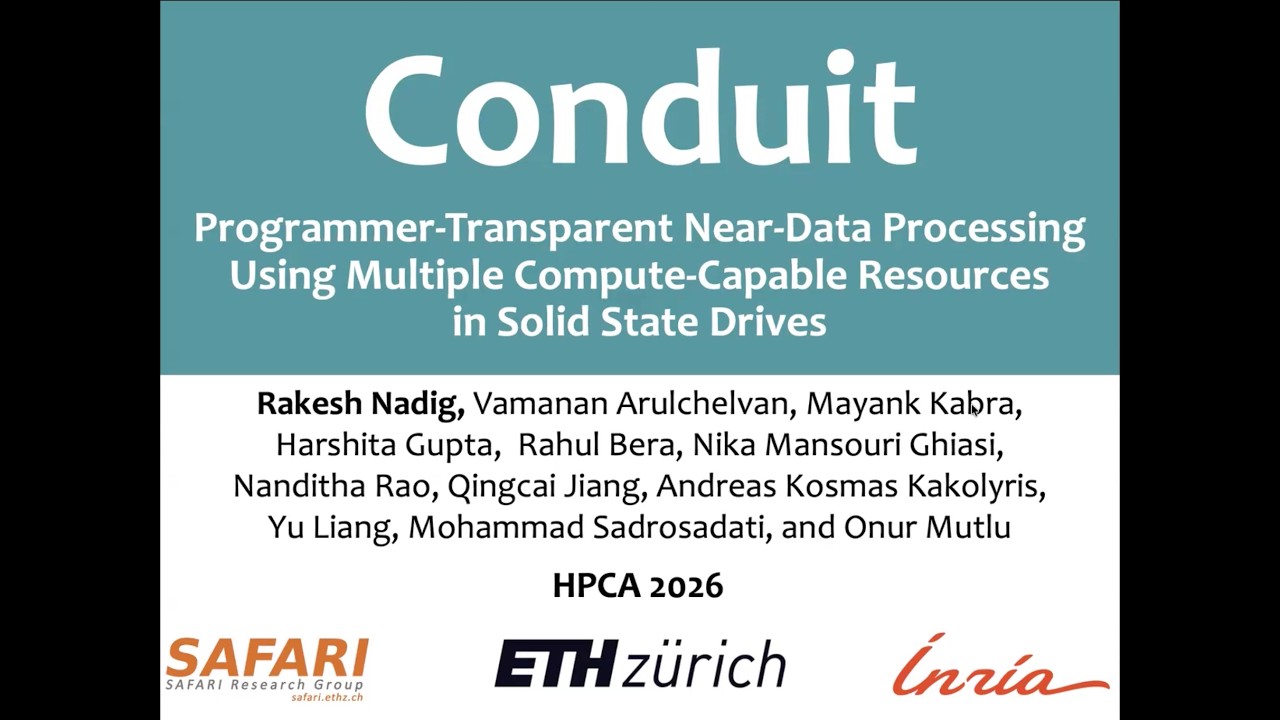
Conduit: Programmer-Transparent NDP Using Multiple Compute-Capable Resources in SSDs - HPCA 2026
Keywords
Summary
207 words
Critical Evaluation
Value of the Information & Strength of the Argument
The talk provides a strong value proposition by addressing a gap in SSD-based NDP: prior works typically map computations to one or two paradigms, lacking generality and programmer transparency. Conduit’s key contribution is the holistic, dynamic offloading at instruction granularity, which is well-motivated by the case study showing workload-dependent bottlenecks. The argumentation is solid: the authors systematically analyze trade-offs, adapt offloading models from other domains, and evaluate against realistic baselines. The cost function is comprehensive, considering multiple factors. The evaluation is thorough, covering performance, energy, and overheads, with a simulator based on a real SSD. The claims are supported by quantitative results. The Q&A shows awareness of limitations and future extensions. However, the talk is a presentation, so some details are omitted, but the argumentation remains convincing.
Scientific Rigor, Source Quality, Title Accuracy
The talk is based on a peer-reviewed paper at HPCA 2026, which lends credibility. The presenter cites prior works in the field, such as Ambit, C DRAM, MIM DRAM, Flash Cosmos, and ADIS Flash, and provides references in the description. The methodology is described with enough detail to be reproducible (simulator based on MPsim, Samsung 980 Pro configuration). The title accurately reflects the content. The talk does not include any advertising or sponsored content. The description includes links to slides and recommended reading, which are relevant and credible. Overall, the scientific rigor is high, with clear sourcing and appropriate context.
242 words
Title / Content Match
The title accurately reflects the content: the talk presents Conduit, a framework for programmer-transparent near-data processing using multiple compute-capable resources in SSDs.
Quality & Reliability
8/10
Presentation of a peer-reviewed academic work (HPCA 2026) with detailed methodology, quantitative evaluation, and references to prior art. The talk is technical and specific, with clear claims supported by simulation results. Minor limitations: reliance on simulations and assumptions about IFP capabilities, but overall rigorous.
Key Moments
Markers derived by PSI from the transcript: the creator did not define chapters.
- Introduction and outline
- High-level overview of a modern SSD and three NDP paradigms
- Trade-offs of NDP paradigms and research questions
- Case study: hybrid and IO-intensive workloads, observations
- Limitations of prior SSD-based NDP techniques and offloading models
- Conduit overview: compile-time pre-processing and runtime offloading
- Cost function details and instruction transformation
- Evaluation setup and results: performance, energy, offloading decisions
- Overhead analysis and additional experiments
- Summary and Q&A on IFP assumptions and extensibility
Cited Sources
- Conduit slides (PDF) — Slides of the presentation
- Conduit slides (PPTX) — Slides of the presentation
- A Modern Primer on Processing in Memory — Recommended reading on processing in memory
- Memory-Centric Computing: Solving Computing's Memory Problem — Recommended reading on memory-centric computing
- Memory-Centric Computing: Recent Advances in Processing-in-DRAM — Recommended reading on processing-in-DRAM
- Intelligent Architectures for Intelligent Computing Systems — Recommended reading on intelligent architectures
- RowHammer: A Retrospective — Recommended reading on RowHammer
- Fundamentally Understanding and Solving RowHammer — Recommended reading on RowHammer
- Accelerating Genome Analysis via Algorithm-Architecture Co-Design — Recommended reading on genome analysis acceleration
- From Molecules to Genomic Variations: Accelerating Genome Analysis via Intelligent Algorithms and Architectures — Recommended reading on genome analysis acceleration
Concurring Sources
- A Modern Primer on Processing in Memory — Provides foundational concepts on processing in memory, supporting the motivation for NDP.
- Memory-Centric Computing: Recent Advances in Processing-in-DRAM — Discusses recent advances in processing-in-DRAM, which is one of the NDP paradigms used in Conduit.
- Intelligent Architectures for Intelligent Computing Systems — Discusses intelligent architectures and computing systems, aligning with the goals of Conduit.
Dissenting Sources
- No discordant sources identified — The talk does not present conflicting sources; it builds upon prior work and extends it.
External References
Contribution & Novelties
Conduit is the first general-purpose, programmer-transparent NDP framework for SSDs that dynamically offloads computations at instruction granularity to multiple heterogeneous compute resources (ISP, PUD, IFP). It addresses the limitations of prior works that map to one or two paradigms and lack generality. The framework includes a compile-time vectorization step and a runtime cost-function-based offloading mechanism that considers data movement, computation latency, dependencies, and resource contention. Evaluation shows significant performance and energy improvements over prior offloading models, with low overheads. The work is extensible to future accelerators.
Pour aller plus loin :
- Processing-in-Memory (Wikipedia) — Provides background on the general concept of processing in memory.
- Near-Data Processing (Wikipedia) — Explains the broader paradigm of moving computation to data.
- Solid-state drive (Wikipedia) — Background on SSD architecture and components.
- NVMe (Wikipedia) — Relevant to the communication interface used in the work.
- RowHammer (Wikipedia) — Related to DRAM reliability issues, relevant to processing using DRAM.
152 words
Radar Profile
The radar profile shows high scores in technical level and information quality, reflecting the deep technical content and rigorous methodology. The lower score in information quantity is due to the short duration and focused scope, but the content is dense. Overall, the profile indicates a highly technical and reliable presentation.
💬 No comments were provided for analysis.