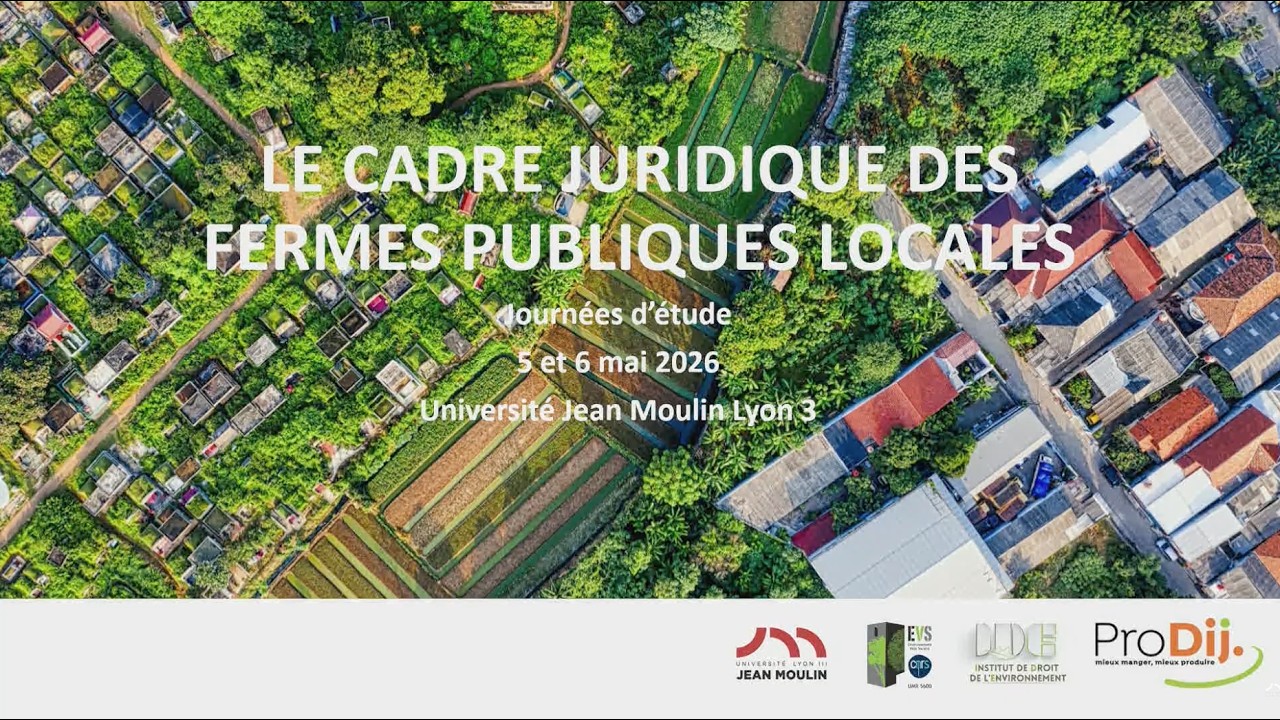
04 - La ferme publique : de la ferme modèle à la production intégrée. Itinéraires juridiques
Keywords
Summary
175 words
Critical Evaluation
Value of the Information & Strength of the Argument
The lecture provides a valuable historical and legal perspective on public farms, enriching the understanding of their evolution and current legal challenges. Billet’s argumentation is solid, systematically addressing vocation, property qualification, and educational links. He supports his points with specific legal references (e.g., CG3P, case law) and historical documents, demonstrating a rigorous methodology. The discussion of the tension between public domain status and agricultural leases is particularly insightful, highlighting practical implications for local authorities.
Scientific Rigor, Source Quality, Title Accuracy
The speaker demonstrates high scientific rigor, citing legal texts (CG3P, Code rural), case law (e.g., Pouvertin 1956, Syndicat du commerce en détail de Nevers, Conseil d’État 2006), and historical sources (1848 ‘La réforme agricole’, 1898 ‘La semaine vétérinaire’). The title accurately reflects the content, focusing on legal itineraries of public farms. The lecture is well-structured and the sources are relevant, though some historical references are from non-academic journals. The Q&A adds depth, addressing boundary issues in public service qualification.
168 words
Title / Content Match
The title accurately reflects the content: a legal-historical analysis of public farms, from model farms to integrated production.
Quality & Reliability
7/10
The speaker is a legal scholar (Philippe Billet) presenting a structured analysis of public farms, drawing on historical sources (e.g., 1848 texts, 1898 veterinary weekly) and legal doctrine (e.g., CG3P, case law). The reasoning is rigorous and well-documented, though it is an opinion/expert lecture rather than a peer-reviewed study.
Key Moments
Markers derived by PSI from the transcript: the creator did not define chapters.
- Introduction: historical origins of public farms (ager publicus, municipal farms under Ancien Régime).
- Vocation of public farms: exemplarity and technology transfer (1848 text, Tuscan example).
- Legal qualification: public vs private domain, criteria of public domain (CG3P).
- Implications of public domain: prohibition of rural leases, temporary occupancy, redevance.
- Legitimacy of public farms vs private initiative: carence de l'initiative privée, Conseil d'État case law.
- Educational role of public farms, link to environmental education and Charter for the Environment.
- Q&A: boundaries of public service, private participation, and service public content.
Cited Sources
- Code général de la propriété des personnes publiques (CG3P) — Legal basis for public domain qualification.
- Arrêt Pouvertin (1956) — Notion of service public par accessoire.
- Arrêt Syndicat du commerce en détail de Nevers — Carence de l'initiative privée.
- Arrêt Conseil d'État, 31 mai 2006, Barreau de Paris — Intérêt public and competition.
- Arrêt CAA Marseille, 16 octobre 2020 — Prohibition of bail rural on public domain.
- Charte constitutionnelle de l'environnement (article 8) — Education and environment.
Concurring Sources
- Code rural et de la pêche maritime (article L. 1) — Defines agricultural policy objectives, including food sovereignty.
- Loi EGalim — Promotes local and sustainable food in public catering.
Dissenting Sources
- Doctrine on service public — Some legal scholars argue that providing means to a public service does not constitute a public service itself, as discussed in the Q&A.
Contribution & Novelties
The lecture offers a comprehensive legal analysis of public farms, synthesizing historical precedents and contemporary legal frameworks. It highlights the tension between public domain status and agricultural leases, a nuanced issue often overlooked. The educational dimension is presented as a potential reconciliation between agriculture and environment, drawing on constitutional provisions.
Pour aller plus loin :
- Domanialité publique — Overview of public domain law in France.
- Bail rural — Legal framework for agricultural leases.
- Service public — Concept of public service in French law.
- Autonomie alimentaire — Concept of food autonomy at local level.
93 words
Radar Profile
The radar profile shows high scores in information quantity, quality, and technical level, reflecting a dense and well-structured legal lecture. The lower reliability score is due to the subjective nature of expert opinion and the lack of peer review, but the argumentation is solid and well-sourced.