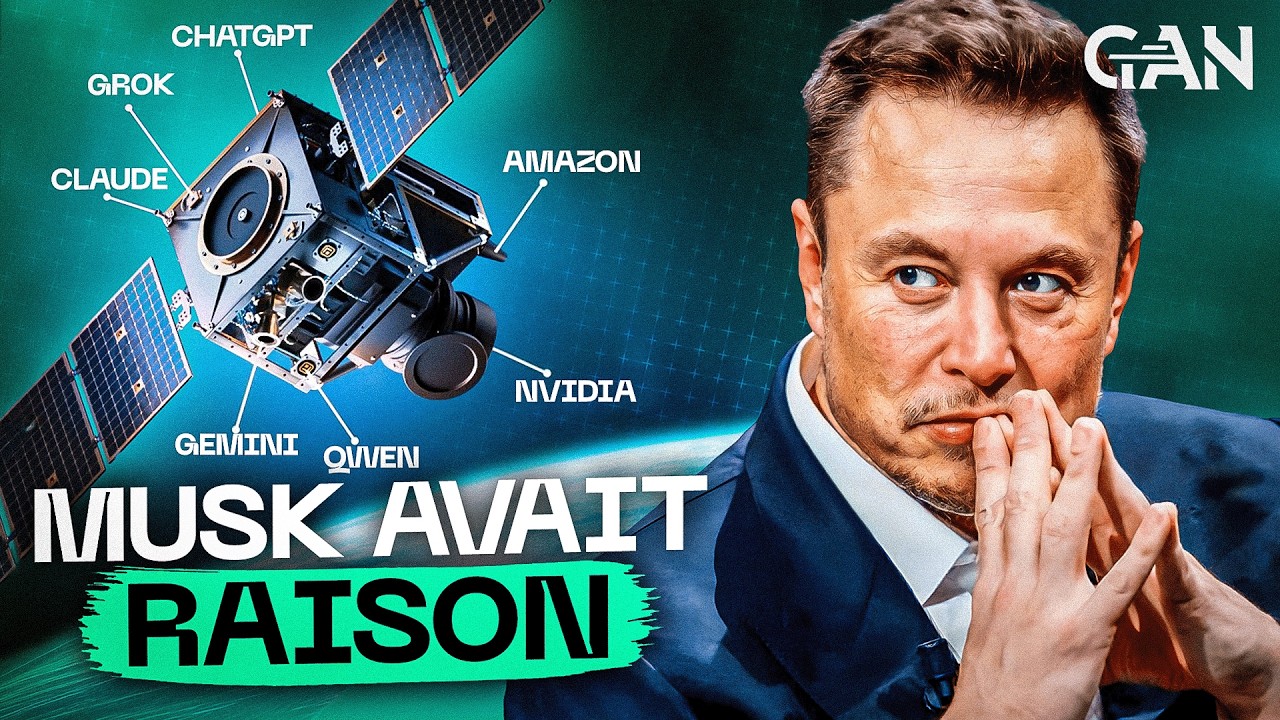
Musk va encore changer le monde (et vous n’êtes pas prêts)
Keywords
Summary
143 words
Critical Evaluation
The video provides a comprehensive and engaging analysis of orbital data centers, a topic of growing relevance. It successfully balances technical details with broader strategic implications. The narrator demonstrates a good understanding of the subject, referencing specific projects and studies. However, the argumentation is primarily based on the narrator’s interpretation and lacks direct citations to primary sources, which affects the overall rigor. The video also tends to speculate about future scenarios without clearly distinguishing between facts and projections. The title is somewhat sensationalist but the content is substantive. The inclusion of counterarguments (e.g., radiation tests, solar advantages) adds depth, but the discussion of cooling remains contentious. Overall, the video is informative and thought-provoking, but viewers should seek additional sources for a more evidence-based perspective.
124 words
Title / Content Match
The title is somewhat sensationalist but accurately reflects the video's focus on Musk's ambitious plans and the broader race for orbital data centers.
Quality & Reliability
7/10
The video presents a well-structured argument about orbital data centers, citing specific projects (SpaceX, Google, Blue Origin, China) and technical challenges (radiation, cooling, debris). It distinguishes between facts and projections, but relies heavily on the narrator's interpretation and lacks direct citations to primary sources. The tone is engaging but occasionally speculative.
Key Moments
Markers derived by PSI from the transcript: the creator did not define chapters.
- Introduction to the race for orbital data centers, mentioning Musk, Google, Bezos, and China.
- Debunking the myth that AI will exhaust global electricity; focus on concentration and speed of power demand.
- Discussion of the challenges of building terrestrial data centers: power grid limitations and cooling.
- Technical challenges in space: radiation, heat dissipation, and debris risks.
- Cooling in space: the vacuum as insulator, need for large radiators.
- Maintenance and obsolescence issues; satellites cannot be easily repaired.
- Cost considerations: launch costs and the role of Starship.
- Counterarguments: radiation tests, solar advantages, and potential for cost reduction.
- Conclusion: the convergence of major players suggests a strategic race for orbital computing.
Cited Sources
- Newsletter Grand Angle Nova — Mentioned as a way to stay updated on the topic.
Concurring Sources
- SpaceX Starship — The video relies on Starship's capabilities for launching orbital data centers.
- Google's Sun Catcher project — Mentioned in the video as a Google initiative for space-based solar power.
Dissenting Sources
- Critique of orbital data centers — Some experts argue that the costs and technical challenges make orbital data centers impractical in the near term.
Contribution & Novelties
The video provides a unique synthesis of the emerging trend of orbital data centers, connecting technical challenges with strategic motivations. It offers a balanced view, acknowledging both the difficulties and potential solutions. The discussion of the ‘plafond de verre’ (glass ceiling) of terrestrial power infrastructure is a valuable perspective.
Pour aller plus loin :
- Kardashev scale — Relevant to the video’s mention of a Type II civilization.
- Space debris — Discusses the risks of orbital debris, a key concern in the video.
- Orbital data center concept — Provides an overview of the concept and its challenges.
96 words
Radar Profile
The radar profile shows high scores in quantity of information and technical level, but lower in reliability due to the lack of direct citations. The overall balance suggests a well-informed but opinion-driven analysis.
💬 Positive: The comments are largely enthusiastic, with viewers expressing appreciation for the clarity and depth of the content. Many engage with the technical aspects, sharing additional ideas and questions. A few express skepticism about feasibility, but the overall tone is supportive and curious.