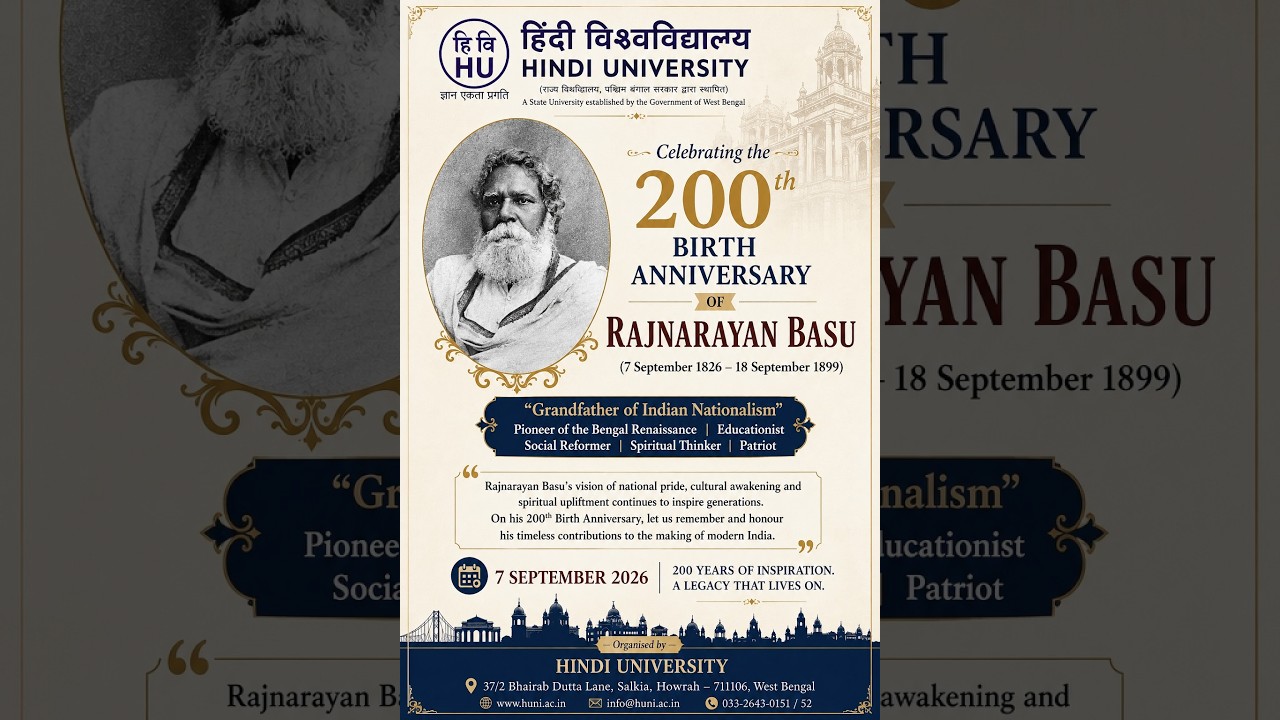
HINDI UNIVERSITY SPECIAL LECTURE ON RAJNARAYAN BASU.
Keywords
Summary
160 words
Critical Evaluation
Value of the Information & Strength of the Argument
The lecture provides a comprehensive overview of Rajnarayan Basu’s multifaceted contributions, synthesizing his roles as a social reformer, educationist, and nationalist. The argumentation is coherent, presenting Basu as a pivotal figure who bridged tradition and modernity. However, the lecture relies heavily on narrative and personal interpretation, with limited critical analysis or engagement with historiographical debates. The speaker’s enthusiasm is evident, but the lack of direct quotes or textual evidence from Basu’s works weakens the scholarly depth. The argument that Basu was the ‘grandfather of Indian nationalism’ is presented without substantial comparative analysis, though it is a plausible claim within the context of Bengal’s intellectual history.
Scientific Rigor, Source Quality, Title Accuracy
The lecture demonstrates moderate scientific rigor. The speaker, a historian, provides a detailed account but does not cite specific sources during the talk, nor does the description include references. The title accurately reflects the content, and the lecture is well-structured. However, the absence of verifiable citations and the reliance on oral narrative reduce its scholarly reliability. The description lists the patron, speaker, and convener but no external links to primary or secondary sources. The lecture’s adequacy to the title is high, as it directly addresses Rajnarayan Basu’s life and work.
210 words
Title / Content Match
The title accurately reflects the content: a special lecture on Rajnarayan Basu delivered at Hindi University.
Quality & Reliability
6/10
The lecture is an expert opinion by a historian, but it lacks citations to primary sources and is based on a single speaker's narrative. The content is plausible and aligns with known historical figures, but the lack of verifiable references and the informal delivery reduce its reliability.
Key Moments
Markers derived by PSI from the transcript: the creator did not define chapters.
- Introduction of the speaker and patron by the host.
- Overview of Rajnarayan Basu's early life and family background.
- Discussion on Basu's role in the Brahmo Samaj and Hindu revivalism.
- Basu's views on education, including women's education and indigenous systems.
- Basu's critique of Western imitation and advocacy for cultural pride.
- Basu's organizational activities, including establishing libraries and night schools.
- Basu's stance on caste system and inter-caste marriage.
- Basu's influence on later thinkers like Vivekananda and Tagore.
- Conclusion on Basu's legacy and his relative obscurity in history.
Contribution & Novelties
The lecture offers a focused perspective on Rajnarayan Basu, a figure often overshadowed in mainstream narratives of the Bengal Renaissance. It highlights his unique synthesis of spirituality, nationalism, and rationalism, and his pioneering role in promoting indigenous education and social reform. The speaker’s emphasis on Basu’s influence on later nationalists adds depth to understanding the intellectual lineage of Indian nationalism.
Pour aller plus loin :
- Rajnarayan Basu - Wikipedia — Provides a concise biography and context.
- Bengal Renaissance - Wikipedia — Contextualizes Basu within the broader movement.
- Brahmo Samaj - Wikipedia — Relevant to Basu’s religious affiliations.
97 words
Radar Profile
The radar profile shows moderate scores across all dimensions, indicating a balanced but not exceptional lecture. The quantity of information is relatively high, but the quality and technical depth are moderate, reflecting the oral and non-cited nature of the content. The reliability score is moderate, consistent with the lack of verifiable sources.