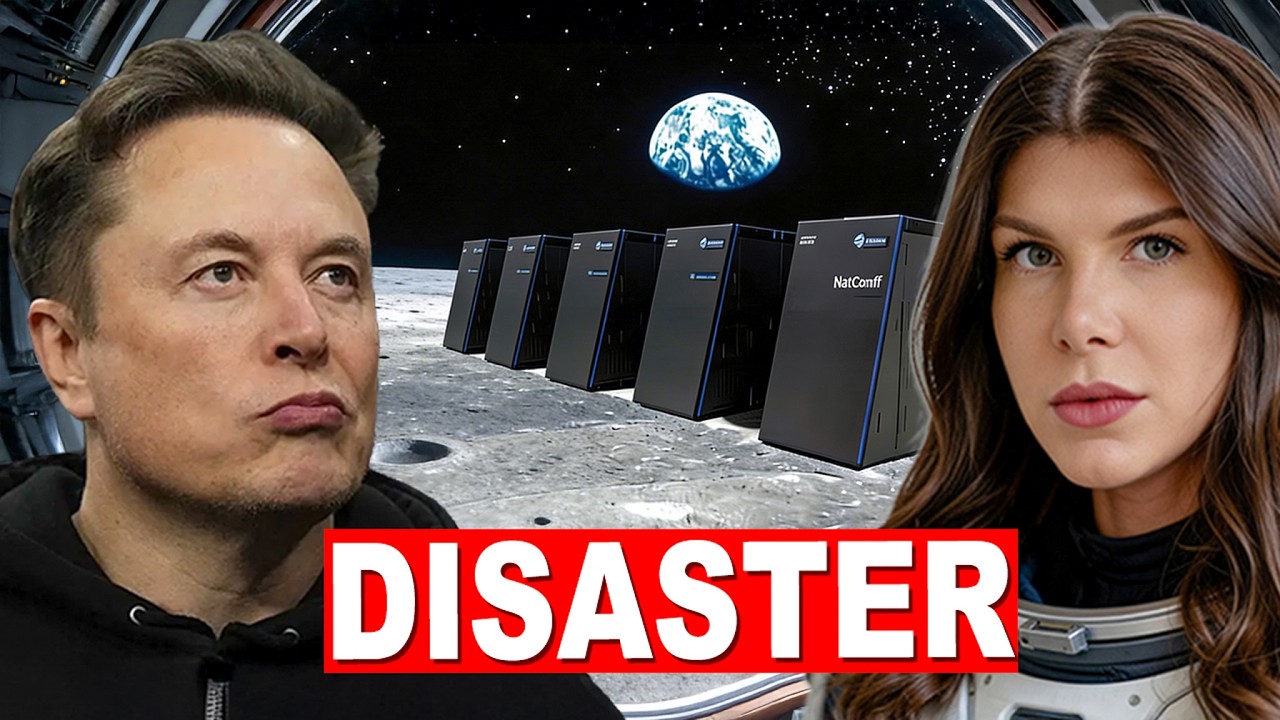
The Killer Behind Data Centers In Space
Keywords
Summary
138 words
Critical Evaluation
The video provides a rigorous and well-argued analysis of the concept of space-based data centers, a topic that is often discussed with hype. The creator, Anastasi In Tech, leverages her background in chip design to offer a grounded perspective, focusing on the physical and engineering constraints that are often overlooked. The argumentation is solid, systematically addressing power generation, thermal management, data transmission, and maintenance. The explanation of radiative cooling and the Stefan-Boltzmann law is particularly effective, debunking the common misconception that space’s coldness aids cooling. The quantitative estimates, such as the radiator area and mass for a 40 MW data center, add credibility. The video also considers economic factors, noting the high launch costs and the need for redundancy. The inclusion of real-world examples like Starlink and Starcloud provides context. However, some figures are approximate and the video includes a sponsored segment for IEEE Spectrum, which could introduce bias, though the sponsor is relevant and the content remains objective. The adéquation between title and content is excellent, as the ‘killer’ refers to the critical challenges, particularly heat. Overall, the video is a valuable contribution to the discourse, offering a balanced and technically informed perspective. The public comments reflect appreciation for the clear explanations and the critical approach, with many viewers acknowledging the educational value. The video successfully bridges the gap between hype and reality, making it a recommended watch for those interested in the future of AI infrastructure.
238 words
Title / Content Match
The title accurately reflects the content, focusing on the critical challenges (especially heat dissipation) that could undermine space data center concepts.
Quality & Reliability
8/10
The video provides a technically detailed and critical analysis of the feasibility of space-based data centers, grounded in physics and engineering principles. The creator, with a background in chip design, offers credible expertise. The content is well-structured and addresses key challenges (power, cooling, bandwidth, maintenance) with quantitative estimates. However, some figures are approximate and the video includes a sponsored segment, which may introduce bias. Overall, the information is reliable and well-presented.
Chapters
Cited Sources
- Anastasi In Tech Newsletter — The creator's newsletter, mentioned as a way to connect and receive updates.
- Deep in Tech Podcast (Apple) — The creator's podcast, mentioned in the description.
- Deep in Tech Podcast (Spotify) — The creator's podcast, mentioned in the description.
- IEEE Spectrum (sponsor link) — Sponsor link for IEEE Spectrum, mentioned in the video as a source of tech analysis.
- IEEE Spectrum YouTube Channel — Mentioned as a resource for tech content.
Concurring Sources
- IEEE Spectrum — The sponsor, a reputable technology magazine, aligns with the video's technical focus.
Contribution & Novelties
The video offers a comprehensive and critical analysis of space-based data centers, synthesizing technical challenges and economic considerations. It provides quantitative estimates for solar array size, radiator area, and launch costs, which are rarely discussed in popular media. The creator’s background in chip design adds unique insight into radiation effects and thermal management. The video also highlights the often-overlooked issue of bandwidth limitations for data transmission from space.
Pour aller plus loin :
- Stefan-Boltzmann law — Fundamental physics behind radiative cooling, central to the video’s argument.
- Spacecraft thermal control — Overview of thermal management techniques in space, relevant to the discussed challenges.
- Free-space optical communication — Technology for laser-based data transmission in space, mentioned in the video.
- Radiation hardening — Techniques to protect electronics from space radiation, a key challenge for space data centers.
134 words
Radar Profile
The radar profile shows high scores in information quantity and technical level, indicating a content-rich and technically deep video. The quality and reliability scores are also strong, reflecting the creator's expertise and clear presentation. The overall balance suggests a well-rounded and trustworthy analysis.
💬 Très positif. Sur les 30 commentaires analysés, la grande majorité exprime une appréciation pour la clarté des explications et la profondeur technique, avec plusieurs commentaires soulignant la valeur éducative et la qualité de la présentation.