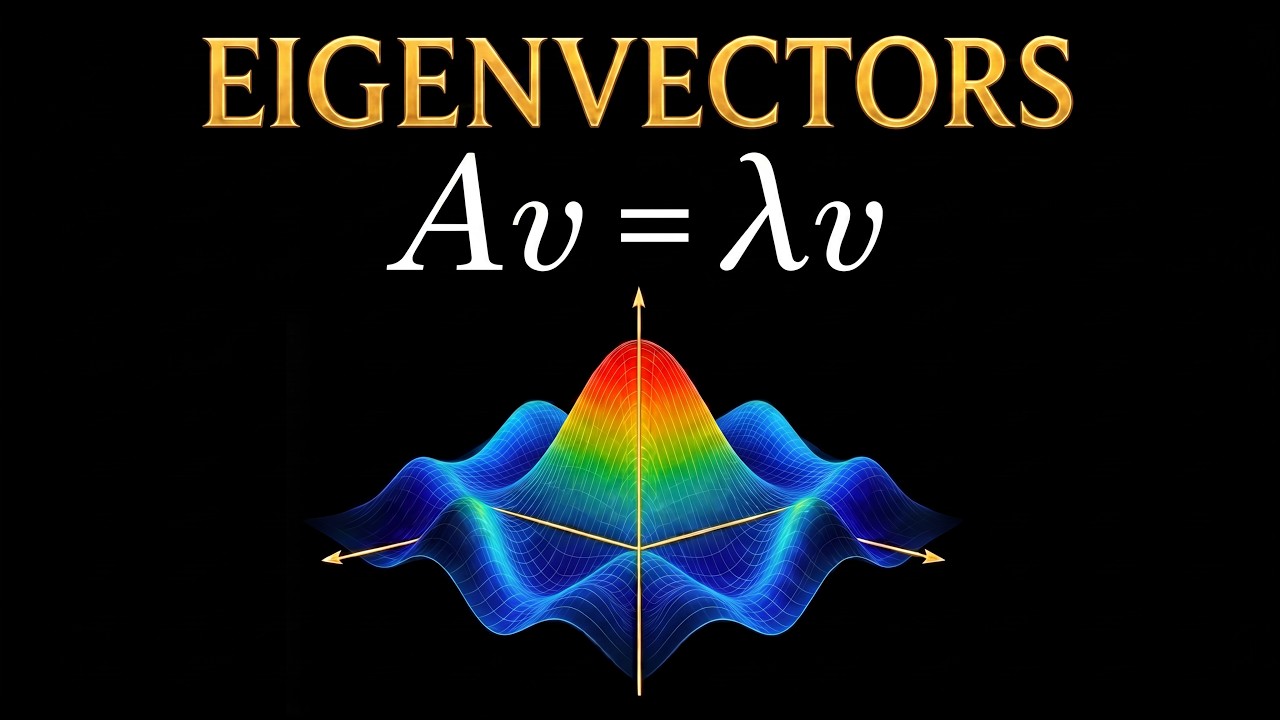
Eigenvectors Are Hiding Something Nobody Talks About!
Keywords
Summary
138 words
Critical Evaluation
Value of the Information & Strength of the Argument
The video’s value lies in its pedagogical approach: it builds intuition from physical examples (Chladni plates, coupled carts) and then derives the mathematical formalism, rather than presenting it as a recipe. The argumentation is solid, with each step logically following from the previous one. The explanation of why the determinant condition arises (non-zero solution requires collapse) is particularly insightful. The connection between eigenvectors and PCA is well-motivated through the constrained optimization problem, and the PageRank example effectively shows the same eigenvector concept in a different domain. The video also honestly addresses limitations, such as shear and rotation, which strengthens its credibility.
Scientific Rigor, Source Quality, Title Accuracy
The video demonstrates high scientific rigor: all mathematical claims are derived on screen, and the physical and data applications are correctly linked to the underlying theory. The sources cited are authoritative: MIT OpenCourseWare’s Linear Algebra course by Gilbert Strang, and Sheldon Axler’s ‘Linear Algebra Done Right’ (free PDF). Historical references to Chladni (1787), Pearson (1901), and Brin & Page (1998) are appropriate and accurate. The title is slightly clickbait but the content delivers on the promise of revealing a deeper understanding. The video’s own animations are original and enhance comprehension.
206 words
Title / Content Match
The title is slightly sensationalized but accurate: the video does reveal a deeper, often overlooked geometric interpretation of eigenvectors.
Quality & Reliability
9/10
The video provides a rigorous, derivation-based explanation of eigenvectors and eigenvalues, with all key steps derived on screen. It correctly handles edge cases (e.g., shear matrix, rotation) and connects the concept to physical and data applications. The mathematical content is accurate and well-structured, with no apparent errors.
Chapters
- A sand plate, a matrix, and the same hidden pattern
- Why finding the arrows forces the determinant to appear
- Diagonalization: the matrix in its own coordinates
- Two coupled carts: eigenvectors become motion
- A cloud of data: PCA and the direction that matters
- Networks, page ranking, and where real arrows run out
Cited Sources
- Linear Algebra Done Right (4th edition) - Sheldon Axler — Referenced as a free official PDF for further study of linear algebra.
- MIT OpenCourseWare 18.06 Linear Algebra (Gilbert Strang) — Referenced as a free full course on linear algebra.
Concurring Sources
- MIT OpenCourseWare 18.06 Linear Algebra — The video's approach aligns with standard linear algebra curriculum, particularly Strang's emphasis on geometric intuition.
- Linear Algebra Done Right - Sheldon Axler — The video's treatment of eigenvectors and diagonalization is consistent with Axler's rigorous, basis-free approach.
Contribution & Novelties
The video’s original contribution is its unified visual and conceptual treatment of eigenvectors across multiple domains (physics, data science, networks), emphasizing the geometric interpretation as ‘directions the system refuses to mix.’ It goes beyond typical textbook presentations by deriving the characteristic equation from the need for a non-zero solution, and by showing diagonalization as a change of viewpoint rather than just a computational tool. The use of original animations to illustrate these concepts is a notable strength.
Pour aller plus loin :
- Eigenvalues and eigenvectors (Wikipedia) — Provides a comprehensive overview of the topic, including history and applications.
- Principal component analysis (Wikipedia) — Details the statistical method and its mathematical foundations.
- Normal mode (Wikipedia) — Explains the concept of normal modes in oscillating systems, directly related to the coupled carts example.
- PageRank (Wikipedia) — Describes the algorithm and its eigenvector formulation.
141 words
Radar Profile
The radar profile shows high scores across all dimensions, with 'qualite_information' and 'fiabilite_globale' being particularly strong. The video excels in providing accurate, well-sourced content with a high level of technical depth, making it an excellent resource for learners.