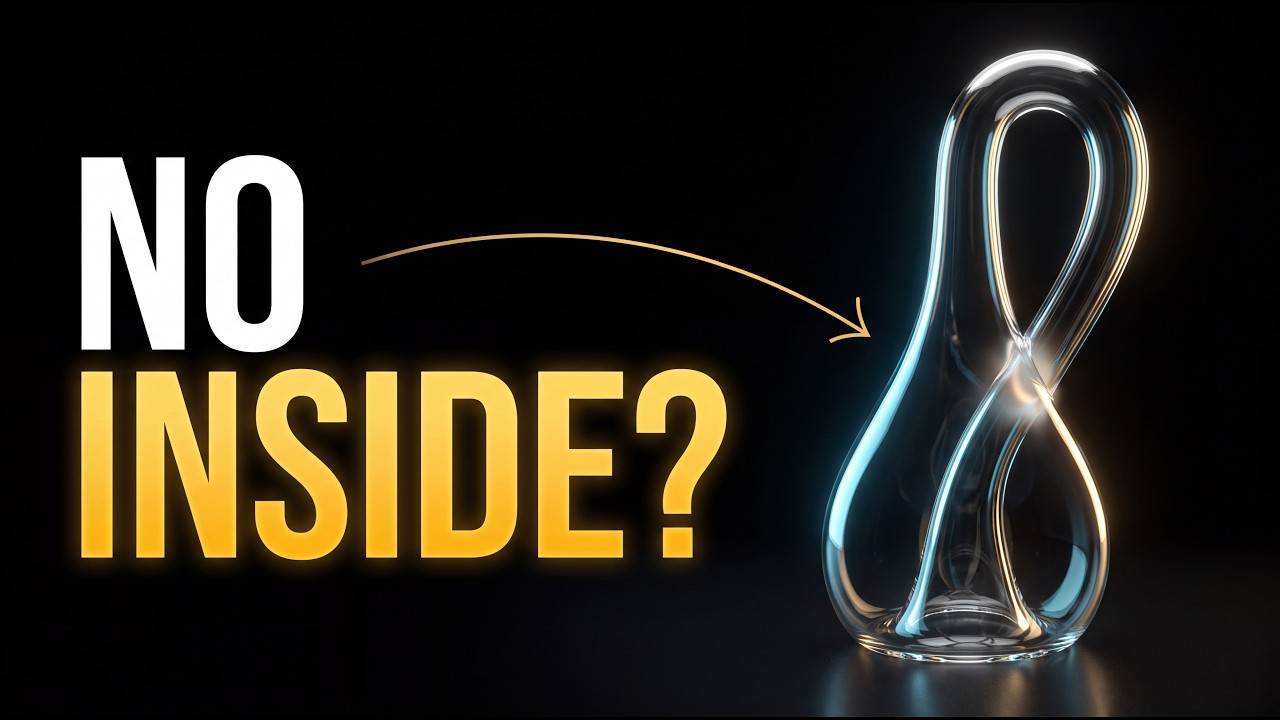
This Bottle Needs a 4th Dimension to Exist
Keywords
Summary
194 words
Critical Evaluation
Value of the Information & Strength of the Argument
The video provides a high-value explanation of a complex topological concept, making it accessible through clear analogies and step-by-step reasoning. The argumentation is solid: it builds from the Möbius strip to the Klein bottle, using the concept of edge gluing to show how a single flipped arrow creates non-orientability. The explanation of why the Klein bottle must self-intersect in 3D is particularly effective, using the analogy of a 2D overpass needing a third dimension. The video also connects the Klein bottle to the broader classification of surfaces, demonstrating its place in the mathematical landscape. The use of scissors-and-paper experiments (cutting the Möbius strip) grounds the abstract concepts in tangible results, strengthening the argument.
Scientific Rigor, Source Quality, Title Accuracy
The video is scientifically rigorous, presenting correct mathematical facts about the Klein bottle, including its construction, properties, and classification. The explanations are accurate and well-illustrated. The title accurately reflects the content, focusing on the need for a fourth dimension. The video does not cite external sources, but it is a self-contained educational piece. The description provides a link to a free ebook, which is a supplementary resource. The content is consistent with standard mathematical literature on topology.
205 words
Title / Content Match
The title accurately reflects the content, which explains why the Klein bottle requires a fourth dimension to exist without self-intersection.
Quality & Reliability
8/10
The video presents a rigorous and accurate explanation of the Klein bottle, covering its construction via edge gluing, non-orientability, embedding in 4D, Euler characteristic, and the classification of surfaces. The mathematical content is correct and well-illustrated with intuitive analogies. The presentation is clear and engaging, with a strong pedagogical structure. Minor simplifications (e.g., the historical anecdote about the name) are typical of popular science and do not affect the core mathematical accuracy.
Key Moments
Markers derived by PSI from the transcript: the creator did not define chapters.
- Introduction to the Klein bottle's impossible properties: no inside, one side, self-intersection.
- Explanation of sidedness and the Möbius strip as a one-sided surface.
- Construction of the Klein bottle from a square with one flipped edge gluing.
- Explanation of why the Klein bottle needs a fourth dimension to avoid self-intersection.
- Demonstration that cutting a Klein bottle yields two Möbius strips.
- Experiments with cutting a Möbius strip, showing surprising results.
- Introduction of the Euler characteristic as a topological invariant.
- Classification of surfaces and the Klein bottle's place as a sphere with two cross caps.
- Conclusion: the Klein bottle is not impossible, but a 4D object casting a 3D shadow.
Cited Sources
- See The Math - Free Ebook — The video description offers a free ebook as a supplementary resource for viewers.
Concurring Sources
- Klein bottle - Wikipedia — The video's description of the Klein bottle's properties (one-sided, non-orientable, self-intersecting in 3D) aligns with standard mathematical references.
Contribution & Novelties
The video excels in making a highly abstract mathematical object (the Klein bottle) intuitively accessible. Its original contribution lies in the pedagogical approach: it systematically reduces all the ‘weirdness’ of the Klein bottle to a single flipped arrow on a square, and then shows how this one detail explains non-orientability, the need for a fourth dimension, and the result of cutting the bottle. The use of hands-on paper experiments (cutting Möbius strips) bridges the gap between abstract topology and tangible experience. The video also effectively connects the Klein bottle to the broader classification of surfaces, giving viewers a sense of its place in mathematics.
Pour aller plus loin :
- Klein bottle - Wikipedia — A comprehensive overview of the Klein bottle, its properties, and its construction.
- Möbius strip - Wikipedia — Detailed information on the Möbius strip, the foundational one-sided surface.
- Classification of surfaces - Wikipedia — The theorem that classifies all closed surfaces, placing the Klein bottle in context.
- Euler characteristic - Wikipedia — The topological invariant used to distinguish surfaces.
- Orientability - Wikipedia — The concept of orientability, which is central to distinguishing the Klein bottle from the torus.
191 words
Radar Profile
The radar profile shows high scores in information quantity, quality, and technical level, with a slightly lower but still strong score in global reliability. This indicates a video that is rich in accurate content, well-explained, and technically sound, though it may rely on simplifications typical of popular science.
💬 No comments were provided for analysis.