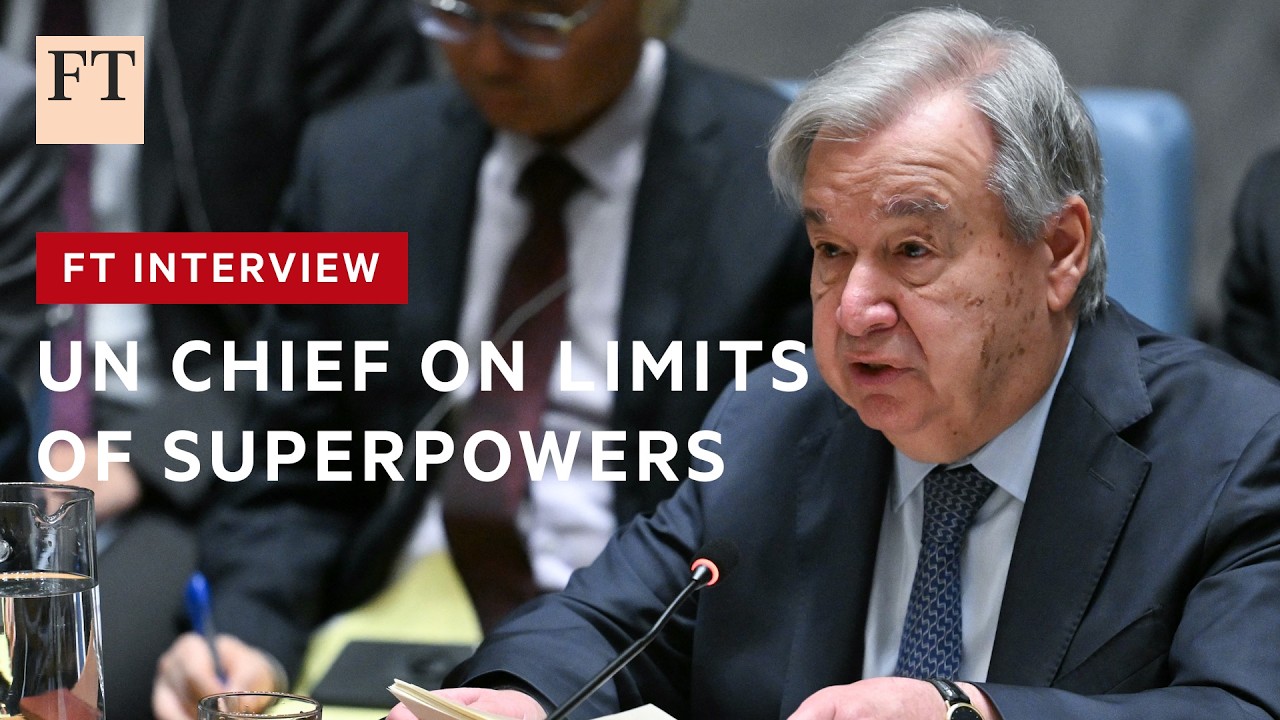
António Guterres on the future of the UN | FT Interviews
Keywords
Summary
170 words
Critical Evaluation
Value of the Information & Strength of the Argument
The interview provides valuable firsthand insights into the UN’s internal operations, budget challenges, and strategic priorities from the perspective of its highest official. Guterres offers a clear argumentation for the UN’s continued relevance, citing concrete examples of cooperation and achievements, such as the AI panel and climate advocacy. However, the argumentation is largely one-sided, with limited critical probing from the interviewer, and Guterres tends to present the UN’s positions as self-evidently correct. The discussion of multipolarity and the need for reform is thoughtful but remains at a high level, without delving into specific mechanisms or potential obstacles.
Scientific Rigor, Source Quality, Title Accuracy
The interview is a primary source, featuring the UN Secretary-General himself, which lends authority. However, the claims made are not independently verified, and the interviewer does not challenge many assertions. The title accurately reflects the content, focusing on the future of the UN. The description includes links to FT subscription services and podcasts, but no direct references to external sources or reports. The interview’s rigor is moderate, as it is more of an opinion piece than a fact-based analysis.
191 words
Title / Content Match
The title accurately reflects the content: an interview with António Guterres about the UN's future, covering budget cuts, geopolitical shifts, and institutional reform.
Quality & Reliability
7/10
Interview with a high-level official (UN Secretary-General) providing firsthand insights, but the content is largely opinion and advocacy, with limited independent verification or critical challenge from the interviewer.
Key Moments
Markers derived by PSI from the transcript: the creator did not define chapters.
- Guterres discusses the paralysis of the Security Council due to geopolitical divides.
- He highlights UN leadership on climate change and AI, including the creation of an international scientific panel.
- Guterres addresses budget cuts and staff reductions, emphasizing the UN's adaptability.
- He discusses the relationship with the US and cooperation in various crises.
- Guterres talks about the rise of multipolarity and the need for a networked multipolar order.
- He addresses the need for Security Council reform and the challenges of changing power relations.
- Guterres defends the UN's clarity on conflicts like Ukraine and Gaza, despite limited mediation leverage.
- He discusses the UN's role in climate change and the shift towards renewables.
- Guterres reflects on the UN's relevance and compares it to the League of Nations.
- He gives advice to his successor: be yourself and do what you believe is right.
Cited Sources
- FT Edit subscription — Promotional link in video description for FT content.
- FT Schools — Link in description offering free FT access for students.
- FT Podcasts — Link to FT podcasts mentioned in the description.
Concurring Sources
- UN Charter — The UN Charter is the foundational treaty, referenced implicitly in the interview as the basis for UN actions.
Dissenting Sources
- Criticism of UN effectiveness — Some critics argue that the UN has become ineffective due to geopolitical paralysis, a view that contrasts with Guterres's defense of the institution.
Contribution & Novelties
The interview provides a unique insider perspective on the UN’s current challenges and strategic direction, particularly regarding budget cuts and the rise of multipolarity. Guterres’s emphasis on the UN’s role in AI governance and climate leadership offers a forward-looking view. The discussion on the need for Security Council reform is insightful, though not entirely novel.
Pour aller plus loin :
- United Nations — Official UN website for context on its structure and activities.
- Multilateralism — Overview of the concept and its evolution.
- Security Council Reform — Background on the ongoing debate about reforming the Security Council.
96 words
Radar Profile
The radar profile shows moderate to high scores across information quantity, quality, and reliability, with a lower technical level, reflecting the interview's focus on political and institutional issues rather than technical details.
💬 No comments were provided for analysis.