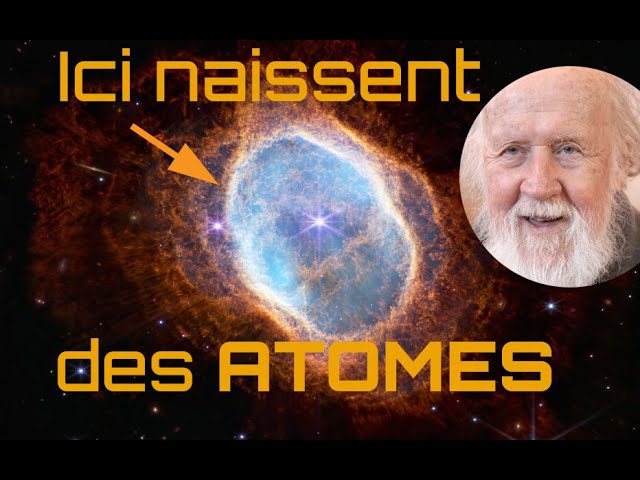
Nous sommes des poussières d'étoiles. Par Hubert Reeves.
Keywords
Summary
167 words
Critical Evaluation
Value of the Information & Strength of the Argument
The value of the information is high, as it presents a comprehensive and accurate overview of stellar nucleosynthesis, a cornerstone of modern astrophysics. The argumentation is solid, building from fundamental principles (nuclear stability, cosmic abundances) to specific evidence (iron peak, supernova light curves). Reeves uses a logical progression, moving from qualitative correlations to quantitative proofs, such as the match between the decay times of radioactive isotopes and supernova light curves. He effectively uses analogies (e.g., a ’thermometer’ for the iron peak) to make complex concepts accessible. The reasoning is clear and well-structured, demonstrating a deep understanding of the subject.
Scientific Rigor, Source Quality, Title Accuracy
The scientific rigor is excellent. Reeves, a respected astrophysicist, presents established science with clarity. He references key concepts like the Hertzsprung-Russell diagram, nuclear binding energy, and the cosmic abundance curve, all well-documented in the literature. The title accurately reflects the content, which is a poetic yet scientifically precise explanation of our cosmic origins. The conference is a reliable source of information for a general audience, with no apparent inaccuracies or misleading claims.
186 words
Title / Content Match
The title accurately reflects the content, which explains the cosmic origin of atoms, a poetic way to say we are made of stardust.
Quality & Reliability
9/10
The content is a conference by a renowned astrophysicist, Hubert Reeves, presenting established scientific knowledge on nucleosynthesis. The explanations are clear, accurate, and based on well-known physics. The speaker's authority and the scientific consensus on the topics discussed ensure high reliability.
Key Moments
Markers derived by PSI from the transcript: the creator did not define chapters.
- Introduction by the host, thanking Hubert Reeves for his contributions to astronomy outreach.
- Reeves sets the stage by recalling the alchemists' dream and the discovery of nuclear physics as the key to element transformation.
- Introduction of the Hertzsprung-Russell diagram and the NZ diagram for atomic nuclei, setting up the framework for correlating stars and elements.
- Discussion of cosmic abundances and the correlation between nuclear stability and abundance, highlighting the iron peak.
- Explanation of the iron peak as a thermometer, indicating temperatures of 2-3 billion degrees, and its link to supernovae.
- Presentation of the 'smoking gun' evidence: the match between supernova light curves and the radioactive decay of nickel-56 and cobalt-56.
- Discussion of helium-4 abundance, primarily produced in the Big Bang, and the formation of lithium, beryllium, and boron via cosmic ray spallation.
- Conclusion: the poetic and humbling idea that we are made of stardust.
Cited Sources
- Association Française d'Astronomie (AFA) website — Mentioned in the introduction as the host organization and where recordings of the conference are available.
Concurring Sources
- B²FH paper (Burbidge, Burbidge, Fowler, Hoyle) — The seminal 1957 paper that established the theory of stellar nucleosynthesis, which is the foundation of the talk's content.
Contribution & Novelties
The conference provides a clear and engaging synthesis of stellar nucleosynthesis, making complex astrophysical concepts accessible to a general audience. It emphasizes the connection between nuclear physics and astronomy, illustrating how the abundance of elements in the universe can be explained by stellar processes. The talk’s originality lies in its narrative approach, using each element’s story to reveal the workings of stars.
Pour aller plus loin :
- Stellar nucleosynthesis — A comprehensive overview of the processes by which elements are formed in stars.
- Hertzsprung–Russell diagram — The diagram used to classify stars by luminosity and temperature, central to the talk.
- Supernova nucleosynthesis — The specific processes that create heavy elements in supernovae, as discussed in the talk.
117 words
Radar Profile
The radar profile shows high scores in information quality, technical level, and reliability, with a slightly lower score in information quantity, reflecting the focused scope of the conference. The overall profile indicates a highly informative and reliable presentation.
💬 No comments were provided for analysis.