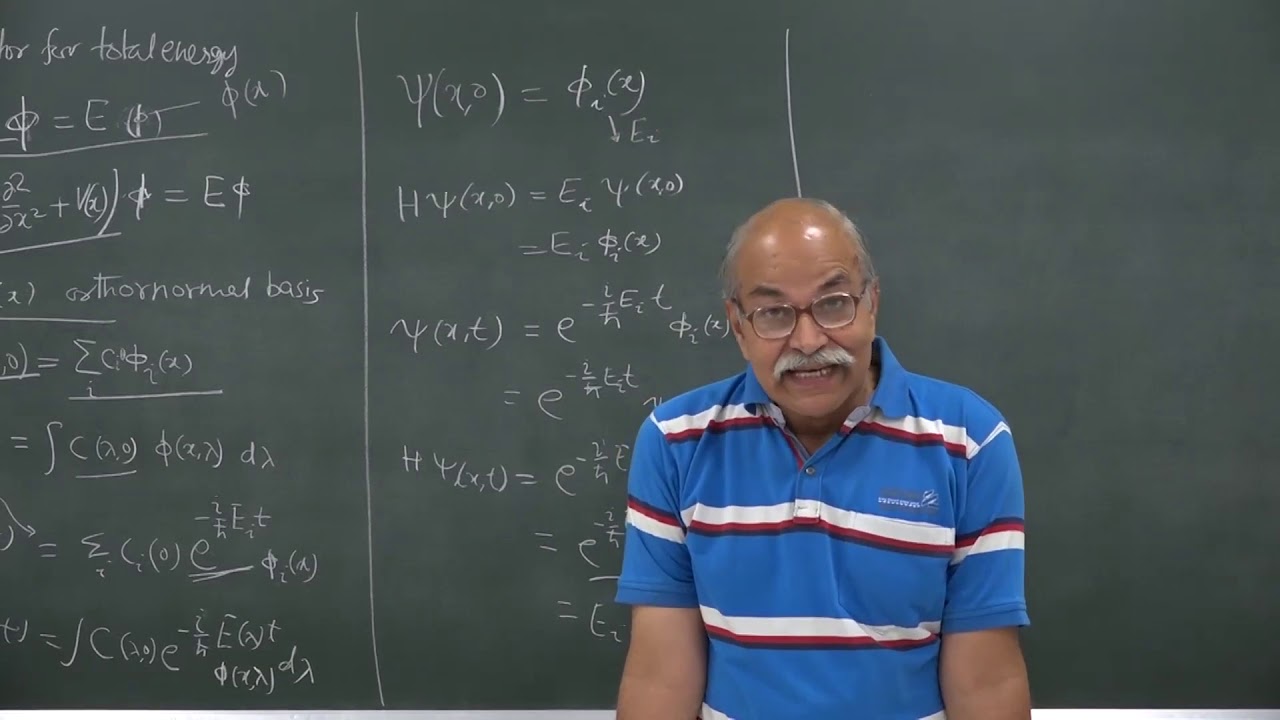
Lec 23 Time Independent Schrodinger Equation
Keywords
Summary
157 words
Critical Evaluation
Value of the Information & Strength of the Argument
The lecture provides a solid conceptual and mathematical foundation for the time-independent Schrödinger equation. The instructor carefully explains the significance of stationary states and why they are central to quantum mechanics. The argumentation is logical and builds on previous lectures, using the expansion of wave functions in eigenfunctions to illustrate the time evolution. The discussion of bound states and the infinite square well is clear and sets the stage for practical applications. The value of the information is high for students seeking a formal understanding, though the lack of visual aids and poor audio may hinder comprehension.
Scientific Rigor, Source Quality, Title Accuracy
The lecture is scientifically rigorous, with correct mathematical derivations and physical interpretations. However, no external sources are cited, and the content relies solely on the instructor’s presentation. The title accurately reflects the content, which is entirely focused on the time-independent Schrödinger equation. The lack of citations is typical for a lecture, but it limits the ability to verify claims independently. The audio quality is a significant drawback, as background noise and unclear speech can obscure key points.
189 words
Title / Content Match
The title accurately reflects the content, which focuses on deriving and interpreting the time-independent Schrödinger equation.
Quality & Reliability
7/10
The lecture is a formal physics lecture covering the time-independent Schrödinger equation, with mathematical derivations and conceptual explanations. The content is accurate but lacks citations to external sources, and the audio quality is poor due to background noise and unclear speech.
Key Moments
Markers derived by PSI from the transcript: the creator did not define chapters.
- Review of time-dependent Schrödinger equation and wave function evolution.
- Introduction of stationary states: if wave function is an eigenfunction, it remains so.
- Derivation of the time-independent Schrödinger equation as an eigenvalue equation.
- Discussion of bound states and the concept of potential energy in quantum mechanics.
- Introduction of the infinite square well potential and its physical interpretation.
- Setting up the problem for the next lecture: finding eigenfunctions of the infinite square well.
Contribution & Novelties
The lecture provides a clear pedagogical explanation of the time-independent Schrödinger equation, emphasizing the physical meaning of stationary states and their role in quantum mechanics. It bridges the gap between the time-dependent formalism and practical applications like the infinite square well.
Pour aller plus loin :
- Schrödinger equation — Provides a comprehensive overview of the equation and its variants.
- Stationary state — Explains the concept of stationary states and their properties.
- Particle in a box — Detailed treatment of the infinite square well problem, including eigenfunctions and energy levels.
89 words
Radar Profile
The radar profile shows high scores in technical level and information quality, reflecting the mathematical depth and accuracy of the lecture. The lower scores in information quantity and reliability are due to the lack of external sources and the poor audio quality, which may affect comprehension.