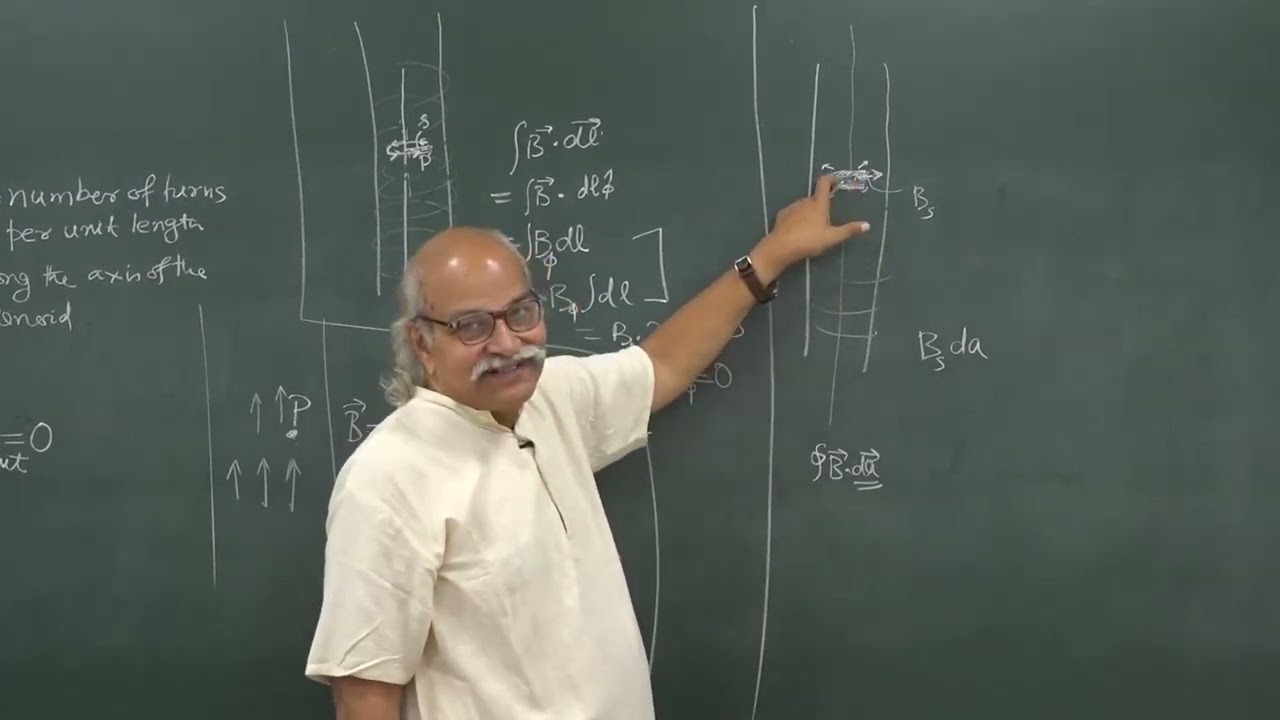
LEC 25 - Magnetic Field due to a Solenoid
Keywords
Summary
119 words
Critical Evaluation
Value of the Information & Strength of the Argument
The lecture provides a solid, step-by-step derivation of the magnetic field inside a solenoid, emphasizing the importance of symmetry and the conditions under which Ampere’s law can be applied. The argumentation is logical and rigorous, with careful attention to the assumptions (e.g., infinite solenoid, tightly wound turns) and the justification for neglecting field components. The use of a finite solenoid example from Purcell adds practical insight, showing the limits of the ideal formula. The presentation is well-structured, making it valuable for students learning electromagnetism.
Scientific Rigor, Source Quality, Title Accuracy
The lecture is scientifically rigorous, with a clear derivation based on fundamental laws (Ampere’s law, Gauss’s law for magnetism). The instructor references Purcell’s ‘Electricity and Magnetism’ for the finite solenoid example, which is a reputable source. However, no other external sources are cited, and the lecture is self-contained. The title accurately describes the content, and the lecture stays on topic throughout. The quality of the presentation is high, with clear explanations and diagrams, though the lack of citations beyond the textbook reference is a minor limitation.
185 words
Title / Content Match
The title accurately reflects the content, which is a lecture on deriving the magnetic field due to a solenoid.
Quality & Reliability
8/10
The lecture is a rigorous derivation of the magnetic field inside a solenoid using Ampere's law and symmetry arguments, with a clear step-by-step approach. The content is accurate and aligns with standard physics textbooks, though it is presented in a didactic style without external citations.
Key Moments
Markers derived by PSI from the transcript: the creator did not define chapters.
- Introduction to the solenoid and the goal of deriving the magnetic field inside.
- Setting up cylindrical coordinates and stating the goal to show B_phi and B_s are zero.
- Using a circular loop and Ampere's law to show B_phi = 0.
- Using Gauss's law for magnetism to show B_s = 0.
- Applying Ampere's law to a rectangular loop to derive B = μ₀ n I.
- Discussion of finite solenoid and reference to Purcell's textbook.
- Graph showing field variation in a finite solenoid and conclusion.
Cited Sources
- Electricity and Magnetism (Berkeley Physics Course, Vol. 2) — Referenced for the finite solenoid example and field plot.
Concurring Sources
- Solenoid magnetic field (HyperPhysics) — Provides the same formula for the magnetic field inside a solenoid, consistent with the lecture.
Contribution & Novelties
The lecture provides a clear and rigorous derivation of the magnetic field inside a solenoid, emphasizing the importance of symmetry and the conditions for applying Ampere’s law. It also discusses the practical case of finite solenoids, showing that the ideal formula holds in the central region. This is a standard topic in electromagnetism, but the pedagogical approach is effective.
Pour aller plus loin :
- Ampere’s circuital law — Fundamental law used in the derivation.
- Gauss’s law for magnetism — Used to eliminate the radial component.
- Solenoid — Overview of solenoids and their magnetic fields.
94 words
Radar Profile
The radar profile shows high scores in information quantity, quality, and reliability, with a slightly lower technical level, indicating a well-structured lecture that is accessible yet rigorous.
💬 No comments were provided for analysis.