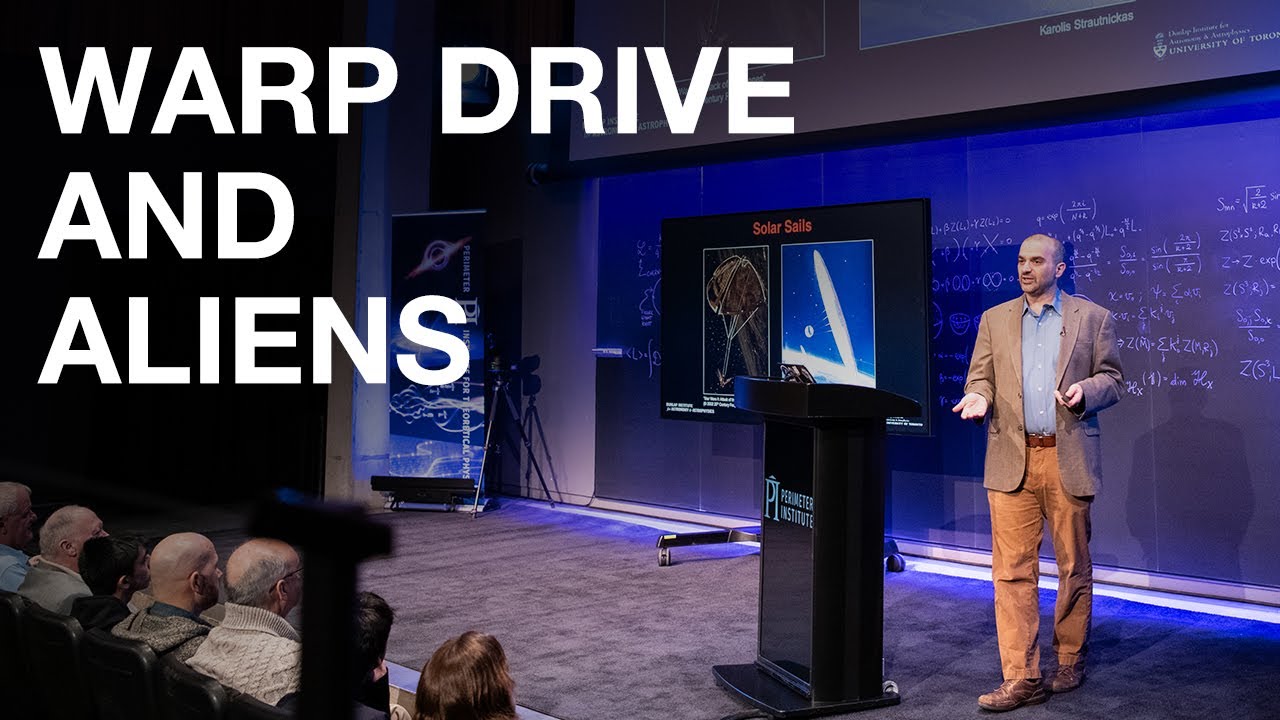
Warp Drive and Aliens: Bryan Gaensler Public Lecture
Keywords
Summary
146 words
Critical Evaluation
Value of the Information & Strength of the Argument
The lecture provides a valuable overview of current topics in astronomy and astrobiology, presented in an engaging and accessible manner. Gaensler effectively uses science fiction as a hook to explain real scientific concepts, making complex ideas like gravitational waves and black hole imaging understandable. His argumentation is solid, based on established physics and recent observational results. He clearly distinguishes between what is known, what is speculative, and what remains unknown, avoiding overstatement. The discussion of the Fermi paradox and the Drake equation is balanced, presenting multiple perspectives on the likelihood of alien life.
Scientific Rigor, Source Quality, Title Accuracy
The lecture demonstrates scientific rigor, with Gaensler referencing specific missions (e.g., Dawn), observatories (LIGO, Event Horizon Telescope), and scientific concepts (Drake equation, Fermi paradox). He appropriately attributes ideas and acknowledges uncertainties. The title accurately reflects the content, and the lecture stays on topic. The description provides links to Perimeter Institute’s general resources, but no specific scientific papers are cited. The content is consistent with the scientific consensus, and no major errors or misleading claims were identified.
184 words
Title / Content Match
The title accurately reflects the content: a public lecture on interstellar travel (warp drive) and the search for alien life.
Quality & Reliability
8/10
Lecture by a leading astronomer, based on established physics and recent discoveries, with clear explanations and appropriate caveats. Minor simplifications for a general audience, but no major inaccuracies.
Key Moments
Markers derived by PSI from the transcript: the creator did not define chapters.
- Introduction and acknowledgment of traditional territory
- Gaensler's personal story of becoming an astronomer
- Discussion of 'Oumuamua and its science fiction parallels
- First image of a black hole (M87*) and comparison to Interstellar
- Neutron star merger and gravitational waves detection
- Challenges of interstellar travel: rockets vs. ion drives
- Fermi paradox and the search for extraterrestrial intelligence
- Discussion of alien megastructures and future prospects
- Conclusion and Q&A session
Cited Sources
- Perimeter Institute Newsletter — Mentioned for updates on future lectures and events
- Perimeter Institute Donation Page — Mentioned for supporting the institute
- Perimeter Institute Public Engagement — Mentioned for public outreach programs
Concurring Sources
- Event Horizon Telescope — The image of M87* black hole was produced by this collaboration.
- LIGO — Detected gravitational waves from neutron star merger.
Contribution & Novelties
The lecture synthesizes recent astronomical discoveries and connects them to science fiction tropes, providing a fresh perspective on the search for alien life and interstellar travel. It emphasizes that real science is as exciting as fiction, and highlights the importance of continued research.
Pour aller plus loin :
- Fermi paradox — Central to the discussion of alien life.
- Drake equation — Framework for estimating the number of communicating civilizations.
- Breakthrough Starshot — A real project aiming for interstellar travel using light sails.
82 words
Radar Profile
The radar profile shows high scores in information quantity and quality, with a moderate technical level, indicating a lecture that is informative and accessible. The reliability is high, reflecting the speaker's expertise and the use of established science.
💬 Positif. Sur les 30 commentaires analysés, la grande majorité exprime une appréciation de la conférence, soulignant l'enthousiasme du conférencier et la clarté de l'exposé. Quelques commentaires apportent des précisions techniques ou des critiques mineures, mais le climat général est très favorable.