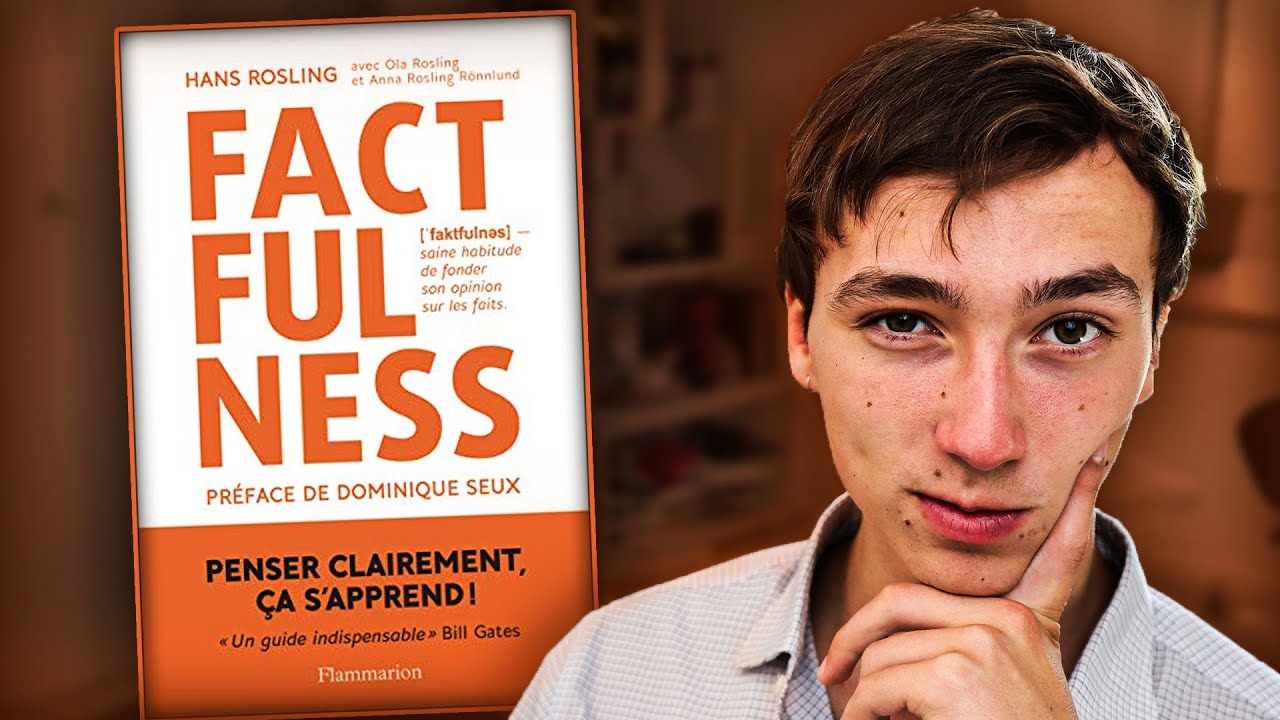
Le livre préféré de Bill Gates - FACTFULNESS (résumé détaillé)
Keywords
Summary
134 words
Critical Evaluation
Value of the Information & Strength of the Argument
The video provides a clear and engaging summary of the book’s key concepts, making complex ideas accessible. The argumentation is structured logically, following the book’s chapters and providing concrete examples for each bias. The creator’s enthusiasm for the book is evident, and he effectively conveys the importance of data-driven thinking. However, the video is a summary and does not critically evaluate the book’s claims or provide counterarguments. The example about feminism is presented as the creator’s own interpretation and may oversimplify a complex issue.
Scientific Rigor, Source Quality, Title Accuracy
The video is based on a single source: the book ‘Factfulness’ by Hans Rosling. The creator does not cite specific data or studies directly, but refers to the book’s content. The description includes links to the creator’s own notes and website, but no external scientific sources. The title accurately reflects the content, as it is indeed a detailed summary of the book. The video is a secondary source, and its reliability depends on the accuracy of the creator’s interpretation of the book.
181 words
Title / Content Match
The title accurately reflects the content: a detailed summary of the book 'Factfulness', which is indeed Bill Gates' favorite book.
Quality & Reliability
7/10
The video is a detailed summary of Hans Rosling's book 'Factfulness'. It presents the main concepts and examples from the book, but does not provide direct citations or references to the underlying data. The creator's interpretation is clear and generally faithful, but some simplifications and personal additions (e.g., the feminist example) may introduce bias.
Chapters
Cited Sources
- Notes on Factfulness (creator's notes) — The creator's own notes on the book, mentioned in the video description.
- Atomic Thinking website — The creator's online school, mentioned in the description.
- Eliott Meunier's blog — The creator's blog, linked in the description.
- Book on note-taking — The creator's book, linked in the description.
Concurring Sources
- Factfulness (book) — The book itself, which the video summarizes.
Contribution & Novelties
The video provides a concise and engaging summary of ‘Factfulness’, making its key concepts accessible to a broad audience. It highlights the importance of data literacy and critical thinking in a world of misinformation. The creator adds personal examples and interpretations, such as the discussion on feminism, which may offer a fresh perspective but also introduces potential bias.
Pour aller plus loin :
- Factfulness (book) — The original book by Hans Rosling, providing the full context and data.
- Hans Rosling’s TED talks — Hans Rosling’s presentations that visually demonstrate the data behind the book.
- Gapminder Foundation — The organization founded by Hans Rosling, offering tools and data to understand global trends.
111 words
Radar Profile
The radar profile shows high scores in quantity of information and reliability, reflecting the video's comprehensive coverage of the book's content. The lower score in technical level indicates that the video is accessible to a general audience, focusing on concepts rather than deep data analysis.
💬 No comments were provided for analysis.