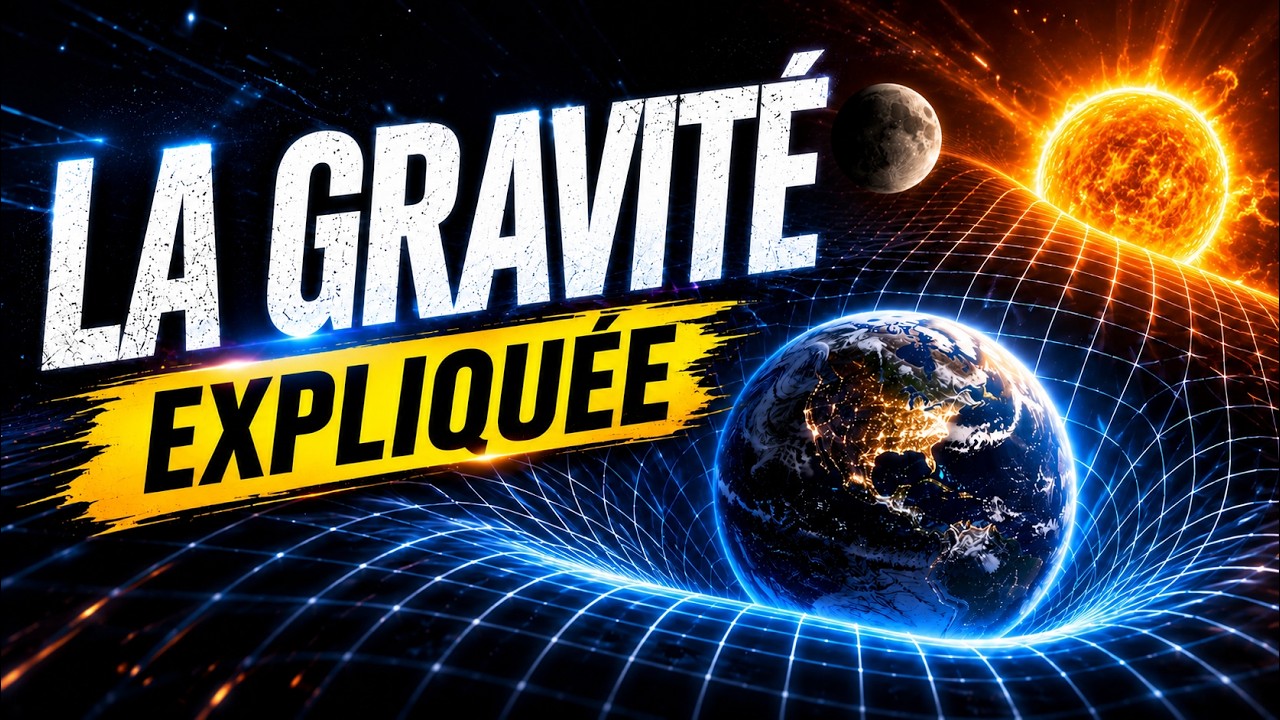
La gravité : La force que nous comprenons totalement mal !
Keywords
Summary
169 words
Critical Evaluation
Value of the Information & Strength of the Argument
The video provides a valuable and engaging synthesis of gravitational physics, from classical to modern concepts. Its argumentation is generally solid, building a logical narrative from historical misconceptions to the modern geometric interpretation. The use of analogies (rubber sheet, elevator) effectively conveys complex ideas. However, the argumentation sometimes oversimplifies, and the claim that ’everything you know about gravity is false’ is hyperbolic. The video does not delve into the mathematical details, but it offers a clear conceptual framework. It also presents speculative theories (MOND, emergent gravity) without sufficient critical evaluation, which could mislead viewers into thinking they are equally established as general relativity.
Scientific Rigor, Source Quality, Title Accuracy
The video demonstrates a good level of scientific rigor in its core explanations, but it lacks explicit citations. The description provides no references, and the video itself does not mention specific sources. The title is appropriate, though somewhat sensationalist. The content is largely accurate, but there are minor inaccuracies, such as the claim that the gravitational acceleration at the equator is about 0.5% lower than at the poles (it’s about 0.5% difference in weight, but the acceleration difference is about 0.5% as well, which is roughly correct). The video also correctly notes that the precession of Mercury’s perihelion was a problem for Newtonian gravity. Overall, the title and content are well-aligned, and the scientific content is reliable for a general audience, but the lack of sources prevents a higher score.
248 words
Title / Content Match
The title accurately reflects the content, which challenges common perceptions of gravity and presents the modern relativistic view.
Quality & Reliability
7/10
The video provides a broad and generally accurate overview of gravity, from Newton to Einstein and modern cosmology. It correctly explains key concepts like the equivalence principle, geodesics, and gravitational waves. However, it contains some simplifications and minor inaccuracies (e.g., the exact value of the gravitational acceleration at the poles vs equator, and the framing of 'gravity is not a force' can be misleading). The lack of citations and the absence of discussion of alternative interpretations (beyond a brief mention) reduce the score.
Chapters
- Le grand paradoxe de la gravité
- De l'erreur d'Aristote à Isaac Newton
- Albert Einstein et la courbure de l'espace-temps
- Comment la gravité façonne la Terre et l'évolution
- L'effet de fronde, orbites et limite de Roche
- La destruction stellaire : étoiles à neutrons et trous noirs
- La détection historique des ondes gravitationnelles
- L'énigme absolue de la matière noire et l'énergie noire
- La crise de la gravité quantique (Théorie des cordes)
- La gravité est-elle une simple illusion ?
Contribution & Novelties
The video offers a comprehensive and accessible overview of gravity, synthesizing historical and modern perspectives. Its main contribution is in making complex concepts like spacetime curvature and geodesics understandable to a general audience. It also connects gravity to broader topics like biological evolution and the mysteries of dark matter and dark energy, providing a holistic view.
Pour aller plus loin :
- General relativity — Provides a detailed mathematical and conceptual overview of Einstein’s theory.
- Equivalence principle — Explains the foundational principle behind general relativity.
- Gravitational wave — Discusses the detection of gravitational waves by LIGO, a key confirmation of general relativity.
- Dark matter — Explores the evidence for and theories about dark matter, a major unsolved problem in cosmology.
- Modified Newtonian dynamics — Introduces an alternative theory to dark matter, mentioned in the video.
134 words
Radar Profile
The radar profile shows high scores in quantity of information and technical level, indicating a content-rich video with a moderate depth. The quality and reliability scores are slightly lower, reflecting the lack of citations and minor simplifications. Overall, the video is informative but not deeply rigorous.