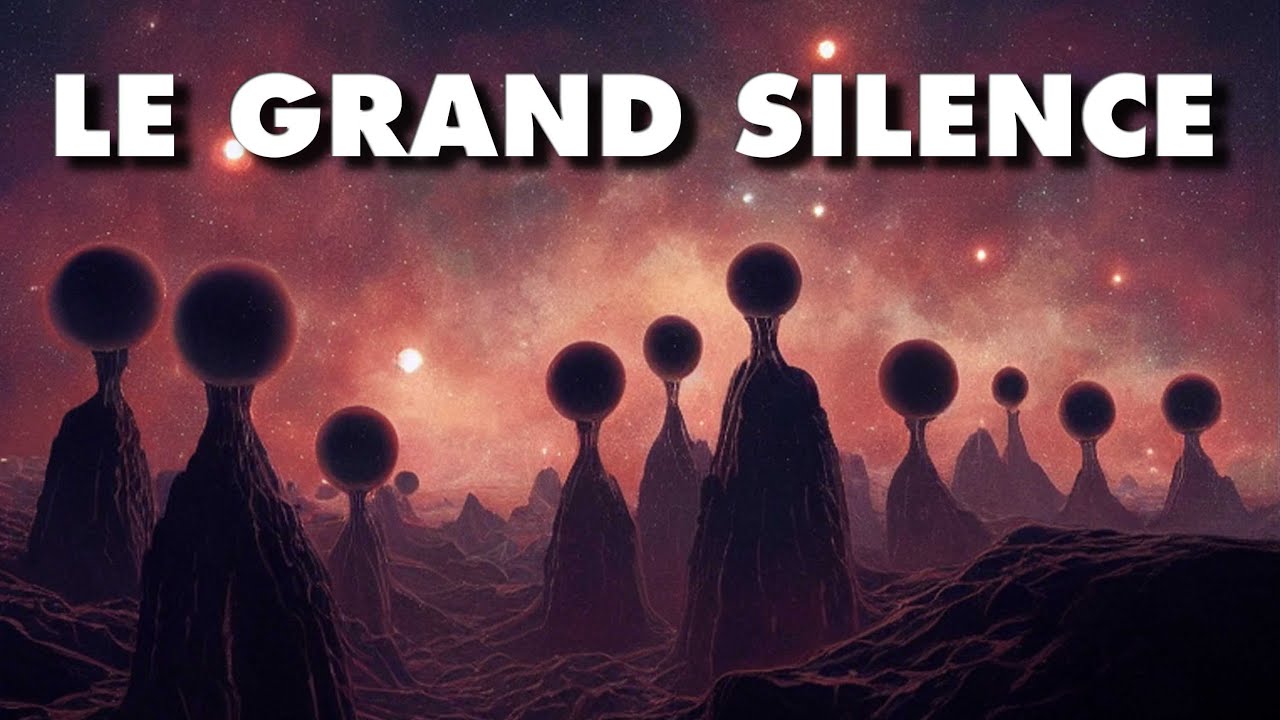
Extraterrestres, pourquoi ce GRAND SILENCE ?
Keywords
Summary
167 words
Critical Evaluation
Value of the Information & Strength of the Argument
The video provides a compelling and accessible synthesis of the Fermi paradox and the Great Filter hypothesis. It effectively uses thought experiments, such as the hypothetical planet X, to illustrate the vast time scales involved and the potential technological gap between us and older civilizations. The argumentation is logical and well-structured, building from the basic premises of the Drake equation to the various possible filters. It presents multiple perspectives and acknowledges the speculative nature of the topic, which strengthens its credibility. The video also does a good job of connecting the abstract concept of the Great Filter to our own future, making it both intellectually stimulating and existentially relevant.
Scientific Rigor, Source Quality, Title Accuracy
The video demonstrates a good level of scientific rigor for a popular science format. It cites a range of sources in the description, including articles from Scientific American, Quanta Magazine, and the CNRS journal, as well as Wikipedia pages on the Drake equation and the Rare Earth hypothesis. These sources are reputable and relevant to the topic. The video clearly distinguishes between established facts and speculative hypotheses, and it acknowledges the uncertainties involved. The title accurately reflects the content, and the video stays on topic throughout. The inclusion of a sponsored segment for NordVPN is clearly marked and does not detract from the scientific content.
229 words
Title / Content Match
The title accurately reflects the content, which explores the Fermi paradox and the Great Filter as a possible explanation for the absence of detectable extraterrestrial civilizations.
Quality & Reliability
8/10
The video presents a well-structured overview of the Fermi paradox and the Great Filter hypothesis, drawing on a range of popular science sources and thought experiments. It clearly distinguishes between established facts (e.g., number of exoplanets) and speculative hypotheses, and acknowledges the uncertainty inherent in the topic. The reasoning is logical and the presentation is engaging, though it relies on simplified estimates and does not delve into the most recent scientific debates.
Chapters
Cited Sources
- The Fermi Paradox — A comprehensive and popular explanation of the Fermi paradox, likely a major inspiration for the video's structure and arguments.
- The Drake Equation Revisited — An article revisiting the Drake equation, providing context for the estimates of the number of civilizations.
- How many alien worlds exist? — A BBC Future article discussing the number of potentially habitable planets, supporting the video's estimates.
- Searching for Interstellar Communications — The original 1959 paper by Cocconi and Morrison proposing the search for extraterrestrial radio signals, a foundational reference for SETI.
- The Fermi Paradox Is Not Fermi's, and It Is Not a Paradox — A Scientific American blog post offering a critical perspective on the Fermi paradox, possibly used to nuance the discussion.
- Drake equation — Wikipedia page on the Drake equation, providing the range of estimates for the number of civilizations.
- Rare Earth hypothesis — Wikipedia page on the Rare Earth hypothesis, which suggests that complex life is extremely rare, a concept related to the Great Filter.
- Équation de Drake — French Wikipedia page on the Drake equation, likely used for the French-speaking audience.
- Paradoxe de Fermi — French Wikipedia page on the Fermi paradox, including the planetarium hypothesis, a specific solution mentioned in the video.
- 11 of the Weirdest Solutions to the Fermi Paradox — A Gizmodo article listing various solutions to the Fermi paradox, providing a broader context for the Great Filter.
- A List of Solutions to the Fermi Paradox — A blog post compiling solutions to the Fermi paradox, likely used as a reference for the video's overview.
- Le paradoxe de Fermi et les extraterrestres invisibles — A CNRS journal article discussing the Fermi paradox and the idea of invisible extraterrestrials, a relevant perspective.
- Galaxy Simulations Offer a New Solution to the Fermi Paradox — A Quanta Magazine article presenting a simulation-based solution to the Fermi paradox, adding a modern scientific angle.
- L'équation de Drake — A French popular science blog post on the Drake equation, likely used for the French-speaking audience.
- Le paradoxe de Fermi : réflexions sur la vie ailleurs et sur Terre — A Pour la Science article on the Fermi paradox, providing a French-language perspective.
- Where Are They? — A MIT Technology Review article discussing the implications of discovering life elsewhere, likely used for the section on the 'terrible nature of filters'.
- The Drake Equation Revisited — A Nature article revisiting the Drake equation, providing a scientific basis for the estimates.
- The Drake Equation — The SETI Institute's page on the Drake equation, a standard reference.
- A new analysis of the Drake equation — A peer-reviewed article analyzing the Drake equation, adding scientific depth.
Concurring Sources
- The Fermi Paradox — This source provides a detailed and popular explanation of the Fermi paradox, aligning with the video's presentation of the problem and the Great Filter solution.
- The Drake Equation Revisited — This article revisits the Drake equation, supporting the video's use of estimates for the number of civilizations.
- Galaxy Simulations Offer a New Solution to the Fermi Paradox — This article presents a simulation-based solution to the Fermi paradox, which is consistent with the video's discussion of potential filters.
Dissenting Sources
- The Fermi Paradox Is Not Fermi's, and It Is Not a Paradox — This source argues that the Fermi paradox is not a true paradox, challenging the premise of the video. It suggests that the lack of detection may be due to our limited search capabilities or the nature of advanced civilizations, rather than a Great Filter.
External References
Contribution & Novelties
The video’s main contribution is its clear and engaging synthesis of the Fermi paradox and the Great Filter hypothesis, making these complex ideas accessible to a broad audience. It effectively uses visual metaphors and thought experiments to convey the vast timescales and probabilities involved. The video also highlights the existential implications of the Great Filter, prompting viewers to reflect on humanity’s future. While it does not present new scientific research, it serves as a valuable educational resource that stimulates curiosity and critical thinking.
Pour aller plus loin :
- The Fermi Paradox — A comprehensive overview of the paradox and its proposed solutions.
- Great Filter — A detailed explanation of the Great Filter hypothesis.
- Drake equation — The foundational equation for estimating the number of communicative civilizations.
- Rare Earth hypothesis — A hypothesis suggesting that complex life is extremely rare in the universe.
- Astrobiology — The interdisciplinary field studying the origin, evolution, and distribution of life in the universe.
158 words
Radar Profile
The radar profile shows high scores in information quantity, quality, and reliability, with a slightly lower score in technical level. This indicates that the video is rich in content and well-sourced, but it is accessible to a general audience rather than being highly technical. The overall profile suggests a balanced and reliable popular science presentation.
💬 Très positif. Sur les 30 commentaires analysés, les spectateurs expriment une admiration quasi unanime pour la qualité de la vulgarisation, la clarté des explications et la beauté de la narration, tout en engageant des réflexions personnelles sur le sujet.