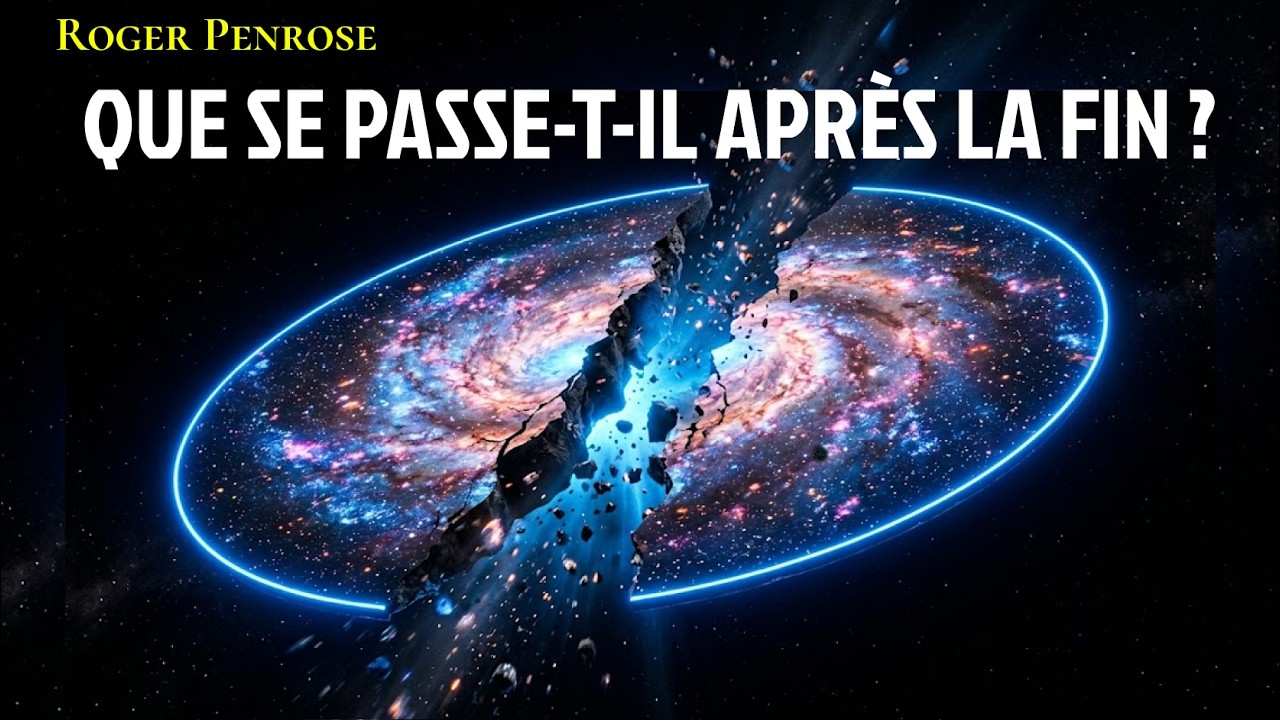
Que Se Passe-t-il Après la Fin de l’Univers ?
Keywords
Summary
118 words
Critical Evaluation
Value of the Information & Strength of the Argument
The video provides substantial information, explaining complex concepts like conformal invariance and entropy with clarity. It presents Penrose’s arguments logically, from the improbability of the initial low-entropy state to the geometric identification of the future and past boundaries. The argumentation is solid, though it sometimes presents speculative ideas with more confidence than warranted, and the disclaimer about AI-generated content and pedagogical reformulation is a caveat.
Scientific Rigor, Source Quality, Title Accuracy
The video references several of Penrose’s books and a specific paper with Gurzadyan, but does not provide direct URLs. The sources are credible, but the lack of formal citations reduces the verifiability. The title accurately reflects the content, and the video’s scientific rigor is generally good, but the speculative nature of some claims and the AI-generated content require caution.
139 words
Title / Content Match
The title accurately reflects the content, which explores the end of the universe and Penrose's cyclic cosmology.
Quality & Reliability
7/10
The video presents established cosmology and Penrose's CCC theory with reasonable accuracy, but includes speculative elements (e.g., Higgs field relaxation) and a disclaimer that 15% is pedagogical reformulation. Sources are mentioned but not formally cited with URLs.
Key Moments
Markers derived by PSI from the transcript: the creator did not define chapters.
- Introduction to the heat death scenario and Penrose's challenge.
- Explanation of the arrow of time and the low-entropy initial state.
- Discussion of the Weyl curvature hypothesis and Penrose's credentials.
- The concept of conformal invariance and the loss of time and scale.
- The role of the Higgs field and the speculative disappearance of mass.
- The conformal cyclic cosmology model and the work of Paul Tod.
- Hawking points as potential observational evidence in the CMB.
- Discussion of the 2010 Penrose-Gurzadyan paper and its reception.
- Summary of the cyclic model and its implications.
Cited Sources
- Cycles of Time: An Extraordinary New View of the Universe — Penrose's book presenting the CCC theory.
- The Road to Reality — Penrose's comprehensive overview of physics.
- Concentric circles in WMAP data may provide evidence of violent pre-Big-Bang activity — Penrose and Gurzadyan's paper on Hawking points.
- The Nature of Space and Time — Book by Hawking and Penrose on singularities.
- Paul Tod's contributions to conformal geometry and CCC — Mentioned as a key contributor to the mathematical framework.
- GW150914 detection by LIGO — Referenced as an example of gravitational wave events.
Concurring Sources
- Cycles of Time — Penrose's book is the primary source for CCC.
- Concentric circles in WMAP data — The paper proposing Hawking points.
Dissenting Sources
- Inflationary cosmology — The video mentions that inflation does not explain the initial low-entropy state, a point contested by some cosmologists.
Contribution & Novelties
The video synthesizes Penrose’s CCC theory in an accessible way, highlighting the geometric continuity between the end of one aeon and the beginning of the next. It emphasizes the role of conformal invariance and the speculative nature of mass disappearance, which is not widely known.
Pour aller plus loin :
- Conformal Cyclic Cosmology - Wikipedia — Overview of the theory and its reception.
- Weyl curvature hypothesis - Wikipedia — Explanation of the hypothesis central to CCC.
- Heat death of the universe - Wikipedia — Standard cosmological end scenario.
- Hawking radiation - Wikipedia — Mechanism for black hole evaporation.
98 words
Radar Profile
The radar profile shows high scores in information quantity and technical level, but slightly lower in quality and reliability, reflecting the speculative nature of some claims and the lack of formal citations.