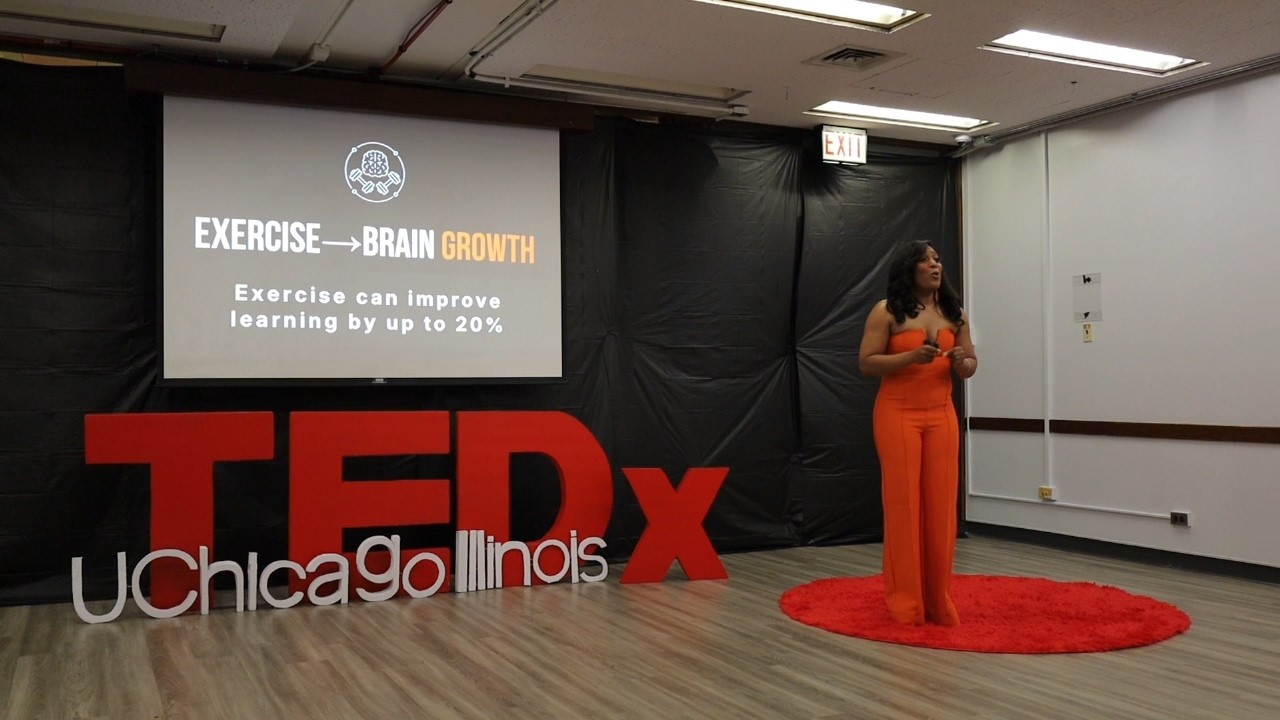
Accelerating Into Who You Were Meant to Be
Keywords
Summary
140 words
Critical Evaluation
Value of the Information & Strength of the Argument
The talk’s value lies in its motivational framing of exercise as a cognitive enhancer, supported by a personal success story. The argumentation is coherent, moving from personal experience to scientific claims, but the scientific evidence is presented in a simplified, general manner without specific studies or data. The speaker’s credibility is established through her professional background, but the lack of detailed citations weakens the scientific rigor. The emotional appeal and relatable narrative of failure and recovery strengthen the argument’s persuasive power, though it may not satisfy a scientifically rigorous audience.
Scientific Rigor, Source Quality, Title Accuracy
The talk references general exercise science research, mentioning BDNF and cognitive improvements, but does not provide specific sources or studies. The description links only to the general TEDx page, not to any cited research. The title is somewhat vague but aligns with the content’s focus on personal growth through physical discipline. The talk’s scientific accuracy is plausible but not thoroughly substantiated, making it more of an inspirational talk than a rigorous scientific presentation.
178 words
Title / Content Match
The title accurately reflects the talk's theme of personal and professional acceleration through physical discipline, though it is somewhat vague and inspirational.
Quality & Reliability
6/10
The talk presents a personal narrative supported by general references to exercise science (e.g., BDNF, cognitive benefits) but lacks specific citations or detailed scientific evidence. The claims are plausible and align with established research, but the presentation is largely anecdotal and motivational.
Key Moments
Markers derived by PSI from the transcript: the creator did not define chapters.
- Introduction and interactive exercise to demonstrate body-brain connection.
- Introduction of the 'muscle mind continuum' concept.
- Personal story of being born premature and overcoming developmental challenges.
- Scientific claims about exercise, BDNF, and cognitive benefits.
- Personal anecdote of academic failure and rebuilding discipline.
- Introduction of the ERR framework (Energy, Routine, Recovery).
- Conclusion and call to action for sustainable success.
Cited Sources
- TEDx Talks — General TEDx page mentioned in the video description.
Concurring Sources
- Exercise and cognition — Supports the claim that physical activity improves cognitive functions.
- Brain-derived neurotrophic factor — Confirms the role of BDNF in brain plasticity and its increase with exercise.
Contribution & Novelties
The talk offers a personal and motivational perspective on the well-established link between physical activity and cognitive function, framing it as a ‘muscle mind continuum’ with a practical framework (ERR). While not scientifically novel, it provides an accessible synthesis for a general audience.
Pour aller plus loin :
- Brain-derived neurotrophic factor — Key protein mentioned, central to the talk’s scientific claims.
- Exercise and cognition — Overview of research on how physical activity affects cognitive functions.
- Executive functions — Cognitive processes highlighted as improved by exercise.
- Stress resilience — Concept related to the talk’s emphasis on stress management through physical discipline.
100 words
Radar Profile
The radar profile shows moderate scores across all dimensions, with slightly higher quality and reliability compared to quantity and technical depth. This reflects a talk that is scientifically plausible but lacks detailed evidence and technical rigor, making it more motivational than deeply informative.