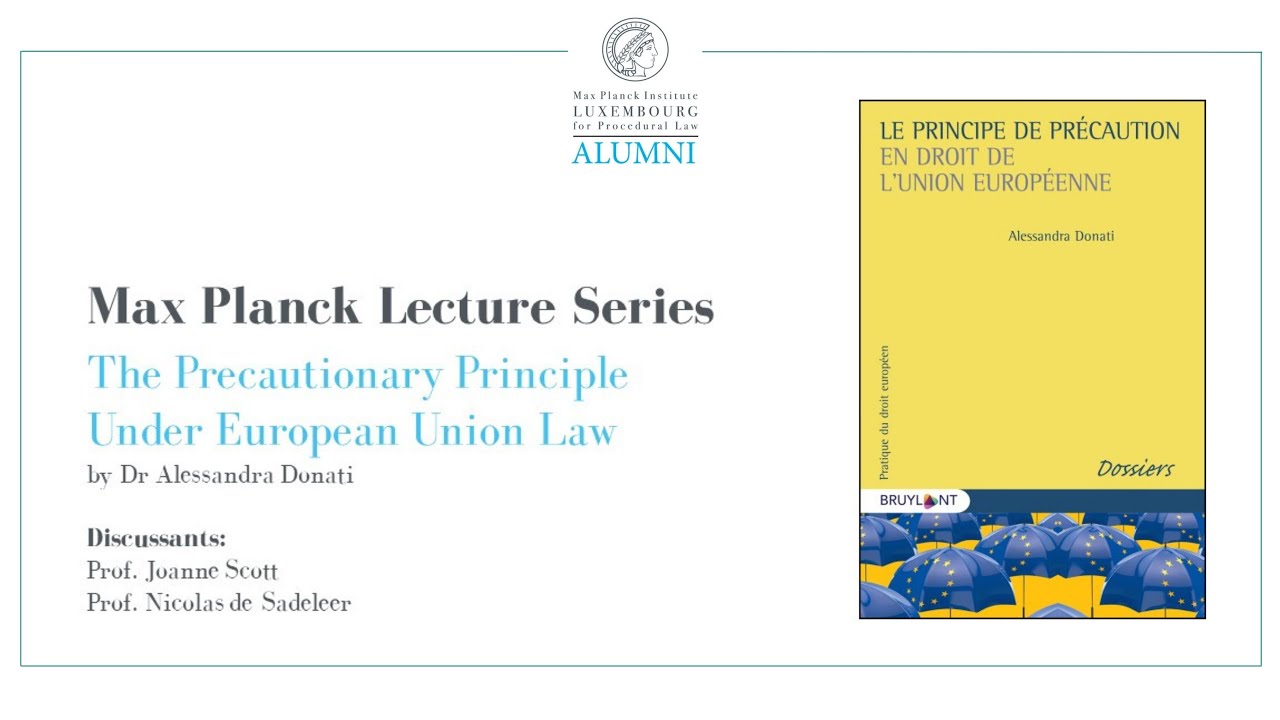
Max Planck Lecture Series - The Precautionary Principle Under European Union Law
Keywords
Summary
183 words
Critical Evaluation
Value of the Information & Strength of the Argument
The lecture offers a sophisticated and original analytical framework for understanding the precautionary principle, moving beyond simplistic definitions to capture its complexity. The use of nodal governance theory and the network metaphor provides a novel lens for legal analysis. The argumentation is well-structured, building from the theoretical foundation to practical implications. The speaker effectively supports her claims with references to EU legislation (Article 191 TFEU) and case law, and she acknowledges the principle’s limitations, such as the difficulty of enforcement. The discussants’ comments, particularly Prof. Scott’s probing questions about the conceptual distinctions and the need for vertical linkages, add critical depth to the presentation.
Scientific Rigor, Source Quality, Title Accuracy
The lecture demonstrates strong scientific rigor, drawing on the author’s doctoral research and published book. The sources cited include EU treaties, case law of the Court of Justice, and academic scholarship, though specific references are not always explicitly detailed in the video. The title accurately reflects the content, which is a focused examination of the precautionary principle in EU law. The presence of two distinguished discussants, Prof. Joanne Scott and Prof. Nicolas de Sadeleer, enhances the credibility of the presentation. The lecture is a formal academic event, and the content is presented with appropriate nuance and caution.
216 words
Title / Content Match
The title accurately reflects the content: a focused lecture on the precautionary principle in EU law, presented by the author of a book on the subject.
Quality & Reliability
8/10
The lecture is delivered by an academic expert (Dr. Alessandra Donati) presenting her peer-reviewed book, with commentary from two established professors in the field. The content is well-structured, references EU law and case law, and is presented in a formal academic setting. However, it is a single presentation with limited critical engagement from the discussants, and the claims are not systematically verified against primary sources in the video.
Key Moments
Markers derived by PSI from the transcript: the creator did not define chapters.
- Introduction and thanks by the moderator, Elena, and Dr. Donati.
- Dr. Donati introduces the topic and explains the rationale for her research on the precautionary principle.
- Discussion of the post-modern nature of the precautionary principle, its flexibility and complexity.
- Explanation of the methodological approach: methodological pluralism and the network metaphor (knots and links).
- Introduction of the two main hubs: anticipation and action, and their components.
- Detailed analysis of the 'anticipation' hub: legal qualification and scientific evaluation of uncertain risks.
- Analysis of the 'action' hub: procedural obligations (duty of care, motivation) and substantive discretion.
- Discussion of the weak links in the network, such as the lack of standards for expertise.
- Conclusion: future challenges, including the weak liability regime and potential extensions to climate risks and corporate sustainability.
- Prof. Joanne Scott's commentary, raising questions about the conceptual clarity of 'knots' and 'hubs' and the need for vertical linkages.
Cited Sources
- The Precautionary Principle Under European Union Law (book) — Dr. Donati's book, which is the basis of the lecture.
- Article 191 TFEU — The legal basis of the precautionary principle in EU law.
- Case law of the Court of Justice of the European Union — Referenced throughout the lecture to illustrate the application of the precautionary principle.
Concurring Sources
- Precautionary principle — General overview of the principle, consistent with the lecture's description.
Contribution & Novelties
The lecture offers a novel analytical framework for the precautionary principle, using nodal governance theory to map its complexity. It provides a structured way to understand the principle’s application, identifying key concepts and their interconnections. The emphasis on ‘weak links’ and the need for further development (e.g., in liability and future generations) highlights areas for future research.
Pour aller plus loin :
- Precautionary principle — Provides a general overview of the principle and its applications.
- Nodal governance — Explains the theory of nodal governance, which underpins the analytical framework.
- European Union law — Offers context on the legal system in which the precautionary principle operates.
105 words
Radar Profile
The radar profile shows high scores across all dimensions, indicating a well-rounded and reliable presentation. The lecture is information-dense, technically sound, and credible, with a strong balance between theoretical depth and practical relevance.