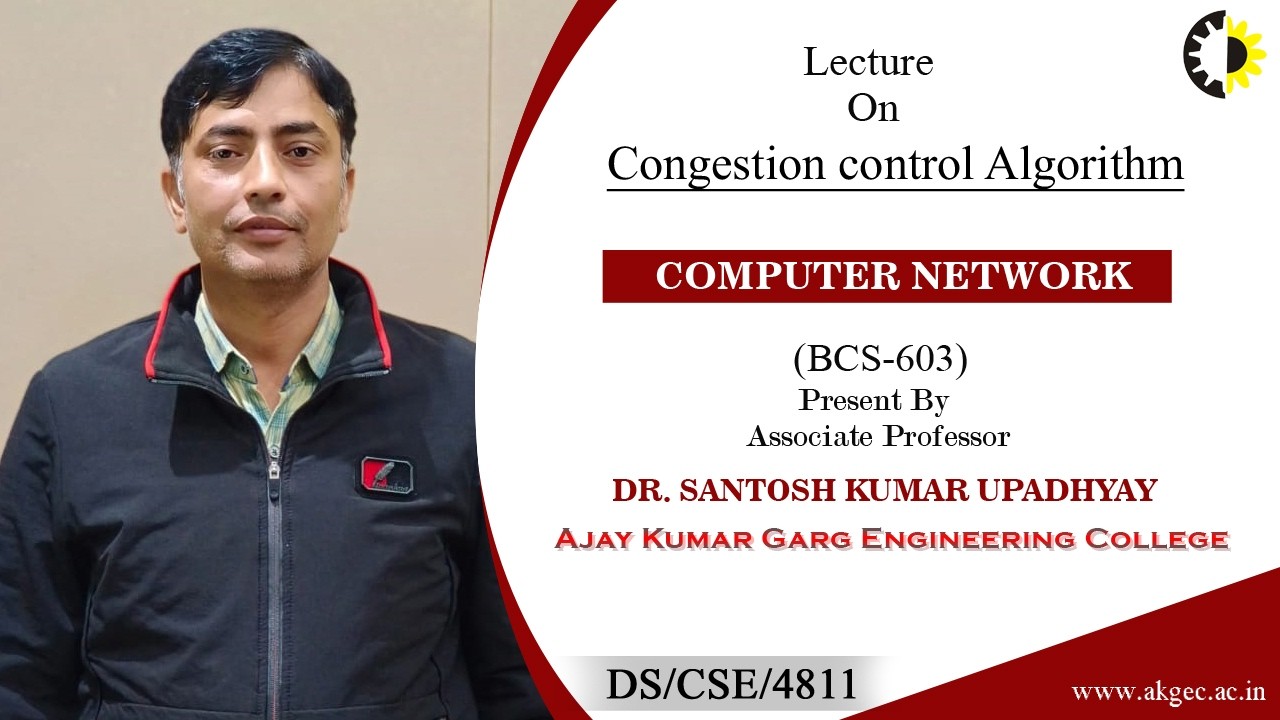
CONGESTION CONTROL ALGORITHM | COMPUTER NETWORK | LECTURE 05 BY DR. SANTOSH KUMAR UPADHYAY | AKGEC
Keywords
Summary
185 words
Critical Evaluation
Value of the Information & Strength of the Argument
The lecture provides a clear and accessible explanation of two fundamental congestion control algorithms, using analogies (water bucket) to aid understanding. The argumentation is logical, progressing from the problem of congestion to the solutions. However, the depth is limited: it does not discuss the mathematical models (e.g., leaky bucket as a queue with constant service rate), the impact on TCP (e.g., congestion avoidance algorithms like Reno, Cubic), or practical considerations such as buffer sizing and QoS. The comparison between leaky and token bucket is qualitative, lacking quantitative analysis of trade-offs.
Scientific Rigor, Source Quality, Title Accuracy
The lecture is a standard educational presentation without citations to external sources or standards (e.g., RFCs). The content aligns with common textbook material (e.g., Tanenbaum’s ‘Computer Networks’), but no specific references are given. The title accurately describes the content. The description provides links to the institution and the course playlist, but no direct references to the algorithms’ origins or further reading.
166 words
Title / Content Match
The title accurately reflects the content: a lecture on congestion control algorithms in computer networks.
Quality & Reliability
6/10
The lecture provides a clear, structured introduction to congestion control algorithms (leaky bucket and token bucket) with analogies and step-by-step explanations. However, it lacks depth in mathematical formalization, practical implementation details, and references to standards or research. The content is accurate but basic, suitable for an introductory university course.
Key Moments
Markers derived by PSI from the transcript: the creator did not define chapters.
- Introduction to congestion and its effects
- Definition of congestion control and traffic shaping
- Leaky bucket algorithm explanation with analogy
- Disadvantages of leaky bucket: packet loss and inefficient bandwidth use
- Token bucket algorithm introduction and steps
- Comparison of leaky bucket and token bucket, highlighting token bucket's flexibility
Cited Sources
- AKGEC Official Website — Institution providing the lecture
- Computer Network Playlist — Course playlist containing this lecture
Concurring Sources
- Leaky bucket — General concept aligns with lecture's explanation
- Token bucket — General concept aligns with lecture's explanation
Contribution & Novelties
The lecture offers a straightforward pedagogical introduction to congestion control algorithms, suitable for undergraduate students. It clearly contrasts leaky bucket and token bucket, emphasizing the token bucket’s ability to handle bursts. However, it does not introduce novel concepts or recent developments.
Pour aller plus loin :
- Leaky bucket — Wikipedia article providing formal definition and variants.
- Token bucket — Wikipedia article with detailed explanation and comparison.
- TCP congestion control — Overview of congestion control at transport layer, including algorithms like Reno and Cubic.
- RFC 896: Congestion Control in IP/TCP Internetworks — Early standard discussing congestion control principles.
97 words
Radar Profile
The radar profile shows moderate scores across all dimensions, indicating a balanced but introductory lecture. The highest score is in information quantity, reflecting the coverage of two algorithms, while technical depth and reliability are moderate, consistent with a basic educational video.