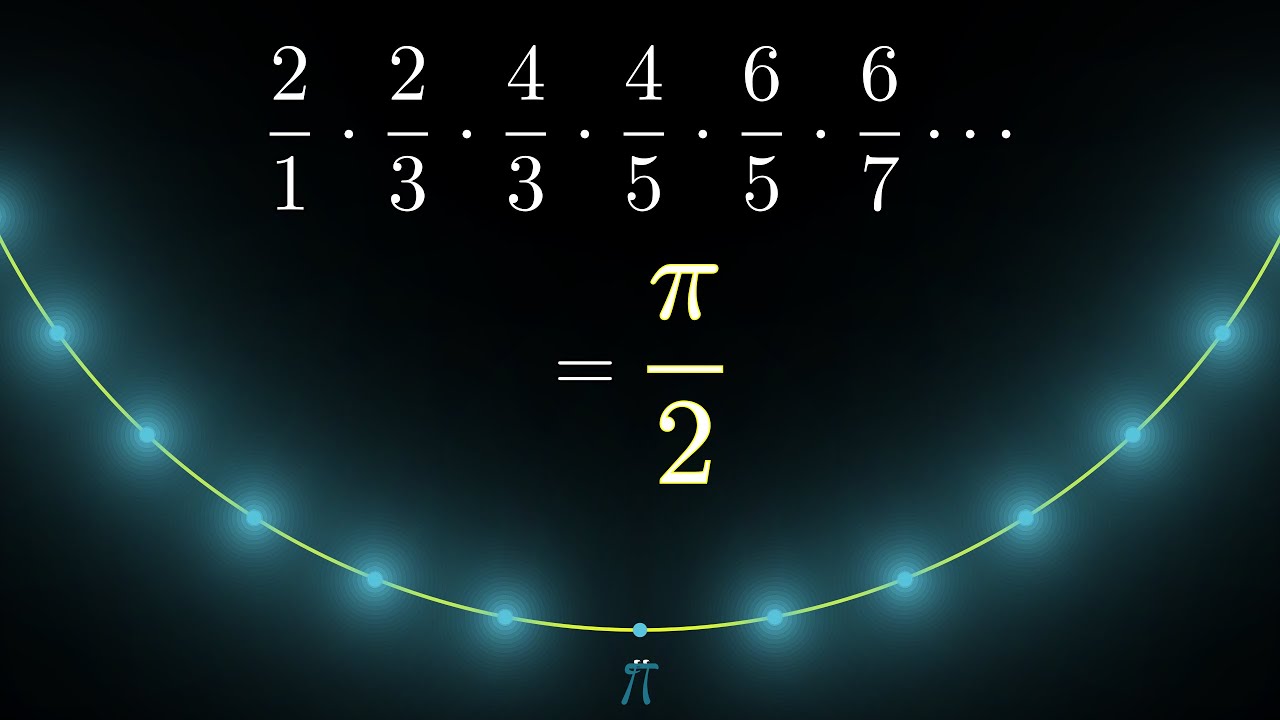
The Wallis product for pi, proved geometrically
Keywords
Summary
210 words
Critical Evaluation
Value of the Information & Strength of the Argument
The video provides a novel and elegant proof of a classical result, offering a fresh perspective that connects the Wallis product to geometry in a visually intuitive way. The argument is carefully constructed, building from simple geometric facts to the final product, and the use of complex numbers is well-motivated. The proof is not only correct but also insightful, revealing deeper connections (e.g., the sine product). The discussion of the exchange of limits is particularly valuable, as it addresses a common point of confusion and demonstrates mathematical rigor.
Scientific Rigor, Source Quality, Title Accuracy
The video is scientifically rigorous, with a clear and logical proof. The creators acknowledge the need for formal justification (dominated convergence) and provide a supplementary blog post for details. The description includes links to relevant sources, such as the Wikipedia article on dominated convergence, a blog post on the topic, and a paper by Johan Wästlund on an alternative approach. The title accurately reflects the content, and the video’s high quality is consistent with the channel’s reputation. The comments are overwhelmingly positive, praising the originality and clarity of the proof.
193 words
Title / Content Match
The title accurately describes the content: a geometric proof of the Wallis product for pi.
Quality & Reliability
9/10
The video presents an original geometric proof of the Wallis product, with rigorous attention to the exchange of limits (dominated convergence) and clear explanations of the underlying complex analysis. The argument is well-structured and the mathematical steps are justified, with references to supplementary material for technical details.
Key Moments
Markers derived by PSI from the transcript: the creator did not define chapters.
- Introduction: presenting the Wallis product and the goal of a geometric proof.
- Setting up the lighthouse and observer configuration on a circle.
- Proving the first key lemma: product of distances is 2 when observer is midway between lighthouses.
- Proving the second key lemma: product of distances is n when observer is at a lighthouse (with that lighthouse removed).
- Introducing the keeper and sailor configuration and the ratio of distance products.
- Calculating the ratio via individual lighthouse contributions, leading to the Wallis product.
- Addressing the exchange of limits and the need for dominated convergence.
- Generalizing the argument to derive the sine product formula.
- Connecting the sine product to Euler's solution of the Basel problem.
Cited Sources
- Dominated convergence theorem - Wikipedia — Referenced as the formal justification for exchanging limits and infinite products.
- Dominated Convergence Theorem - Math3ma blog — A blog post on the dominated convergence theorem, linked for further reading.
- Johan Wästlund's paper on the Wallis product — An alternative approach to the Wallis product, mentioned in the video and description.
- Knuth's 'Why Pi?' talk at Stanford — A blog post discussing Donald Knuth's talk building on Wästlund's work.
- 3Blue1Brown supplemental blog post on Wallis product — Referenced in the video comments as the supplemental blog post by Sridhar Ramesh.
Concurring Sources
- Dominated convergence theorem - Wikipedia — Supports the rigorous exchange of limits used in the proof.
- Johan Wästlund's paper — Provides an alternative proof of the Wallis product, confirming the result.
External References
Contribution & Novelties
The video presents an original geometric proof of the Wallis product, which is a novel contribution to the exposition of this classical result. The proof is elegant and intuitive, using a lighthouse metaphor to make the complex analysis accessible. It also generalizes to the sine product formula, providing a unified perspective. The discussion of dominated convergence adds rigor and educational value.
Pour aller plus loin :
- Wallis product - Wikipedia — Background on the Wallis product and its history.
- Sine product formula - Wikipedia — The generalization to the sine product, as derived in the video.
- Basel problem - Wikipedia — Euler’s solution, which is connected to the sine product.
110 words
Radar Profile
The radar profile shows very high scores across all dimensions, with particularly strong performance in information quality and reliability. The video excels in providing a novel, well-explained proof with rigorous attention to mathematical details, making it an excellent educational resource.
💬 Très positif. Sur les 30 commentaires analysés, l'enthousiasme est unanime, saluant l'originalité de la preuve, la clarté des explications et la qualité des animations, avec quelques échanges techniques sur les subtilités de la convergence.