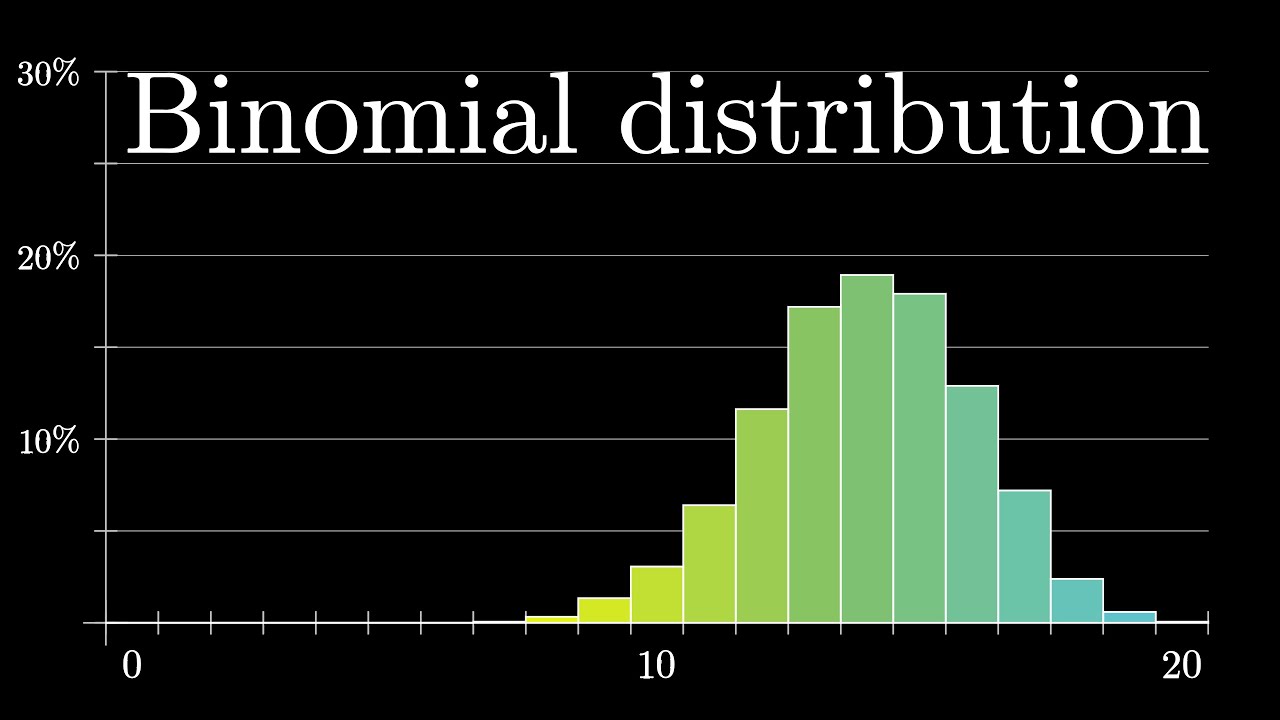
Binomial distributions | Probabilities of probabilities, part 1
Keywords
Summary
180 words
Critical Evaluation
Value of the Information & Strength of the Argument
The video provides substantial value by connecting a real-world decision problem to core statistical concepts. It clearly explains the binomial distribution, its formula, and its interpretation, using both simulation and mathematical derivation. The argumentation is solid, building logically from the problem setup to the likelihood function, and it effectively motivates the need for Bayesian methods. The use of visualizations and step-by-step reasoning enhances understanding without oversimplifying the mathematics.
Scientific Rigor, Source Quality, Title Accuracy
The video demonstrates high scientific rigor, with accurate mathematical content and clear explanations. It cites a relevant blog post by John Cook as the inspiration for the example, and the description includes links to the channel’s resources and the open-source animation library used. The title accurately reflects the content, which focuses on binomial distributions and their role in reasoning about probabilities. The video does not overstate claims and appropriately notes the limitations of the simplified model, promising further discussion in subsequent parts.
165 words
Title / Content Match
The title accurately reflects the content, which introduces binomial distributions in the context of estimating probabilities from data.
Quality & Reliability
9/10
High-quality educational content from a reputable mathematics channel, with clear explanations, animations, and references to a blog post by John Cook. The mathematical derivations are accurate and well-illustrated.
Key Moments
Markers derived by PSI from the transcript: the creator did not define chapters.
- Introduction of the problem: choosing among sellers with different ratings and review counts.
- Preview of Laplace's rule of succession as a simple answer.
- Setting up the model: each seller has an unknown success rate s.
- Simulation of 10 reviews with a 95% success rate, showing variability.
- Derivation of the binomial distribution formula for 48 successes out of 50.
- Visualization of the binomial distribution for different success rates.
- Plotting the likelihood function as a function of s.
- Discussion of the likelihood for 10/10 reviews and the need for Bayesian inversion.
- Conclusion and preview of part 2 on Bayes' rule and probability densities.
Cited Sources
- A Bayesian Review of Amazon Resellers — The video is based on this blog post, which presents the seller rating problem.
- Manim (animation library) — The animations in the video are made using this open-source Python library.
- 3Blue1Brown website — Official website of the channel with additional resources.
- Part 2 video — Continuation of the series, covering Bayesian updating.
Concurring Sources
- A Bayesian Review of Amazon Resellers — The video's example is directly inspired by this blog post, which discusses the same problem from a Bayesian perspective.
External References
Contribution & Novelties
The video’s original contribution lies in its pedagogical approach, using a relatable e-commerce scenario to introduce the binomial distribution and likelihood functions, and to motivate Bayesian reasoning. It effectively bridges intuitive questions with formal mathematics, making the concepts accessible without sacrificing rigor.
Pour aller plus loin :
- Binomial distribution (Wikipedia) — Provides a comprehensive overview of the distribution, its properties, and applications.
- Bayes’ theorem (Wikipedia) — Essential for understanding the next step in the series, as it explains how to update probabilities based on evidence.
- Laplace’s rule of succession (Wikipedia) — Directly relevant to the previewed answer, explaining the rule’s derivation and assumptions.
103 words
Radar Profile
The radar profile shows high scores in information quality and reliability, with slightly lower scores in quantity and technical depth, reflecting a focused introductory video that prioritizes clarity and foundational understanding over exhaustive coverage.
💬 Très positif. Sur les 30 commentaires analysés, les spectateurs expriment un fort enthousiasme pour la clarté des explications et la qualité des animations, avec de nombreux commentaires humoristiques et des demandes pour la suite de la série.