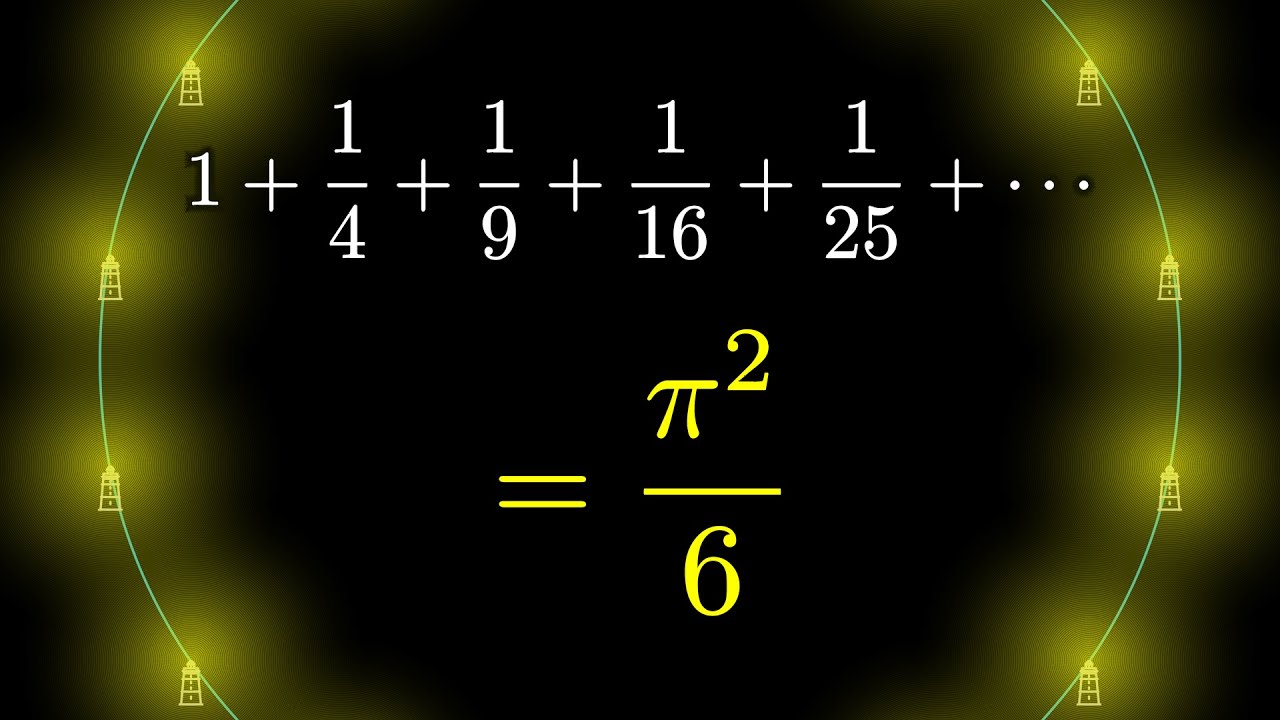
Why is pi here? And why is it squared? A geometric answer to the Basel problem
Keywords
Summary
164 words
Critical Evaluation
Value of the Information & Strength of the Argument
The video provides a highly valuable and original perspective on the Basel problem, offering a geometric intuition that is rarely presented. The argument is built step by step, starting from the physical setup of lighthouses and the inverse square law, then introducing the inverse Pythagorean theorem, and finally constructing a sequence of circles that leads to the result. The reasoning is clear and logically sound, with each step justified visually and mathematically. The use of light as a metaphor is not only elegant but also aids in understanding the underlying mathematics. The argument is solid and convincing, and the video successfully bridges abstract analysis with geometric intuition.
Scientific Rigor, Source Quality, Title Accuracy
The video is scientifically rigorous, based on a paper by Johan Wästlund, which is referenced in the description. The proof is presented with care, and the author acknowledges the need for a more careful limit argument at the end, pointing to the paper for details. The sources cited are credible and relevant. The title accurately reflects the content, and the video delivers exactly what it promises: a geometric answer to the Basel problem. The description also includes links to related videos and interactive tools, enhancing the educational value.
210 words
Title / Content Match
The title accurately reflects the content: it poses the question of why pi appears in the Basel problem and provides a geometric answer.
Quality & Reliability
9/10
The video presents a rigorous geometric proof of the Basel problem, based on a published paper by Johan Wästlund. The argument is carefully explained, with visual animations and references to supporting materials. The mathematical reasoning is sound and the sources are credible.
Key Moments
Markers derived by PSI from the transcript: the creator did not define chapters.
- Introduction of the Basel problem and its history.
- Physical interpretation with lighthouses and inverse square law.
- Explanation of the inverse Pythagorean theorem.
- First transformation: replacing one lighthouse with two.
- Iterative doubling of the circle and placement of lighthouses.
- Limit to a line and sum over all integers.
- Derivation of the final result pi^2/6.
Cited Sources
- Cosmic.pdf - paper by Johan Wästlund — The paper on which the video's proof is based.
- Brilliant.org — Sponsor of the video, providing educational content.
- Brilliant principles — Referenced principles list.
- Geogebra interactive figure — Interactive tool to explore the inverse Pythagorean theorem.
- Mathologer video on Pythagorean theorem cousins — Related video on Pythagorean theorem variants.
- Mathologer video on Basel problem — Another video on the Basel problem.
- Music by Vincent Rubinetti — Background music used in the video.
- 3Blue1Brown website — Channel's official website.
- Reddit community — Community discussion forum.
Concurring Sources
- Mathologer video on Basel problem — Provides an alternative proof of the Basel problem, consistent with the result.
- Paper by Johan Wästlund — The original paper presenting the geometric proof.
External References
Contribution & Novelties
The video offers a novel and highly intuitive geometric proof of the Basel problem, based on the inverse Pythagorean theorem and a physical analogy with light. This approach is rarely presented in standard textbooks and provides a deep insight into why pi appears in the result. The step-by-step construction of circles and the limit to a line is both elegant and illuminating.
Pour aller plus loin :
- Basel problem - Wikipedia — Historical context and other proofs.
- Inverse Pythagorean theorem - Wikipedia — The key geometric identity used.
- Inverse-square law - Wikipedia — Physical principle behind the light analogy.
- Euler’s solution to the Basel problem — The original analytical proof.
110 words
Radar Profile
The radar profile shows high scores in all dimensions, with particularly strong performance in quality of information and reliability. The video is technically deep but accessible, and the argument is well-supported. The only slight weakness is the level of technical detail, which may be challenging for some viewers, but this is offset by the clarity of the presentation.
💬 Très positif. Sur les 30 commentaires analysés, le public exprime une admiration unanime pour la clarté et l'élégance de la démonstration, avec de nombreux commentaires soulignant l'émerveillement et la compréhension intuitive apportée par la vidéo.